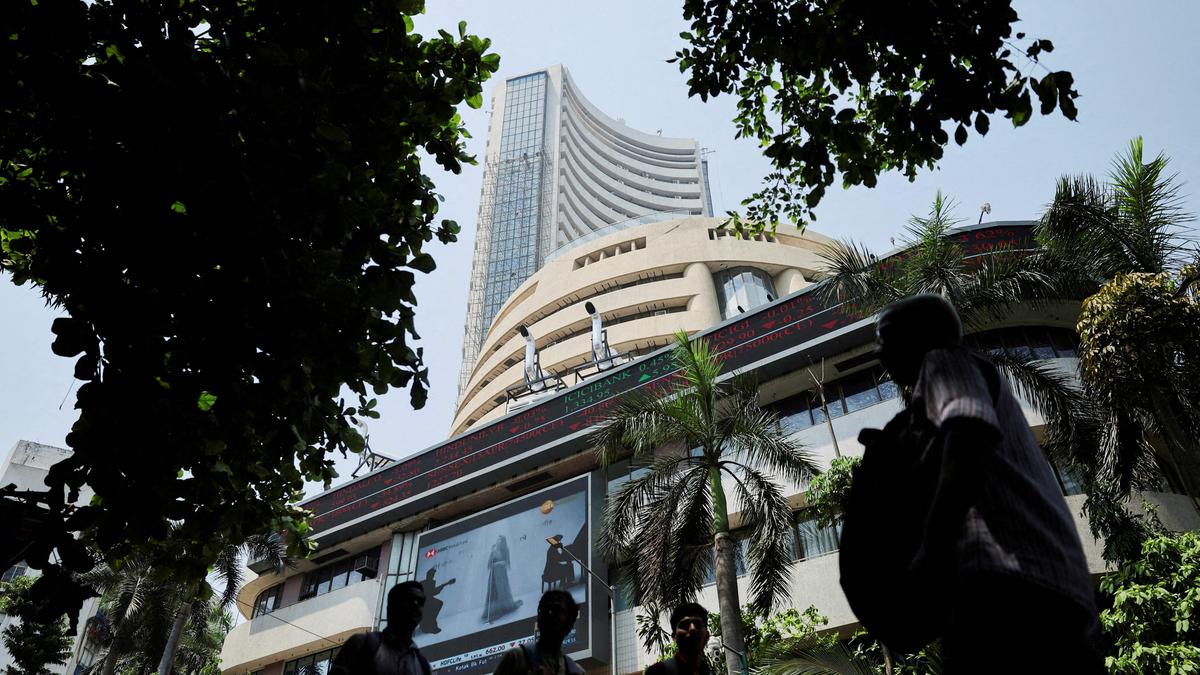
Men walk past a screen displaying market results outside the Bombay Stock Exchange (BSE) in Mumbai
| Photo Credit: Reuters
Foreign Institutional Investors (FIIs) bought equities worth ₹29,631 crore in August 2026, marking their largest monthly net inflow in 23 months.Foreign investors have now bought Indian stocks for two consecutive months for the first time this calendar year. In July 2026, FIIs invested ₹20,200 crore in Indian equities, reversing part of the ₹49,340 crore outflow recorded in June.With the July and August inflows combined, FII investments in Indian equities stood at ₹49,831 crore, effectively offsetting the June outflow.Mutual funds also remained net buyers during the month, investing ₹125 crore, compared with ₹61 crore in July 2026.However, the strong momentum in debt markets witnessed over the previous two months failed to continue in August. After recording significant inflows of more than ₹58,000 crore in the preceding two months, FIIs turned sellers of General Limit debt securities, offloading ₹2,224 crore during the month.Interest in government securities through the Fully Accessible Route (FAR) also weakened sharply. FII inflows into FAR bonds stood at just ₹264 crore in August, compared with ₹21,652 crore in June.Despite the moderation in debt flows, overall FII inflows remained positive for the third consecutive month. Net FII inflows stood at ₹25,492 crore in August, down from ₹40,031 crore in July.“The important factors driving the FPI flows into India are the reversal of the chip trade, the stability in the rupee and, more importantly, the improving earnings growth in India,” said V K Vijayakumar, Chief Investment Strategist at Geojit Investments Limited.“A significant trend in FPI investment in India recently is the direction of flows towards SMIDs (mid- and small-caps). Growth and earnings momentum are much higher in the SMIDs compared to large-caps. This trend of FPI investment in SMIDs is likely to continue,” he added.FIIs had earlier reduced their exposure to Indian equities as valuations appeared expensive relative to corporate earnings. India’s price-to-earnings (P/E) ratio stood at 23.88 times as of July 31, 2026, according to the MSCI Index factsheet.The MSCI India index, a global benchmark widely tracked by foreign investors, returned 9.49% in 2025, significantly underperforming the MSCI Emerging Markets index, which gained 41.05%.The shift towards alternative investment avenues has not been limited to equities. The spread between the US and Indian benchmark 10-year government bond yields narrowed to around 2.1–2.3 percentage points in August 2026, down from roughly three months earlier.The narrowing yield differential has reduced the relative advantage of investing in Indian government securities over US Treasuries, potentially influencing foreign investors’ asset-allocation decisions. Published - August 31, 2026 08:41 pm IST