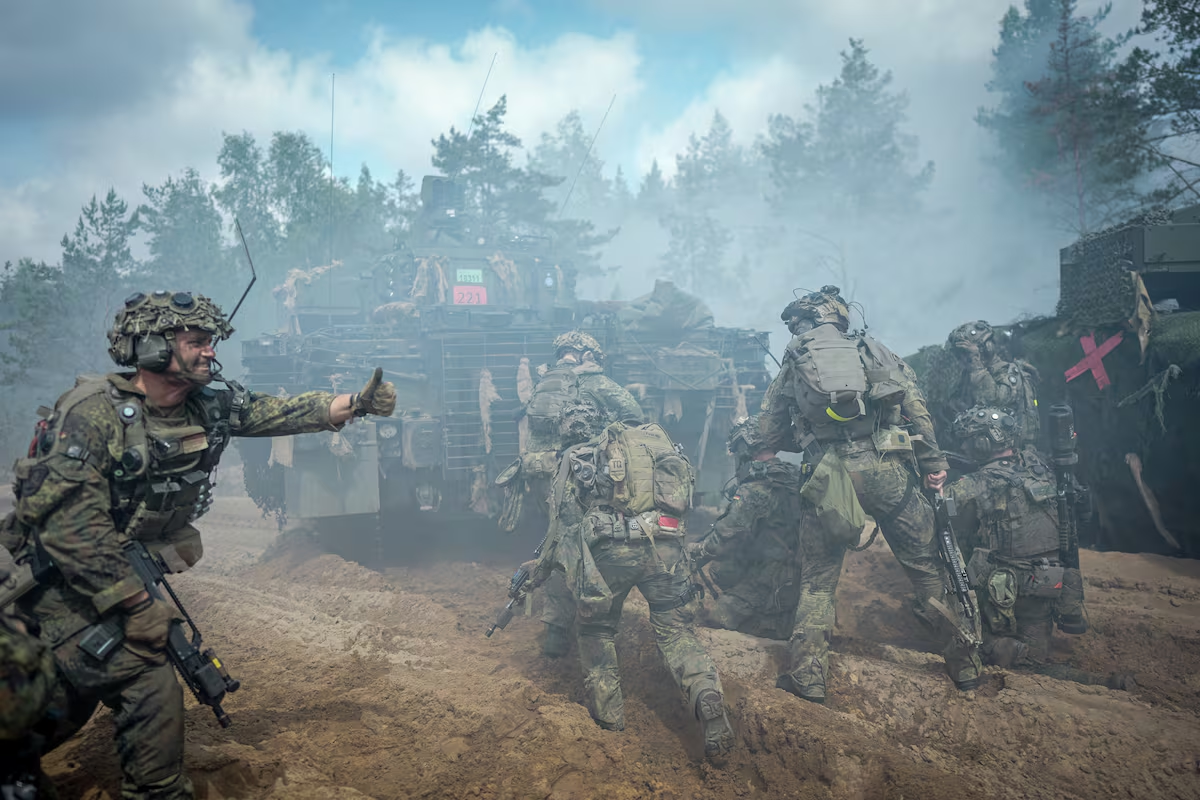
OpinionBy Mark Montgomery and Bradley Bowman Aug 31, 2026, 10:30 AMGerman soldiers take part in the large-scale exercise "Freedom Shield 2026" of the new 45th Armored Brigade in Pabrade, Lithuania, on June 10, 2026. (Kay Nietfeld/picture alliance via Getty Images)The Pentagon’s review of U.S. force posture in Europe has many NATO allies asking questions about the future of America’s military footprint on the continent, even as CIA Director John Ratcliffe traveled to Moscow to reportedly warn the Kremlin not to attack alliance members. Pentagon policy chief Elbridge Colby said that the review was meant to ensure that NATO allies are “moving fast and irreversibly” to “take primary responsibility for the defense of Europe” in a speech to the North Atlantic Council on Aug. 27.Germany, for its part, has taken notice – and acted.Berlin’s role in NATO has been defined for decades more by its restraint than by its contribution, a nation constitutionally cautious about military power and chronically underspending on defense.That era is over. Spurred by Russian President Vladimir Putin’s naked aggression in Ukraine and increasingly sharp demands from the Trump administration, Germany has undergone a strategic transformation so rapid and consequential that it has become the most important European nation in the alliance, not just by virtue of its economic clout, political power, and geographic position, but by the choices it has made about how to use them.RELATEDThe foundation of Berlin’s power is economic. Germany boasts a GDP of approximately $5 trillion, the largest in Europe and the third largest in the world.But for too long Berlin did not translate its economic clout into necessary levels of defense spending. That is now changing.Chancellor Friedrich Merz said on July 3 that “Germany is doubling its defense budget within four years.” Berlin’s defense spending as a percent of GDP has grown from 1.43% in 2021 to an estimated 2.69% for 2026.The government promised last year to increase the budget to €162 billion ($189 billion) by 2029. That would put Berlin above 3% of GDP and on a path to achieve the minimum 3.5% of GDP on core defense requirements by 2035, a commitment codified by alliance members in the 2025 NATO Hague Summit Declaration.Germany established a €100 billion (approximately $113 billion) special defense fund in 2022, the most significant single defense investment decisions by any European government in response to Putin’s invasion of Ukraine. That accelerated procurement across every combat domain, from air defense and armored vehicles to maritime and cyber capabilities.These investments are strengthening the already robust defense industrial base in Germany, anchored by companies such as Rheinmetall, TKMS, Hensoldt, Diehl Defense, MBDA Deutschland and KNDS Deutschland.Many of these companies are creating industrial partnerships with American companies, deepening the transatlantic defense production relationship.Rheinmetall, for example, a preeminent land warfare systems producer in Europe, has established joint ventures with American partners in Ukraine and is in active discussions about co-production arrangements with U.S. defense companies for a 155 mm artillery munition and ATACMS, what is known as the Army Tactical Missile System.RELATEDThose partnerships will strengthen the American defense industrial base and will help Germany carry more of the security burden in Europe and better support Ukraine, while increasing the alliance’s capacity to sustain high-intensity, long-duration conflict.The most visible and important expression of Germany’s strategic transformation is its decision to permanently station a combat brigade in Lithuania, the first time Germany has permanently forward-deployed combat forces outside its borders in Europe since the end of the Second World War. The 45th Armored Brigade in Lithuania represents a fundamental shift in German strategic culture: from a nation that once exported pacifism to one that accepts forward deterrence as a national responsibility.For the Baltic states and Poland, which have long been skeptical of German commitment, this is what matters most: not defense budget percentages or procurement contracts, but German soldiers standing guard on NATO’s eastern flank.That is a message that Putin understands.Europe’s most powerful economy, its most capable defense industrial base, and now its most consequential forward military commitment are all moving in the same direction at the same time. That convergence of economic weight, industrial capacity, and forward strategic commitment is what makes Germany indispensable to the alliance’s future.China, Russia, Iran, and North Korea have formed what we describe as a new Axis of Aggressors. They are “pursuing unprecedented levels of cooperation,” according to Chairman of the Joint Chiefs Gen. Dan Caine. That cooperation is making each of these adversaries more formidable.At this moment of growing risk, Americans should not take its allies and partners for granted. The United States is powerful, but Americans need help given growing threats and finite resources.Disagreements will arise between Washington and Berlin, but those disagreements must not be allowed to derail Berlin’s growing defense investments and transatlantic unity and cooperation.Americans need friends that match words with deeds and help carry the shared security burden.That is exactly what Berlin is finally doing — and Germans, Americans, and the NATO alliance will be more secure as a result.Rear Adm. (Ret.) Mark Montgomery and Bradley Bowman are senior directors at the Foundation for Defense of Democracies. Bowman and Montgomery are co-authors, with Elaine K. Dezenski, of the new book “Axis of Aggressors: Countering the Cooperation of China, Russia, Iran, and North Korea.”
Germany is stepping up on defense — and Washington should celebrate
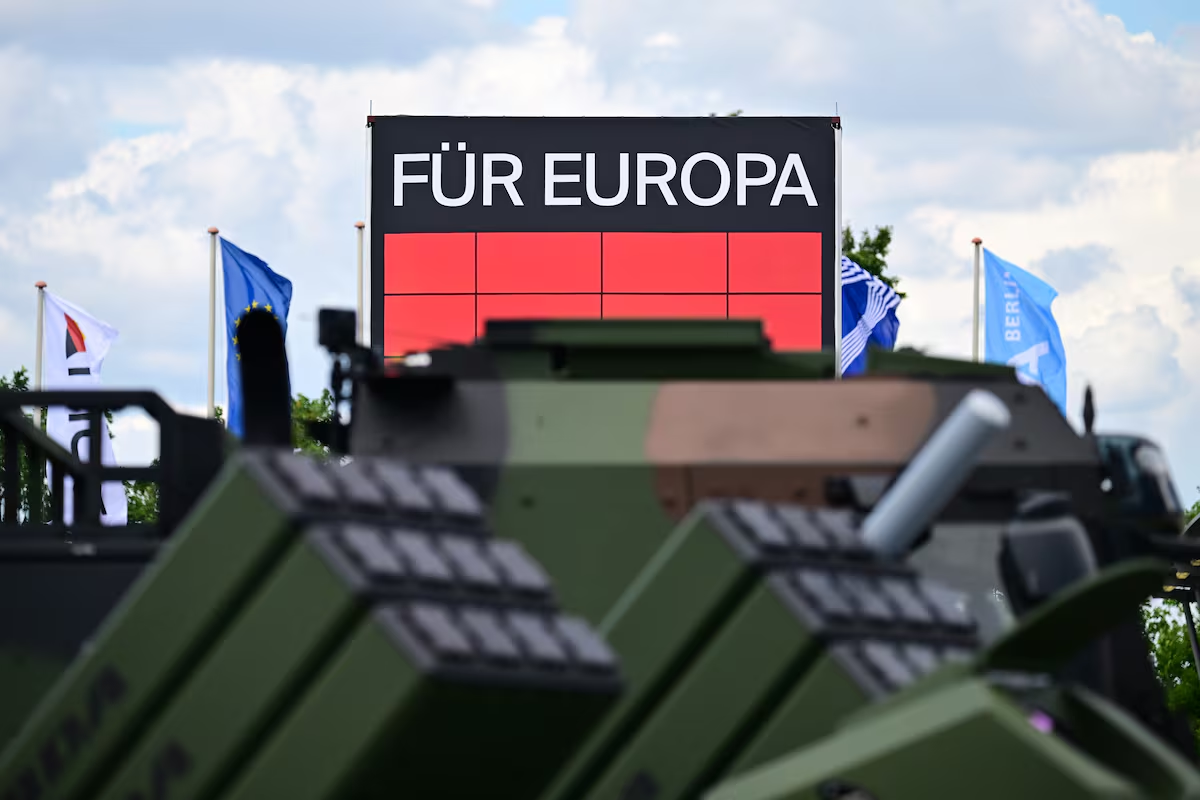
Opinion: German defense firms are creating industrial partnerships with American companies, deepening the transatlantic defense production relationship.
872 words~4 min read