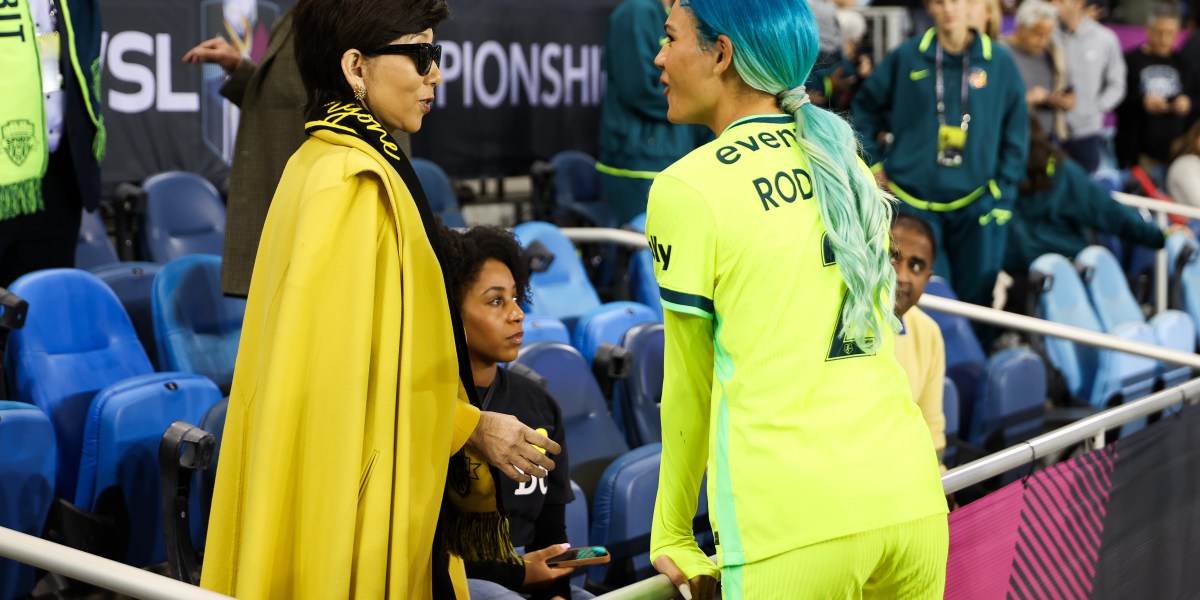
Seven years ago, venture capitalist and Angel City FC co-founder Kara Nortman was trying to convince investors that 10,000 fans would regularly show up to watch professional women’s soccer in Los Angeles.The premise of Angel City’s original business plan was built around having enough people pass through the stadium gates to support the other elements of a sports business — from sponsorship, merchandise and media to eventually larger commercial opportunities.Alongside fellow co-founders Julie Uhrman and Natalie Portman, Nortman helped the team exceed expectations with roughly 16,000 season-ticket holders in its inaugural season. They also sold more sponsorships than any other team before playing their first NWSL game in 2022.Nortman has since made investing in women’s sports her specialty. Her investment thesis is simple: What if the problem isn’t demand, but everything surrounding the product?Monarch Collective, the $250 million private-equity fund she co-founded with Jasmine Robinson in 2023, has invested in three NWSL teams that have proved exactly that with LA-based Angel City, San Diego Wave and Boston Legacy. The fund, exclusively focused on women’s sports, has a portfolio which now spans four soccer teams across two continents, a WNBA franchise and a new sports-merchandise platform.Angel City sold 16,000 season-ticket packages ahead of its inaugural 2022 season. (Kevork Djansezian / Getty Images)“I think people still get distracted by the idea that all sports are alike,” Nortman says. “At Monarch, we focus on the most mature parts of the ecosystem. When we started Angel City, Deloitte wasn’t even measuring this market.”Per Deloitte’s 2022 report, total global revenue for elite women’s sports was $692 million. That company now predicts global revenues in women’s elite sports will reach at least $3 billion in 2026, representing a 340 percent increase in four years.But before she was able to help prove women’s sports was a viable business, Nortman was just a fan watching the U.S. women’s national team capture its third World Cup at the 2015 tournament in Canada. That victory ignited a curiosity about the sport, but when Nortman wanted to see those players play in a league, she was surprised by the poor production of the available broadcasts and how difficult merchandise was to buy.“For me, it came down to butts in seats,” she says, recalling thoughts she had while watching the U.S. play in Vancouver during that World Cup. “I took a step back and said, ‘How does this feel as a fan? Are these the best players in the world? Is this a format that people enjoy internationally? It is the most popular sport in the world?’”The answer was always yes.However, she watched players who generated large audiences during the World Cup essentially disappear from consumers’ lives once they returned to their club sides.“Imagine Nike or Gatorade buying a 90-minute commercial watched by hundreds of millions of people, only for customers to search for the advertised product afterward and discover they couldn’t buy it,” Nortman says. “Concluding from that experience that there was no demand would be absurd.”When Nortman searched for answers, she remembers people telling her she was alone in this pursuit for more.Except she was not.Robinson, Nortman’s partner at Monarch, was an early believer. When they were introduced, by then San Francisco 49ers executive and now Leeds United chairman Paraag Marathe, Robinson was a partner at venture-capital firm Causeway, a growth-stage fund focusing on sports, media, gaming and fitness.Jasmine Robinson co-founded Monarch Collective with Kara Nortman. (Michael Nagle / Bloomberg via Getty Images)A graduate of both Harvard and Stanford universities, she arguably understood sports business like no other. She worked for the 49ers across numerous parts of the organization during the NFL team’s transition from Candlestick Park in San Francisco to their move to Levi’s Stadium an hour away in Santa Clara for the 2014 season, including fan experience, merchandising and concessions.“For months, I had been thinking, literally waking up in the middle of the night, about the need for a dedicated women’s sports fund,” Robinson recalled. “There was all this momentum in women’s sports, but not enough capital to sit alongside it.”
Who is behind Monarch Collective? The 10,000-fan bet that changed women’s soccer investment
Understanding the private-equity fund behind several successful women's sports ventures
1,884 words~9 min read