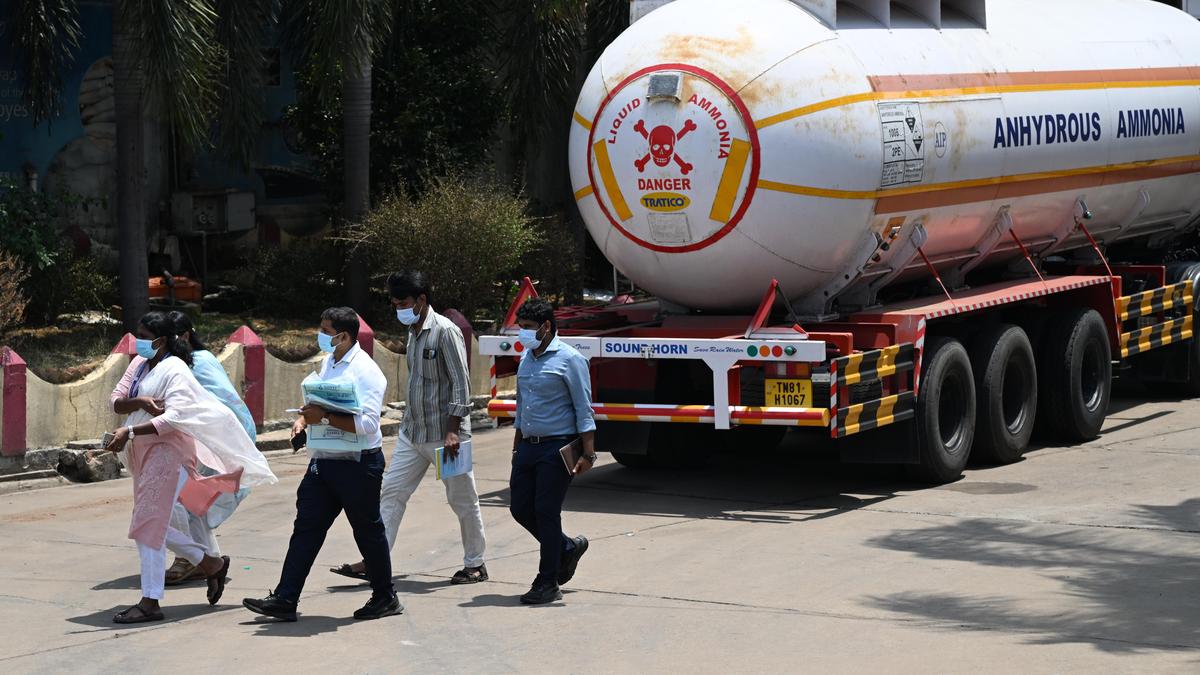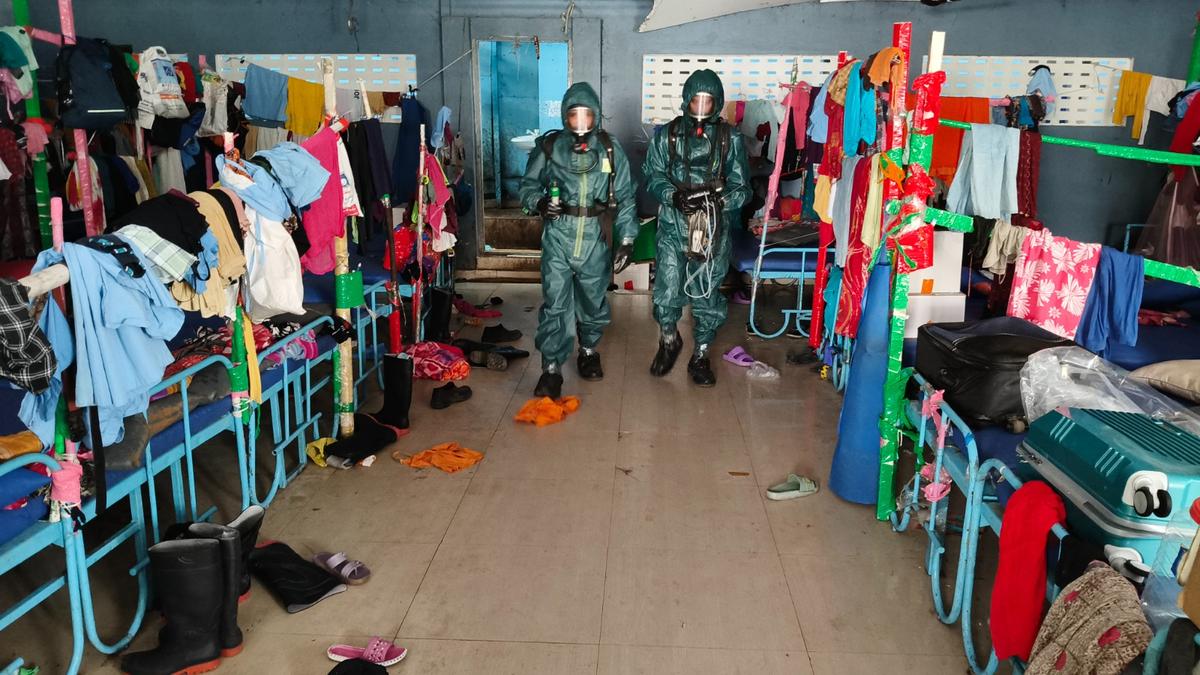
At around 10.40 am on June 21, the female migrant workers’ quarters at a seafood processing plant in Tamil Nadu’s Tiruvallur district, was almost full. Many of the women were still sleeping because it was a Sunday, their day off.The quarters were situated on the first floor of the plant, operated by St Peter and Paul’s Sea Food and Exports. The floor was also crammed with equipment, including refrigeration machinery, pipeline systems and an ice flakes generator machine.Suddenly, the occupants began to feel breathless. Ammonia, a poisonous gas, was leaking up from faulty infrastructure in the plant below, and quietly filling up the room.When news of the gas leak broke out, Kiran Kumar immediately rushed to the hospital where victims were being taken. Kumar is a social worker with Jesuits Migrant Services, which aids and advocates for the rights of migrant workers.He was keen to help the workers and their families in any way he could. But at the hospital, authorities denied him permission to meet the workers. Kumar was unsurprised – this was an obstacle he often faced in his work.Over the next few days, Packiaraj SJ, a Jesuit priest and the head of the organisation, and Kumar, called government officials, and police and hospital administrators, seeking permission to enter the hospitals where victims were admitted. They did not acquiesce. Kumar tried visiting the hospitals directly, but police stationed outside turned him away, saying that his services were not needed.Kumar pleaded with authorities, explaining that he could be useful to them. In his decade of work with migrants, Kumar had gained fluency in Hindi. He had also become familiar with villages, districts and cities in states like Odisha, Jharkhand, Bihar, Assam and Uttar Pradesh, from where most workers to the state migrated. He had even picked up other local languages and educated himself about communities that lived in these regions.It was only a full week after the incident that Kumar was allowed to meet the women – by then, 18 had died. According to the bail order of one of the company’s directors, which Scroll accessed, most of the deceased women had been brought to the company by the same contractor named Suresh. Four were minors. Nearly 70 workers had been hospitalised, many of whom remained in a coma for several days.A memorial to those who lost their lives in the Tiruvallur factory ammonia leak, at an event held in Chennai. Photo: Courtesy event organisersAuthorities contacted Kumar because they had been unable to trace the family of a deceased worker for three days. The information on the worker’s Aadhaar card was inaccurate, leaving them with no way to find the name of her village or members of her family.Over the next two days, Kumar tracked down the woman’s family. It was another three before her body was handed over to them. “By the time the body reached them, it had decayed quite a bit, despite the embalming,” Kumar said.In the days and weeks that followed, Kumar helped coordinate the tracking and return of many other injured workers.Most of the deceased were Adivasis. Fourteen were from Odisha’s Keonjhar district, and belonged to the Juang community, categorised as a particularly vulnerable tribal group. There were also others from Adivasi communities in Assam and Jharkhand. The high number of Adivasi victims led the National Commission for Scheduled Tribes to take note of the incident, and write to the district collector, seeking details about it.Even a month or so after the incident, Kumar recounted, when he went to see a patient who was in a coma, police stopped him. “Sometimes, I lose my temper when things like this happen,” he said. “But I’ve also become accustomed to this attitude from officials.”Kumar and other activists told Scroll that the June incident was only the most recent evidence of the immense vulnerability of migrant workers in Tamil Nadu, which is among India’s most industrialised states. Migrant workers are crucial for this industrialisation – while the state government is currently conducting a survey to determine the number of such workers in the state, according to the 2011 census, 34.87 lakh people had migrated to the state for employment.In most such incidents involving deaths and injuries of these workers, a crucial factor is that companies typically house the workers within factory sites – often in dehumanising conditions that expose them to major health risks. Even when factories and plants provide housing to workers outside worksites, the accommodations usually violate building codes, are overcrowded and pose safety risks.Further, their freedoms are typically restricted. A 2024 report of the Corporate Accountability Lab, which examined seafood processing plants in Andhra Pradesh, underlined this concern, noting that migrant workers were at high risk of forced labour. This was particularly so among “those whose housing is tied to their employment, a common practice across the supply chain”, it stated.This type of living arrangement is not limited to seafood processing plants, or Andhra Pradesh. Scroll’s investigation across industrial areas in Chennai and Tiruvallur revealed that workers in a wide range of sectors, including automobile, general engineering and chemical manufacturing, as well as in smaller enterprises like restaurants, textile stores and petrol bunks, live in the premises of their workplaces, or adjacent to them.Across industrial areas in Chennai and Tiruvallur, workers in a wide range of sectors live in the premises of their workplaces, or adjacent to them. Photo: Johanna DeekshaActivists regularly deal with cases in which workers are injured or killed, or go missing. In June, for instance, a worker at a Larsen & Toubro site in Chennai died, and 48 were injured, after a corroded staircase collapsed in the workers’ labour camp in Nandambakkam. In September 2025, another worker, from another Larsen & Toubro site in Kattupalli died after tripping on a staircase in a makeshift shelter near the site. Around 100 employees were lathi-charged by police when they protested after the incident, demanding that the worker’s family be paid compensation for the death.Scroll contacted all the companies named in this story, as well as the Tamil Nadu government, seeking responses to arguments that they had not adequately protected migrant workers. This story will be updated if they respond.“Most incidents don’t come to light because the employers quietly take care of it, pay for treatment and send them home with a small amount,” Kumar said. He added that employers have nearly complete control over migrant workers’ lives. “What we are seeing with migrant labour today is a new urbanised form of bonded labour and enslavement,” he said.This story is part of Common Ground, our in-depth and investigative reporting project. Sign up here to get the stories in your inbox soon after they are published.The isolation of workers at the Tiruvallur seafood unit was evident when Scroll visited it in early July – even villagers who lived next to the plant said they did not know that so many women were living within the premises. “We would see some of the women sometimes, many of them looked 15-16 years old,” said Selva, a neighbour. “They would walk to the small shop down the road.”On the day of the leak, when locals rushed to help, and carried the women outside one by one, they were surprised.“We had no idea so many women lived within those walls,” Selva said. The villagers struggled because of the gas. “We could not even stand there for a few minutes, because we were also struggling to breathe,” Selva said.There was a similar lack of transparency at other industrial sites Scroll visited. Conversations with workers in the area around another seafood processing unit in Chintadripet, in Chennai, revealed that the unit housed migrant workers. But the security guard at the gate dodged questions about them – it was only when another local overheard our conversation and emphasised that workers lived inside that the security guard hesitantly agreed.But a senior staffer I met, who was walking into the premises, paused for a few seconds when I asked about migrant workers, then denied outright that any were employed at the unit, let alone that they lived inside.Owners of seafood processing units, many of which process shrimp, often housed workers on site, explained Siddharth Chakravarty, a researcher with the National Federation of Small Scale Fishworkers. Workers, including those from Adivasi communities, “are usually made to stay inside the compounds, similar to the plant in Tamil Nadu, often in premises adjacent to processing facilities”, he said. “As a result, when ammonia leaks occur, which is common, they cause severe impacts on health and at times deaths of workers.”Sara Abraham, a former lawyer and sociologist, explained that in fact, according to section 16 of the Interstate Migrant Workmen Act, 1979, employers are required to “provide and maintain suitable residential accommodation to such workmen during the period of their employment”.But, she noted, “There is no clarity about the type of accommodation, where it should be. The company can claim that its barracks are temporary accommodation, though workers live there for years on end”. Further, the law “doesn’t make it mandatory for the accommodation to conform to standard building codes”, she added.Migrant workers' quarters in Gummidipoondi. Though a 1979 law requires employers to provide accommodation to migrant workers, it does not lay down specifications about the kind of facilities these should be. Photo: Johanna DeekshaThe lack of clear guidelines ends up disadvantaging workers, Abraham said.“When employers provide workers with substandard housing, which is furthermore confined to being within a compound with security at the gate, workers have little leeway to demand better accommodation, or rental expenses,” she said.Indeed, a 2026 study on workers in Chengalpattu in Tamil Nadu found that 59.6% had makeshift housing, and that 32.77% felt their living space was unsafe. The study also found that 61.2% of the workers suffered from poor mental health.The practice of housing workers on site was also common in an area of Tiruvallur called Kosapur, which Scroll visited, and which has a high concentration of industries, including wood and engineering industries. “Nobody lives outside, they all live within the factory,” said a shopkeeper.Most workers hesitate to speak to outsiders, especially those from civil society organisations or the media. One worker, from Uttar Pradesh, said in a brief conversation that the facilities for them were not good, but that he did not have any objections. From the outside, the accommodation building that was visible looked dilapidated – several men were waiting their turn for a shower in an open-air bathroom.Conversations with workers were easier at an event for migrant workers held in Chennai in late July, organised by the Jesuits Migrant Services. Here too, some of the workers appeared to have accepted the difficulties they lived with.Among them were four young men, aged between 19 and 21, from Assam. They worked and lived within the compound of a factory in Chennai that manufactured vehicle parts. The men said that they did not mind staying at the factory and that they only wished that there were more toilets and bathrooms. “We are about 13 people in a room, so it would help to have extra toilets,” he said.But when asked more questions about safety on the site, workers tended to remember adverse incidents.The worker from Uttar Pradesh recalled an incident where a colleague lost a finger in an accident. On another occasion, “a snake bit a worker while he was sleeping”, he said. “The employers gave the family some money and sent back the body.”Similarly, after some thought, the young men from Assam recounted that a colleague had lost a toe while operating a machine. “The employers paid his hospital bill and gave the family Rs 2 lakh and sent him back,” one said.Two other young men from Odisha at the Chennai event had worked for two years in a factory in the city that manufactured tractor components, and where workers stayed on the first floor. “If we stay outside, a lot of time goes in travelling, so staying inside is fine with us,” one said. He noted that the rooms were large, and that the sleeping arrangements were not crowded because workers alternated between day and night shifts.The manufacturing processes at the unit required high temperatures, which workers said affected the living quarters as well. The problem was exacerbated by the fact that workers also had to use the rooms to cook their meals. “Yes, it does get very hot in the rooms,” the worker said.After the June incident, both the directors of the seafood export company were accused of offences that included culpable homicide and using child labour.In their bail application, the directors of the company said that the company had an annual turnover of Rs 300 crore and that they were “willing” to pay Rs 10 lakh per victim. They also claimed that the incident was an “accident” and not a case of negligence.The accused were released on conditional bail after paying a bond of Rs 25,000 and were asked to compensate the families of the deceased workers, and those who were injured.But Kumar and other activists said that securing compensation was often an uphill task because companies did not usually formally register workers. Activists explained that avoiding registering their workers also gave companies the freedom to pay lower wages and demand longer working hours.The Tamil Nadu government has an online portal that allows workers to self-register. But Kumar said it was unrealistic to expect workers to learn about this process and see it through.“How are workers going to be able to register themselves?” he said. “The employers must be mandated to make the government aware of the number of workers they are bringing in and how they are being brought here.”The consequences of the lack of transparency are grave. Kumar and other activists said if the seafood plant workers had been registered properly, authorities would have been more quickly able to determine how many people had died or been injured, and trace their families.But instead of following a systematic process, Abraham said, after the incident, workers were immediately shifted into a wedding hall, where they stayed for the next few days, and where media and social welfare groups were not allowed to meet them. She argued that such an approach, which the government often resorted to in such situations, “creates a bizarre situation of workers moving into a deeper situation of confinement after a major tragedy which has already completely upended their lives”.A migrant workers' settlement in Gummidipoondi. A 2026 study on workers in Chengalpattu in Tamil Nadu found that 59.6% had makeshift housing, and that 32.77% felt their living space was unsafe. Photo: Johanna DeekshaIn mid July, Scroll met the families of two of the ammonia leak victims who were still undergoing treatment at the Rajiv Gandhi Government Hospital in Chennai. One of them had emerged from a coma just a few days earlier, almost a month after the incident.The father of one of the victims, from Odisha, said that nobody from the company had called him to inform him about his daughter’s condition. “When I heard about the ammonia leak, I had a feeling my daughter may have been working in the same plant,” he said. He learnt it was her when he received a call from his son-in-law, who worked in the same plant.The husband of the other victim said he was furious that the company had not reached out to them. “An agent from the neighbouring village told my wife about the job, I told her not to join but she insisted,” he said. Since then, the agent had not called “to find out about my wife”, he said.This was a common situation, Kumar noted. “Many agents bring the workers to the factories and then become incommunicado to family members,” he said. “If they want any help after that, they have no one to call.”Activists said that companies usually stonewalled their efforts to gather information to help workers and their families.Kumar is currently working on a case of a death of a worker from Jharkhand. “When we went to enquire at the police station, the representative of the company he worked in refused to disclose the name of the company,” he said. “And when we tried to speak to his colleagues, they blocked our access.”Construction workers, who were often housed in makeshift accommodations close to their worksites, were particularly vulnerable, he observed. “If something falls on them, or if they fall off a height, nobody is going to know,” he said. “Nobody is held accountable.”Kumar said many migrant workers in the state were from very remote regions with little exposure to the outside world. This made it imperative, he said, for the government to pay greater attention to how they are brought into the state and placed in the care of the employers.But, he argued, “Both here and in the source states, labour departments are ill equipped. It’s such a struggle for us to contact them, or to get any response or help from them, when we are trying to trace a worker or send someone home.”Packiaraj echoed Kumar’s observations. “It is very difficult to coordinate with the labour department when it comes to migrant worker issues,” he said.Despite their hardships, many workers Scroll spoke to said that they were glad to have work. “If we were home, we would not be earning so much,” said Asha, a worker from Jharkhand at a copper recycling unit in the industrial town of Gummidipoondi, in Tiruvallur. “This land is feeding us, so we must not complain.”The town, which is home to many industries, as well as a State Industries Promotion Corporation of Tamil Nadu industrial park, has seen so many migrant workers arrive that a tiny village of sorts inside it is occupied entirely by migrant workers and their families. Though some of the plants in the industrial park provide free accommodation to workers in rooms adjacent to their compounds, many choose to live in the settlement because they have families.Elderly men in traditional North Indian style dhotis and turbans sat under a tree – fathers of those working in the estate. Even the clinic nearby had its name and other details written in Hindi.The day before I visited the settlement, a boiler explosion had killed one worker and injured five others at a copper recycling unit at the estate. “We don’t know how many died or how many were injured,” one worker said. “The news we get is never accurate.”Asha, who asked to be identified by a pseudonym because she was fearful of retaliation from her employers, worked at the same factory. The day I met her, Asha along with two of her colleagues, Anandi and Priya, also identified by pseudonyms, had gone to work in the morning at 8 am, as they usually did. But they were sent back because the plant was shut down after the explosion. “Now that means we don’t get paid for the day,” Asha said.I asked if they felt that was unfair. “Yes, there are things that happen that are unfair, but how can we complain? We are not in our homes,” she said. “We are in pardes,” a foreign land.The women then went on to list other problems they faced. They explained that due to the hazardous nature of their work, they are required to wear protective shoes, gloves, glasses and masks. The costs of the shoes and gloves are cut from the workers’ salaries, they said. “They give us the masks for free, but we have to pay for the other things,” Anandi said.Anandi took out a small bar of soap from her pocket. “Our whole bodies get covered in soot, especially our hands. So we carry soap to wash our hands before lunch,” she said.Women workers in Gummidipoondi explained that their employers gave them masks, but that they had to pay for protective shoes, glasses and gloves. Photo: Johanna DeekshaAnandi frequently falls ill. “The doctor told me that my chest is filled with soot,” she said. When the workers fall sick the supervisors give them a tablet called Embulide, a painkiller. “When I complained, they told me, laughing, to eat banana and jaggery, and said I would be fine,” Anandi said. When workers are injured or fall ill, they are taken to the hospital, but the bills are left for them to pay, she observed.If the workers arrive a few minutes late, the security guard slams the gates shut, Asha said. “We have to walk 30 minutes to the factory and we have to walk past isolated wild areas with snakes, and where often drunk men stand and harass us,” she said. “So sometimes we get late, but they refuse to let us in, forcing us to lose the day’s wages.”A woman worker in Gummidipoondi said that a doctor had told her her chest was filled with soot. She explained that her employers merely gave workers a painkiller when they fell ill. Photo: Johanna DeekshaAnandi explained that they were paid around Rs 400 for eight hours of work – Tamil Nadu’s minimum daily wage is around Rs 550. “Some money is also deducted,” she said. “Each time, we get a different amount.” The workers from Odisha at the tractor manufacturing company had also complained that they were only being paid between Rs 12,000 and Rs 14,000 a month, or under Rs 500 a day.Perhaps what upsets the workers the most is that they feel they are treated poorly compared to their Tamil counterparts.“When there is some really strenuous or dehumanising work to do, they ask the North Indian workers to do it,” Anandi said. “The Tamil workers will outright say they won’t do certain jobs. Those are reserved for us.”She added, “The Tamil workers can take breaks also, but we can’t.”Kumar reiterated this observation, noting that migrant workers were also often paid lower wages. “They make migrant workers work overtime also but don’t compensate them,” he said.“It is much easier to exploit migrant workers than Tamil workers,” he added. “The local workers are aware of their rights and demand fair salary, and also appropriate working conditions.”At the seafood plant in Tiruvallur, too, villagers living in the area said that locals would only take up general cleaning jobs in the factory. “Some people sweep and clean the outside, but inside, only migrants work,” one villager said. “Our people will not work in such hazardous conditions.”The seafood plant was shut down after the June incident – villagers said they were relieved, and that they had been demanding its closure for years. But some argued that the move came too late, partly because there was an overall lack of empathy for migrant workers. If locals had died, Selva argued, many “would have gone to the streets and raised a hue and cry. But because they were migrant workers, nobody did anything.”
Why Tamil Nadu’s factories are death traps for migrant workers
The workers’ living quarters are often within or next to worksites. As the June tragedy in Tiruvallur showed, this exposes them to immense safety risks.
3,803 words~17 min read