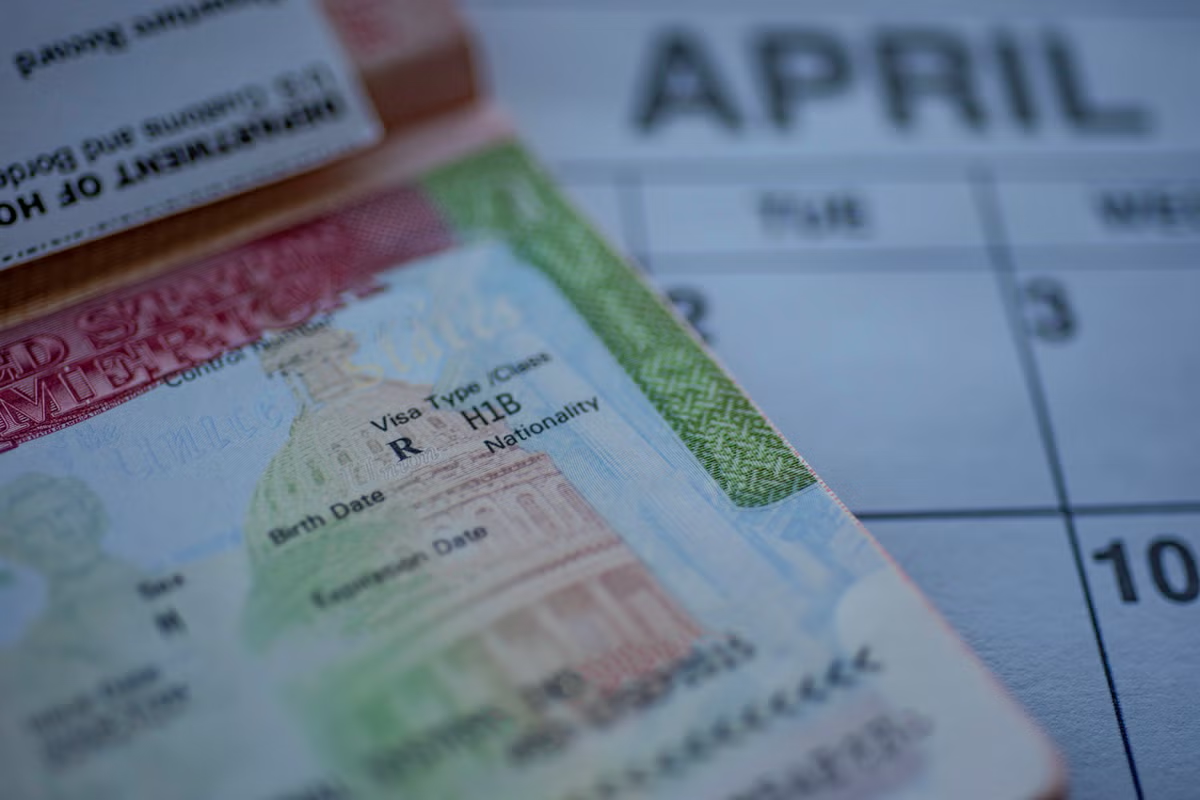
The Trump administration’s latest regulatory move concerning employment authorisation for H-4 visa holders has raised concerns among thousands of Indian families in the US. However, there has been no immediate change to the employment authorisation status of existing H-4 EAD holders.The US Department of Homeland Security (DHS) has included a proposal in its regulatory agenda titled “Removing H-4 dependent spouses from the classes of noncitizens eligible for employment authorization (EAD).” If eventually adopted, the measure would reverse a 2015 rule that allows certain H-4 spouses of H-1B visa holders pursuing permanent residency to apply for employment authorisation.Also Read: Green-card interview pause casts a shadow over Indians' US plansHowever, the measure is still at an early stage. DHS has classified it as a “Long-Term Action”, while the proposed-rule date is listed as “To be determined”. No draft regulatory text has been released, and the agency has not set a deadline for publishing one, reported TOI.In practical terms, the entry signals that DHS intends to consider changes to the H-4 EAD programme in the future. It does not, by itself, end the programme or cancel existing employment authorisations.H-4 EAD holders face no immediate changeAny attempt to eliminate H-4 EAD eligibility would have to go through the federal rulemaking process. DHS would first need to publish a proposed rule, seek public comments, review and respond to those comments, issue a final rule and then set an effective date.That process would take months at a minimum, and a final rule could also be challenged in court.Immigration attorney Jonathan Wasden urged H-4 EAD holders not to panic. “Don’t worry about this just yet,” Wasden told TOI, pointing out that there is a long road between the current proposal and an actual change in the law.Also Read: Uzbekistan introduces 30-day visa-free regime for Indian citizens during PM Modi's visitHe also noted that an earlier attempt to change the rules had failed to reach finalisation because of problems with the economic impact analysis. At worst, he said, a new rule would have prospective impact, meaning those already eligible for EADs would not necessarily be affected.Why the move matters to Indian familiesThe significance of the H-4 EAD programme is closely linked to the lengthy US employment-based green-card backlog, particularly for Indian nationals.Many Indian professionals in the US work on H-1B visas while pursuing permanent residency through employment-based categories such as EB-2 and EB-3. Because of country-specific limits and the size of the backlog, Indian applicants can face exceptionally long waits for green cards.A recent analysis by the National Foundation for American Policy (NFAP) estimated that more than a million Indians, including dependants, were waiting across the first three employment-based green-card categories as of December 2025, reported TOI.The EB-2 category covers professionals with advanced degrees and individuals with exceptional ability in the sciences, arts or business. A bachelor's degree followed by five years of progressive experience in the relevant specialty can also qualify as equivalent to an advanced degree. EB-3 covers professionals, skilled workers and other workers.The backlog has reached such levels that an Indian national whose employment-based immigration petition or labour certification application was filed in January 2026 or later could potentially face a wait of 179 years for permanent residence in EB-2 and 38 years in EB-3, according to the NFAP analysis.Against that backdrop, the H-4 EAD has become an important part of life for many families. The work authorisation allows eligible spouses of H-1B workers to take up employment, pursue careers, earn independent incomes and become self-employed while their families remain in the green-card queue.An EAD also enables holders to carry out activities that can depend on employment authorisation, including operating a bank account and driving a car.Nearly one lakh Indian spouses are estimated to hold H-4 EADs. Any eventual abolition of the programme could therefore have a significant financial and professional impact on these households.How the H-4 EAD programme beganThe H-4 EAD programme was introduced in 2015 during the Obama administration. The rule was aimed in part at addressing the difficulties faced by families caught in lengthy employment-based green-card backlogs.Under the rule, certain H-4 spouses could seek employment authorisation if their H-1B spouses were on a path towards permanent residency or had secured an extension beyond the standard six-year H-1B limit.The programme has faced challenges before.During the first Trump administration, the government announced plans in 2017 to rescind H-4 EAD eligibility. However, the administration never reached the stage of publishing a proposed rule, and the effort was eventually withdrawn.The programme has also been the subject of a separate legal battle. Save Jobs USA, a group representing US technology workers, challenged the H-4 EAD rule, arguing that DHS had exceeded its authority under the Immigration and Nationality Act by allowing H-4 dependent spouses to work.In July 2024, the DC Circuit Court upheld a lower court ruling that DHS has the authority to grant employment authorisation to H-4 visa holders.What H-4 EAD holders should watch nowFor H-4 EAD holders, the key point is that their employment authorisation remains valid for now.The next significant development would be the publication of an actual proposed rule in the Federal Register. That would trigger a formal public-comment period and offer more clarity on the scope of any proposed changes, the people who could be affected and the potential timeline.Until that happens, the regulatory agenda entry does not amount to an immediate termination of H-4 EADs.There is, however, a separate issue that H-4 EAD holders need to keep in mind. DHS ended the automatic extension of employment authorisation for renewal applications filed on or after October 30, 2025.That change has contributed to work gaps, job losses, financial pressures and emotional distress among some EAD holders, with several affected workers taking their cases to court.With inputs from TOI
H-4 EAD: What Trump’s latest move means for Indian H-1B spouses and their work permits - The Economic Times
In a potential policy shift, the US Department of Homeland Security has suggested ending H-4 EAD eligibility for spouses, significantly affecting many Indian families enduring extended green card delays. While individuals with existing H-4 EADs will maintain their work authorization for now, this proposal necessitates an extensive federal rulemaking timeline and public commentary. As such, any final outcome might be delayed for months and could meet with legal opposition.
955 words~4 min read