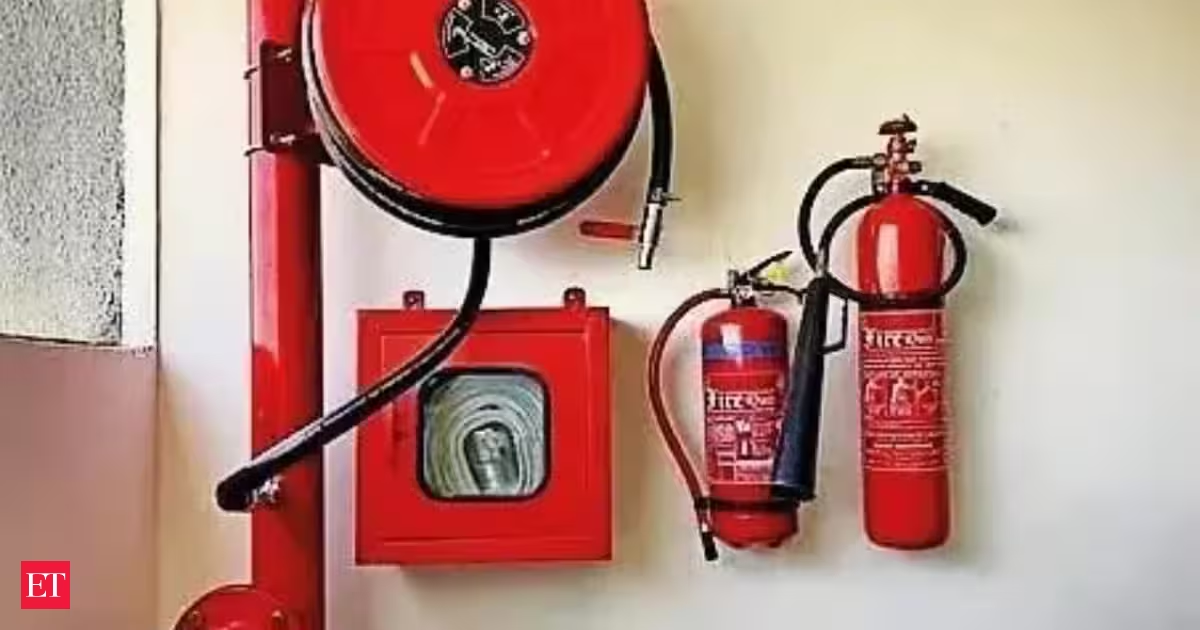
NEW DELHI: The Delhi government has notified the Delhi Fire Service (Amendment) Rules, 2026, under which auditors will have to sign off on a detailed checklist of requirements for fire safety clearances to buildings, replacing the previous inspection format. The amendments provide for a shift in references from the National Building Code of India to the building by-laws, and allow the fire services increased power to prescribe additional safety measures in specific cases.The amendments provide for a shift in references from the National Building Code of India to the building by-laws, and allow the fire services increased power to prescribe additional safety measures in specific cases. (Getty Images/iStockphoto)The revised Form J, which is used for the inspection of buildings to assess compliance with the minimum standards for fire prevention and fire safety prescribed under the Delhi Fire Service Rules, 2010, has been broadened. Some of the categories have been reorganised, broadening the scope of individual safety requirements in the new check- list. Delhi home minister Ashish Sood said, “The safety and security of every citizen of Delhi is our government’s topmost priority. By notifying the Delhi Fire Service (Amendment) Rules, 2026, we are aligning our fire safety standards directly with the Unified Building Bye-Laws.”“These revised rules enforce modern, mandatory safety measures across all buildings— ranging from 6-meter clear access routes for fire engines to automated continuous monitoring, sprinkler systems, and dedicated emergency power backups. Furthermore, a standardised auditor inspection checklist will bring complete transparency and accountability to safety compliance. We are committed to building a safer, more resilient, and modern Delhi,” Sood said.The notification, issued by the home department on August 28, stated that the amended rules will come into force from the date the amended Unified Building Bye-Laws (UBBL), 2016, are notified by the Delhi Development Authority. Applications pending on the date the amendments come into force will, however, be processed under the provisions applicable on the date of their application.”To be sure, all regulations related to fire safety in Delhi are governed by the Delhi Fire Service Act, 2007, and the Delhi Fire Service Rules, 2010. Form J, until now, was an affidavit or declaration that was to be signed by the applicant, stating that all fire prevention and fire safety measures have been tested and are in good working condition. An amendment was introduced in 2025, wherein an exhaustive checklist of 20 items was added to Form J, elaborating the areas and equipment that need to be checked. In the new amendment notified on Friday, some of the categories have been merged along with increased detail in each category.The requirement covers residential buildings, excluding hotels and guest houses, as well as business buildings that are more than 15 metres high or have five or more floors, including a mezzanine or stilt floor above ground level. Hotels and guest houses are required to obtain the certificate if they exceed 12 metres in height or have four or more floors, including a mezzanine or stilt floor above ground level. Educational or office buildings also require the certificate if they are more than 9 metres high or have three or more floors, including a mezzanine or stilt floor above ground level.Officials said that under the amendments, the Delhi Fire Services (DFS) can require owners or occupiers to provide fire-safety measures based on international standards identified by the fire prevention wing. The DFS director can also require additional fire-prevention and safety measures where necessary, with reasons recorded in writing.Simultaneously, the government has also retained the power to relax, modify or annul firesafety requirements for particular occupancy categories or buildings in special areas.‘Minimum’ requirements redefinedAs per the notification, the inspections will entail checks on building access, including the width of the access road, gate and internal access road around the building. It will also comprise an assessment of exits, including fire-check doors and pressurisation arrangements for staircases, lift wells and lift lobbies.A dedicated section now brings together fire and smoke barriers, fire stops and smoke management. Auditors will inspect fire-check doors, sealing of electrical shafts, fire/smoke/ water curtains and fire dampers. Smoke management systems in basements, as well as ground and upper floors, will also be examined.The revised checklist retains provisions relating to fire extinguishers, first-aid hose reels, automatic fire detection and alarm systems, manually operated electronic fire alarms (MOEFA) and hydrants, with expanded provisions.For instance, the public address system category now covers “Public Address System and/or Voice Evacuation System”, while the earlier automatic sprinkler category has been expanded to cover automatic sprinkler and fire suppression systems.Another significant addition is a dedicated provision for fire towers and fire lifts. Auditors will now examine protection of the fire tower and lift lobby, communication facilities inside lift cars, the firefighter’s grounding switch and lift signage.The rules also replace the earlier broad reference to standby power supply with a detailed assessment. The checklist requires auditors to verify emergency power for fire pumps, pressurisation and smoke-venting systems, including dampers and actuators, firefighter lifts, exitsignage lighting, emergency lighting, fire alarm systems, emergency voice evacuation and public address systems, magnetic door hold-open devices and lighting in the fire command centre.There will also be inspection for fire-check floors and refuge areas, including their total area and location. Exit-related requirements have been strengthened through specific checks for floor numbering and reflective tape marking in corridors leading to exits.The upgraded fire control room provision mandates a “Fire Control room with Automated Continuous Monitoring System”, with checks for the detector system panel, flow switch panel, PA system panel, battery backup and building floor plans.GC Mishra, a former director of DFS, told HT: “These measures are part of the deregulation measures being undertaken by the government. The amended rules draw a clear line between the job of the agencies who regulate building norms and the fire department. The job of assessing the structural stability, height and other building parameters is the job of the agency concerned, while the fire department’s job is to ensure that the building has functional fire fighting systems. These are more clearly defined by the new rules.”
Amended fire rules notified, with broader safety checklist
Delhi notifies Fire Service Amendment Rules 2026, replacing inspections with auditor-signed fire safety checklists for building clearances.t | India News
1,008 words~5 min read