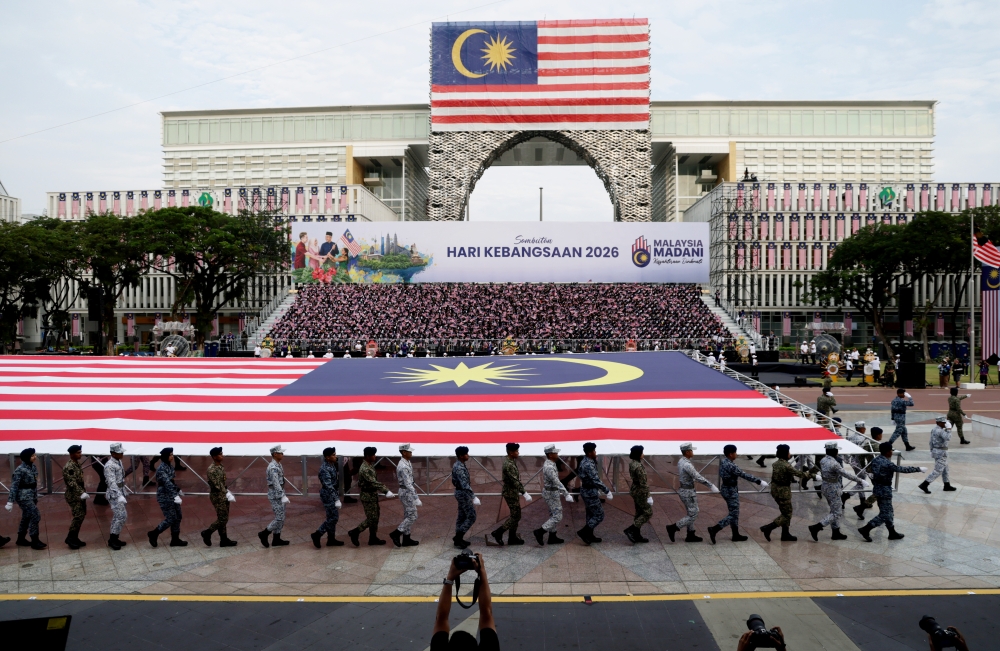
First Published: Sunday, 30 Aug 2026 8:45 AM MYT AUGUST 30 — Every Merdeka, we become very good at displaying Malaysia. We bring out the batik, songket, saree and cheongsam, rediscover our many cultures, celebrate our food and languages, and listen as politicians remind us that diversity is our strength. I do not say this cynically because these rituals matter, and it is genuinely beautiful seeing the country represented in all its complexity.But sometimes I wonder whether we have become much better at displaying diversity than talking honestly about what happens underneath it. We celebrate kita very easily every August. What we talk about much less is how often our politics seems to require a mereka.I do not mean only racial slurs, religious insults or the vicious things people write online. Those are the obvious forms. But it is interesting to explore what comes before them, the more subtle process through which we decide that one person belongs more than another, that one community has a deeper claim to the country, or that some people must continually explain why they deserve to be here at all.Contemporary Malaysian politics keeps bringing us back to precisely this question. The author argues that Malaysia must move beyond performative diversity and confront the politics of exclusion that strengthens belonging by casting others as outsiders. — Bernama pic In July, Kedah Menteri Besar Muhammad Sanusi Md Nor said that Chinese have China and Indians have India while Malays have only this land. Around the same period, PAS president Abdul Hadi Awang described DAP supporters as pendatang brought in by colonialists.We can condemn such remarks, defend them, contextualise them, investigate them and eventually move on to the next controversy, as Malaysia usually does. But the question is why such language still works. Why does pendatang retain such political force in 2026, almost seven decades after Merdeka?The word does more than describe migration. In contemporary Malaysian politics, it places someone outside the emotional centre of the nation. It says that you may possess the same IC or passport, but somewhere behind your citizenship lies another country to which you can still be rhetorically returned.History itself makes the obsession with origins rather strange. Human societies have always moved. Pendatang tells us less about history than it does about power. If we travel far enough backwards, almost everyone comes from somewhere else. The important question for a modern political community is what happens after people have made a country their home, sometimes for generations. Citizenship is supposed to be one of the places where ancestry stops being destiny.Yet Malaysia seems to maintain another category beyond legal citizenship, what I think of as the emotionally legitimate Malaysian. This is where Benedict Anderson’s Imagined Communities (1983) is important here, Anderson described the nation as an imagined political community in which millions of people who will never know one another nevertheless understand themselves as belonging to the same collective. His argument makes me think about Malaysia in a slightly different way because the question is not only how we imagine kita. It is what happens when kita becomes easier to imagine once somebody has been made mereka.Malaysia is hardly alone in this, but we have our own long history of classification. Race, religion and citizenship are not abstract identities here. They have been woven into colonial administration, constitutional arrangements, political parties, education, elections and our everyday understanding of one another. Merdeka ended colonial rule, but it did not automatically remove the habit of sorting human beings into categories and assigning political meaning to those categories.Difference itself is not the problem. Malaysia does have different histories, communities and constitutional arrangements. The trouble begins when difference becomes hierarchy, and hierarchy becomes permission. Once that happens, it becomes easier to believe that some people deserve less sympathy, less security or less dignity because they have already been placed outside the circle of kita.Carl Schmitt takes this somewhere much darker. In The Concept of the Political (1932), he argued that the fundamental political distinction was between friend and enemy. I do not invoke Schmitt comfortably, especially given his own political trajectory, but his insight into political temptation remains disturbing. A frightened community can be brought together very quickly when somebody gives it an enemy.Sometimes I look at Malaysian political discourse and wonder how much of this logic ironically remains with us. Malays are warned that they may lose political power. Non-Malays are told, directly or indirectly, that they can never take their place here entirely for granted. Muslims are warned that Islam is under threat. Non-Muslims fear increasing religious control. Almost every community carries a story about what somebody else supposedly wants to take away from it.Religion makes this particularly sensitive because faith touches something deeper than ordinary political preference. Religion itself is not the problem, and I resist the lazy argument that faith necessarily produces intolerance. Religion has given Malaysians community, compassion, and a language for speaking against injustice. We have even developed a bureaucratic mechanism for much of this in the form of the 3R issues involving race, religion and royalty. Between January 2025 and January 2026, 2,486 complaints sought the removal of such online content, with 1,493 pieces eventually taken down following MCMC monitoring and engagement with platforms. Some speech does cross into threats, incitement and dehumanisation and should be taken seriously. But removing offensive content cannot become our main mechanism of response to hate. Otherwise, we become very good at deleting the symptoms while refusing to discuss what keeps producing them.The Rohingya make this contradiction painfully Malaysian. In December 2016, thousands gathered in Kuala Lumpur in solidarity with persecuted Rohingya Muslims. Then prime minister Najib Razak and Hadi Awang appeared at the same gathering, setting aside political rivalry as solidarity was expressed through the language of humanity, Islam and the ummah.A decade later, Suhakam is warning about discriminatory rhetoric, hostility and dehumanisation directed at Rohingya living among us. Reuters reported in July that at least nine Rohingya community schools had closed amid growing online hostility and fears over children’s safety. I find that contrast difficult to ignore. The Rohingya did not suddenly become less persecuted when they came closer to Malaysia. What changed was their relationship to us. Perhaps this is where the line between kita and mereka becomes most revealing. A persecuted Muslim far away can be embraced as part of kita. The same person living beside us can very quickly become mereka.Hannah Arendt understood something fundamental about this. In The Origins of Totalitarianism (1951), her discussion of statelessness gave rise to the idea often described as the right to have rights. Rights become terribly fragile when a person does not belong to a political community willing and able to guarantee them.Malaysia gives that philosophical problem a very concrete form. We are not party to the 1951 Refugee Convention and still do not have a national asylum system. Refugees are treated under immigration law as undocumented migrants, they cannot formally work and their children do not have access to public schools. They live physically among us while remaining politically outside much of what kita means.That, for me, is where the Merdeka conversation needs to become more difficult.Every year we talk about unity, harmony and tolerance. I am increasingly unsure that tolerance is enough. There is something slightly hierarchical inside the word itself. I tolerate something whose presence I assume I have the authority to permit. Perhaps we should stop performing harmony for just long enough this Merdeka to ask who benefits when Malaysians remain afraid of one another.Can Malay political confidence exist without Chinese insecurity? Can religious conviction remain strong without producing enemies of the faith? Can citizenship matter deeply without turning the non-citizen into somebody less human? Merdeka freed us from colonial rule, but independence does not automatically free a society from its need to create outsiders. That may be one of the harder freedoms we have yet to achieve, learning to know who we are without first deciding who does not belong. So among all the flags, songs, food, costumes and speeches this August 31, perhaps Malaysia is finally old enough for a more uncomfortable question.Why must we manufacture mereka for kita to exist?If our sense of belonging grows only when somebody else’s becomes weaker, then the problem is not that we have failed to love Malaysia enough. We just do not know how to be kita without first creating a mereka.* Khoo Ying Hooi, PhD is an Associate Professor at Universiti Malaya.** This is the personal opinion of the writer or publication and does not necessarily represent the views of Malay Mail.
Merdeka: Why must we manufacture ‘mereka’ for ‘kita’ to exist? — Khoo Ying Hooi
AUGUST 30 — Every Merdeka, we become very good at displaying Malaysia. We bring out the batik, songket, saree and cheongsam, rediscover our many cultures, celebrate our food and...
1,434 words~7 min read