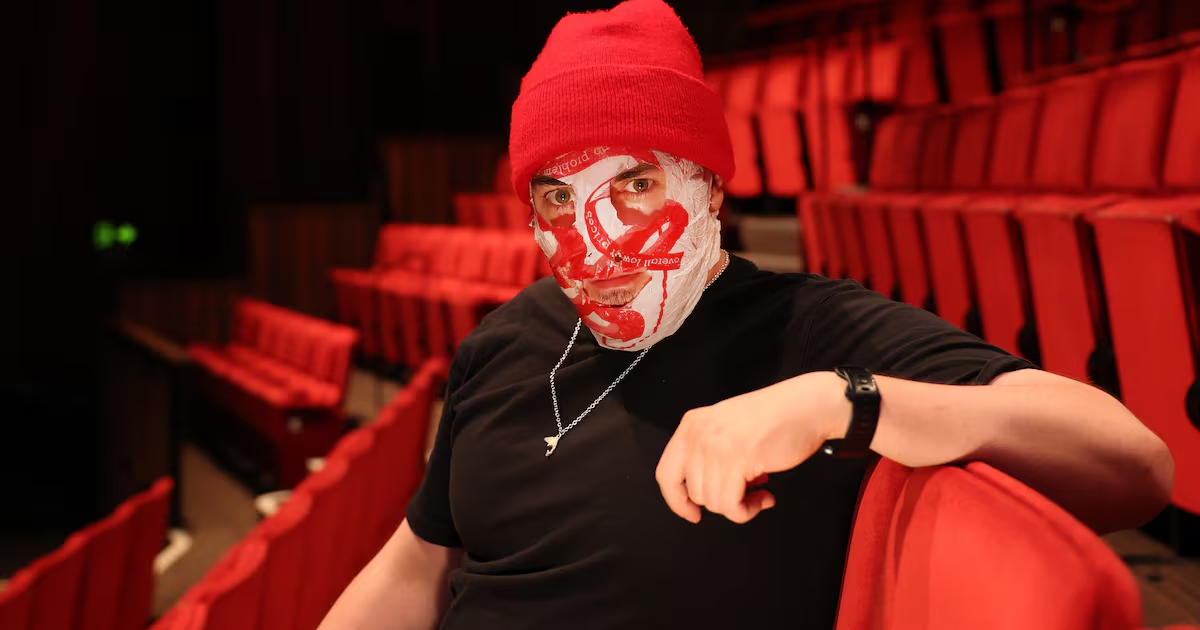
In a busy beer garden in Dublin, the writer and podcaster Blindboy Boatclub is talking about neurodivergence in writing and how the CIA funded writers in Latin America. If you leaned in you would recognise his voice from the Blindboy podcast or the Rubberbandits or his TV documentaries, but nobody leans in. He is not wearing his trademark plastic bag mask. So what does he look like? Is he ...a) Hideous to behold.b) A totally featureless pink oval, like a balloon.c) The most beautiful man I have ever seen.d) Not a man at all, but some sort of beast.You’ll get no answer from me. Blindboy guards his real-life identity very carefully. Earlier, at a rehearsal of Animals, the new Abbey play adapted from his short stories by Dan Colley, he absented himself until the photographer was finished taking pictures. His need for anonymity has something to do with his autism, he thinks. The psychologist who helped diagnose him said, “You have a job where you’re famous, but you wear a plastic bag so you don’t get bothered in the shop? A lot of people would really want to have what you have.”These days Blindboy works in an office in a building among accountants, solicitors and lawyers. None of them know who he is either. He goes in in a suit and tie. “I got the idea from Nick Cave when he was coming off heroin. He went and got a suit and tie and said, ‘This is what I do. I go in and I write songs in my office’ ... It gives me the opportunity to meet people every day and practise small talk. It gives me purpose. It allows me, in a job where I’m self-employed, [to create] boundaries.”[ Blindboy: ‘I left my first day of school feeling great shame. The pain of that still rises up in me’Opens in new window ]He is also influenced to do this, he says, by “these monks who meditate beside rotting corpses so that they can confront the thing they’re most afraid of, which is death. The thing I’m most afraid of is having to work in an office ... I meditate amongst the corpses. I work inside my biggest fear but I shut that door, and my office is a neurodivergent-friendly space. I get in that door and I take off my suit, and I have a tracksuit in my office, and I get to walk around, and I get to stim and do all these things.”School was difficult for him and he was constantly being kicked out of class (he had a kind art teacher who let him sit making art in the back of his art room when he was kicked out elsewhere). He had a regular job just once, in a call centre in 2006. “I got fired after six weeks for leaning back in my chair too much and printing out 93 pages about CIA crack cocaine smuggling,” he says. “And the other thing that got me fired was, I was expected to go and sit with people at lunchtime in my team to socialise as part of the job and no one told me that. Instead, I f**ked off to the car park because I needed to be by myself. But it was interpreted as: this guy isn’t friendly.”Blindboy at the Abbey Theatre in Dublin. Photograph: Clodagh Kilcoyne Blindboy’s hugely successful podcast is, for the most part, a monologue that he spends three days writing and recording. He thinks of it as a never-ending autofictional novel. Each instalment is about 20,000 words long. “The recording software that I use allows me to record my voice with the precision that I can edit words with a word processor ... Ten years ago it would have crashed my computer because of the amount of data.” He laughs. “I write with my mouth for people to read with their ears.” Sometimes mediums stretch their limits, he says. The German-American writer Charles Bukowski, he notes, “had a character called Hank Chinaski, this alcoholic, terrible writer who just does college tours and is horrible to women and it’s really misogynistic and it’s just him. And I’m reading it, going, first off, Hank Chinnaski is just f**king Bukowski and secondly, this is a podcast. Bukowski was a manosphere podcaster.”There was a subsection of his fans in the Rubberbandits days who might have liked Blindboy to become manosphere podcaster but he’s far too emotionally intelligent for that. He has as many female fans as male ones. “If anyone says to me, ‘To be a man is this way’, it’s very rarely useful information,” he says. “What I try and focus on instead is taking gender out of it. ‘Can I be an adult?’ An adult is someone who is assertive, who understands their own emotions and is able to express them. An adult is someone who has the skill to respond to their emotions rather than react to them. And what the manosphere does is it encourages people to become emotionally reactive. It encourages men to basically say that the only emotions that you’re allowed to feel are jealousy, anger, bullying, aggression. Empathy is framed as weakness. You need to be able to say, ‘I’m insecure. I’m jealous of other people. I feel shame. I feel small. I worry that other people are more powerful than I am.’ Unless you’re going there and accepting those negative things as part of who you are, you’re not going to progress into becoming an adult who can respond to the world.”A huge proportion of the podcast’s fan base is outside Ireland. He recently sold out a live show at the Sydney Opera House. Does he notice a difference in the audience? He laughs. “They take me seriously. In Ireland, I’m still the f**king eejit with the bag on his head, and that’s fine. In Australia I’m not that person. There are people in Australia and people in Britain, and if I post a video of me with the bag on talking, they actually get weirded out. And I love that, to be honest.”[ Blindboy: ‘All I want is to live a boring life… I have no interest in fame. I couldn’t give a f**k about it’Opens in new window ]He’s not sure why his listenership has spread like this. “One thing that spreads my podcast is the amount of Irish people who are English teachers ... If they have students that are very advanced English learners, they’ll give them my podcast as a little challenge. Going, ‘All right, can you understand this fella?’ I actually end up with a lot of international listeners from that. And then they spread.”Blindboy at the Abbey Theatre in Dublin. Photograph: Clodagh Kilcoyne There is also, if you listen to the podcast and read any of his three short story collections, a continuity between the two forms. He is viewed by some, this interviewer included, as a unique and important literary talent, but he’s been a bit wounded in the past by negative reviews. “I do want to be embraced by the literary world,” he says. “But the part of me that wants to be embraced is a toxic, insecure part of myself. So I want to be the best writer that I can be. I want to be the best version of me. I write books because I love the process. And I write books so that I can have an opportunity to write another one. And that there is the joy for me. The part of me that wants to be accepted by the literary establishment is the little autistic kid in school that was called stupid. I don’t have a Leaving Cert. So I have a lot of shame around wanting to be called a good boy ... I’m wary of the part of me that wants approval.”For him, writing also has a therapeutic function. “I did train to be a psychotherapist in my 20s, and journalling is a huge part of becoming a therapist, to try write my emotions as raw as possible. There’s bits of me in all the characters. The Donkey is a fictional story about a man trying to save an abused donkey, “but a huge amount of it is when my dad died when I was 21 of a brain tumour and I lost the ability to cry. If I feel something intensely, I always try and write it down in the moment.”The Donkey is in his most recent collection, Topographica Hibernia, and is also included in the new play, as is another moving story, The Cat Piss Astronaut, about a boy with an obsessive interest in space being assaulted by a grown woman. “About 90 per cent of that is autobiographical,” he says. “When I was about four years of age, I was in a playground, and there was a grown woman there, probably the age that I am now, and I started telling her and her little daughter that one day the sun was going to expand and that it would engulf us all. And I think what that did is it actually frightened that woman. Her daughter got upset too, and I think she did not know how to soothe her daughter so she beat me the way you’d beat an adult.” [ Blindboy Boatclub: ‘I had the choice of being a psychotherapist or a mad bastard’Opens in new window ]In discussing his influences, Blindboy references Flann O’Brien, Ernest Hemingway and Mariana Enriquez, but that story was influenced by Frank McCourt. “He won the Pulitzer and he won it for a good reason,” he says. “The opening of Angela’s Ashes, the first few chapters, where Frank McCourt does first person from the perspective of a three-year-old. It’s just brilliant. I was trying to go to the earliest, earliest memories.”Other stories are more fantastical. I’ll Give You Barcelona began when he was in the gym and a man in his 50s came in and “shaved his arsehole at everyone. I wondered what his dreams would be like, and that dream came to me: him ripping the skin off, wrapping it around the dog. That’s so stupid. I cannot fail now because I started with failure and [then] I’m trying to unfail ... I always begin the process with failure. In order to write, the biggest barrier is the fear of failing. So if you’re trying to write something good, you’re going to fail. I start with the worst idea possible and write my way out of it.”Rehearsals in the Digital Hub for the new Blindboy play at the Abbey Theatre. Photograph: Clodagh Kilcoyne Rehearsals in the Digital Hub for the new Blindboy play at the Abbey Theatre. Photograph: Clodagh Kilcoyne Earlier, in the rehearsal space in the Digital Hub in Dublin 8, we watched Dan Colley and choreographer Jessie Thompson guide seven actors through a beautiful and grotesquely physical performance of the story I’ll Give You Barcelona. I watch as the character’s “skin” is ripped from one actor by the rest of the cast in a sort of surreal dance. The play interweaves seven of Blindboy’s stories. There are 12 performers and 90 costumes. Blindboy wanted to work with Colley because Colley had previously worked on adaptations of the work of the fantastical writers Gabriel García Márquez and Jorge Luis Borges. “Me and Dan, we’re on the same wavelength. I’m handing my album over to a brilliant DJ to remix.”In the pub, later, he seems in awe of Colley and Thompson and all of the actors. “What I love is learning the ability to shut the f**k up, to notice when someone else is really good at their craft.” He is creatively voracious. He constantly makes synth music (to the extent he’s been offered a record deal that he declined: “You have to have a hobby. Not everything should be monetised.”) He wants to write a novel next. He’d love to make nature documentaries. His last RTÉ series, The Land of Slaves and Scholars, won a Grierson Award. But he worries about the commercial expectations of many broadcasters. He loves classic 1970s documentary series such as The Ascent of Man, Ways of Seeing and The Shock of the New. “They can really only exist in pure public service broadcasting ... ‘Here’s a bunch of money to do your thing’ ... If you can fund something the way you fund science, you get occasional excellence. When you fund anything on a commercial model, where you must have a return, you get consistent mediocrity.”He sighs. “And it’s so toxic in your industry,” he says, meaning journalism. “I love doing this interview. I love chatting with you but I am afraid of this interview because I know it will end up as an Instagram post, and some of my words will be taken out of context by an online editor. When that happens, the tone is, ‘Get a load of this prick’. And I know that the caption is designed not to tell people that I’m in the Abbey, but ‘How can we get the dads in the comments pissed off?’”Great art, he says, is replenishing but he finds the internet depleting. He has a second phone that’s free of social media in order to read or work. “I think with the written word, in particular, because you’re hearing it in your own voice, you’re hearing it in your own mind. Reading is a participatory act. When you do a good hour of reading, you come away from it feeling recharged. When you come away from an hour of doomscrolling, you do not feel recharged.”Blindboy at the Abbey Theatre in Dublin. Photograph: Clodagh Kilcoyne He has an interesting take on most things, and even his perspective on AI is strangely uplifting. “In Greek mythology thousands of years ago, Prometheus and Zeus were bored. Prometheus says: ‘Let’s make a little world of people like us.’ Zeus goes ‘chill the f**k out. What if they become smarter than us?’ Prometheus falls in love with them, gives them fire. The second they start creating art which is beautiful, Zeus creeps out and goes, ‘Oh s**t! This AI is going to become more powerful than us’, and he introduces mental health problems via Pandora’s box to limit the AI.”He laughs: “With Irish mythology, you have a race in Ireland [the Tuatha Dé Danann], the gods, and then you have, coming from somewhere around Spain, the Milesians. The gods go, ‘Let’s keep them away by casting a spell.’ The humans, the Milesians, they use poetry and art to beat the gods. Then they come to Ireland and they banish the gods underground and they become the fairies. So if AI wins and takes us over, we’ll have rogue humans who are trying to break the AI through code.” He smiles, and I can see his smile because he has no mask on. “We’re the fairies now.” Animals runs at the Abbey Theatre from September 23rd-November 7th as part of the Dublin Theatre Festival.
Blindboy unmasked: ‘The thing I’m most afraid of is having to work in an office... so now I work in an office’
The writer and podcaster on adapting his short stories for the Abbey stage, how his podcast is used as a kind of advanced Duolingo, and how the fairies will rise against AI
2,505 words~11 min read