Business Plus
10 HOUR(s)
Ahsan Habib
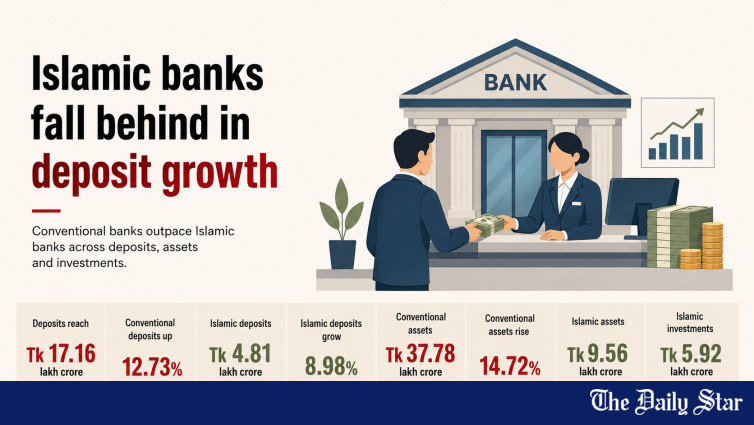
Jakir Hossain, an employee of a renowned drug company, had a fixed deposit of Tk 10 lakh with an Islamic bank for several years.When some banks struggled to return depositors’ funds in 2024 after the fall of the Awami League government and directors of the banks fled the country, he decided to withdraw his funds and keep them with a healthy conventional bank that has a shariah-based window.He was not alone.In the months after the 2024 mass uprising, the banking sector was revealed to have been hollowed out by years of corruption and plunder, with several Islamic banks among the worst affected. Directors fled the country, branches struggled to pay depositors, and panic withdrawals accelerated.Two years later, the damage has deepened. Bangladesh Bank data shows deposits at full-fledged Islamic banks stayed roughly flat through most of 2024 and 2025, hovering close to Tk 4 lakh crore, before falling to about Tk 3.9 lakh crore by June 2026.Year-on-year growth turned negative in late 2024 and hit minus 1.07 percent in June 2026. In that single month, deposits at full-fledged Islamic banks fell by roughly Tk 17,000 crore, coinciding with fresh protests and leadership disputes at Islami Bank Bangladesh, the country’s largest shariah-based lender.Yet demand for Islamic finance has not disappeared. It has moved towards conventional banks that offer shariah-based services.BB data shows conventional banks’ Islamic windows and branches held about Tk 37,000 crore in March 2024. By June 2026, that had more than doubled to roughly Tk 78,000 crore, growing in every quarter in between. Growth was still running at about 11 percent year-on-year in the final quarter, while full-fledged Islamic banks contracted by 5 percent.“This steady growth in deposits of conventional banks can be primarily attributed to the unstable situation in the Islamic banking sector after the July 2024 uprising, which shifted the reliability and confidence of depositors more towards conventional banking,” the central bank said in its latest report on Islamic banking.The shift shows that customers have not necessarily abandoned shariah-based finance. Instead, many are choosing institutions they consider safer while retaining their preference for Islamic banking.