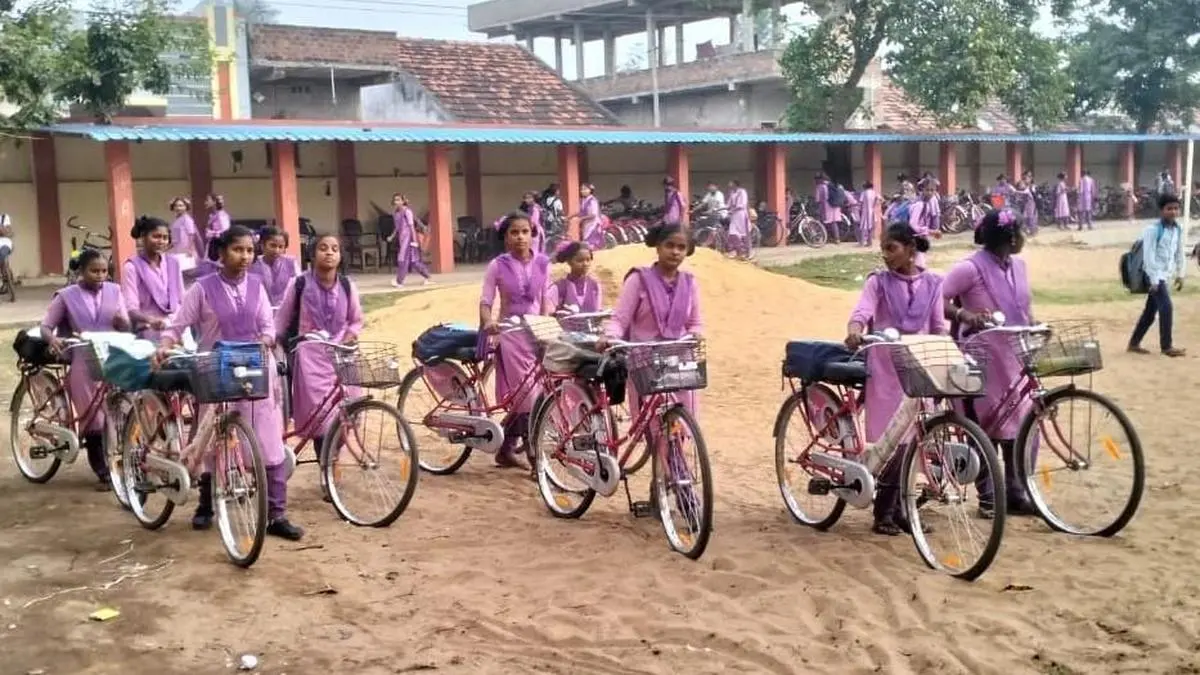
Education is the single biggest CSR cause, absorbing about 34 per cent of all spending in 2024-25
| Photo Credit:
In July 2026, a report delivered a triumphant headline: ‘India Inc’s corporate social responsibility (CSR) spending hit a record ₹40,794 crore in 2024-25, up 17 per cent on the year before’. More companies are giving than ever, and a larger share of the money is going straight into projects rather than into government funds. On the surface, a policy experiment is working.Yet a record number only measures how much was spent, not whom it reached. That is the question worth asking, since the fund now is large enough to matter.India is one of very few countries to make corporate charity a legal duty. Under Section 135 of the Companies Act, 2013, any company with a net worth of ₹500 crore or more, a turnover of ₹1,000 crore or more, or net profit of ₹5 crore or more must spend at least 2 per cent of its average net profit over the previous three years on approved social causes, from education and health to rural development and the environment.Nearly 30,000 firms now spend under the rule. But no central plan directs the money. Each company picks its own causes, its own projects and, crucially, its own locations. Multiply those thousands of separate decisions across a decade and a pattern takes shape, and the pattern is not the one the law’s drafters might have hoped for.The money follows income, not need. Chart 1 makes this plain. Each bubble is a State; its position from left to right shows income per person, and its height shows CSR received per person (Ministry of Corporate Affairs database). If giving followed need, the richer States on the right would receive less per head, and the bubbles would slope downward.They do the opposite. The dashed line rising from bottom-left to top-right is the trend, and almost every large State sits along it. In 2024-25 the link between a State’s wealth and its CSR per person was strong, with a correlation of +0.71, and it has stayed strong for 11 years running.The consequences are stark at the extremes. Delhi received roughly ₹1,243 per person and sits high in the “over-served” zone. Bihar, among the poorest States in the country, received about ₹35 a head, pinned to the bottom-left corner. Uttar Pradesh, at ₹92, and West Bengal, at ₹108, are not far above it. These are three of India’s largest and least prosperous populations, and they draw some of the thinnest support.If we narrow the lens to a single sector, the same logic hardens. Education is the single biggest CSR cause, absorbing about 34 per cent of all spending in 2024-25. Chart 2 plots each State’s SDG-4 (quality education) score against how much education CSR it receives per person. Bihar has the weakest education outcomes in the country (SDG-4 (quality education) score of 32 — worst in India). In 2023-24, it received about ₹4 per person for education. Delhi, the top on outcomes (SDG-4 score of 85 — highest in the country), got about ₹286, seventy times more.And education is no outlier. Together with health, it accounts for roughly 56 per cent of all CSR, and both causes lean towards the States already doing best. When corporate money piles up where public provision is already strongest, it widens the gaps it was meant to close.The cause is not corporate indifference. Every firm’s logic is sound on its own terms: they spend near their plants and offices, invest in the communities they draw workers and goodwill from, and back the causes they know how to run. Since industry concentrates in the richer States, so does the money. The distortion is not the work of any villain; it is the aggregate of thousands of individually reasonable decisions, none of which was ever asked to consider the national map.That is exactly why this is a question of design rather than conscience. And the concentration is a habit, not a hard limit. When the pandemic struck, CSR pivoted within weeks, pouring into health and relief through 2020-21. Once the emergency eased, giving settled back into its familiar grooves. Corporate India can plainly move money to acute need when it chooses to. Left alone, its choices simply point elsewhere.How to fix itThe remedy need not be heavy-handed, and it should not be. India already has the scaffolding. NITI Aayog’s aspirational-districts programme maps the country’s most under-served pockets with hard data. The most direct nudge would be to match private rupees spent in those districts with public ones, so that a company’s giving stretches furthest where it is scarcest.Gentler tools point the same way: recognition for firms that invest in the hardest places, or lighter compliance for money that reaches the bottom of the development ladder.None of this dictates where a company must spend. It rewards the choice the mandate was always meant to encourage. Sharper disclosure would help too, since today we can see where the money goes but almost nothing about what it achieves.The architects of Section 135 got the hard part right. They built a large, durable stream of development finance and made corporate India a genuine partner in it. The unfinished task is the one this year’s headline glides past: not how much is given, but where. A decade in, the fair question for policymakers and boardrooms alike is whether we are willing to send the money somewhere harder.The writer is Lead Economist and Head of Center of Data for Economic Decision-making (CoDED) at Pahlé India FoundationPublished on August 29, 2026