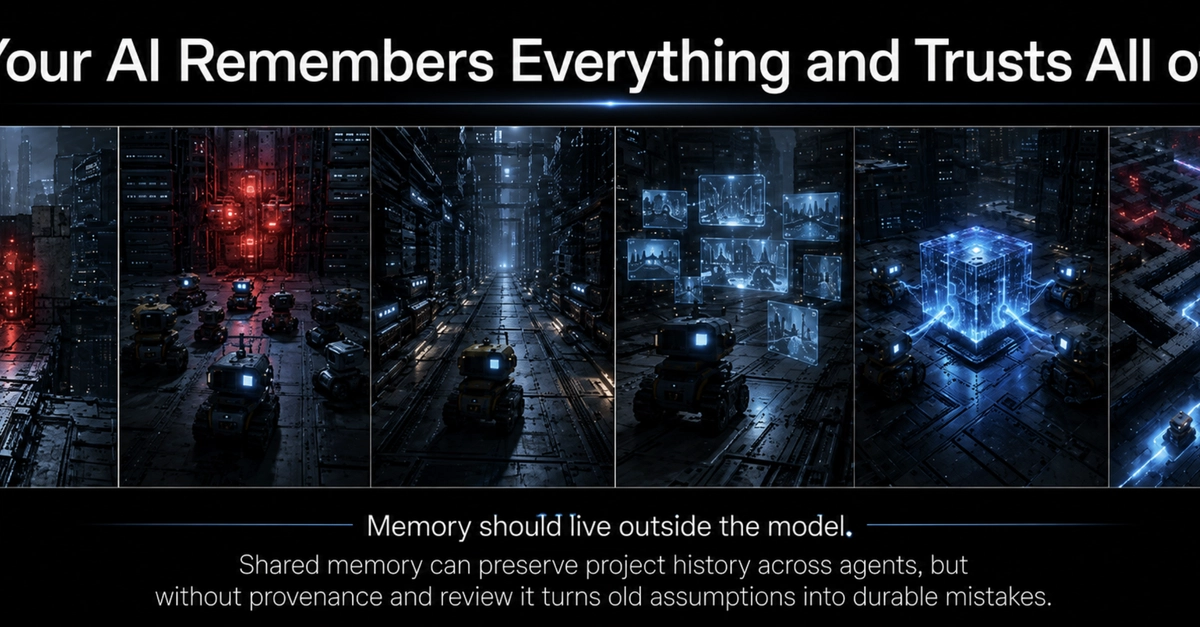
I think we are still talking about AI memory in the wrong way. Most implementations are variations of the same pattern: store previous information, retrieve it later, inject it into the prompt, and call the result memory. That is useful, but architecturally it is not very different from leaving Post-it notes around your apartment and deciding the apartment now remembers things. The more I work with AI systems, the more I think memory should not belong to the model at all. It should belong to the system around the model.
The model should be able to disappear tomorrow while the history survives. Claude should be able to write something today, GPT should be able to read it tomorrow, a local model should be able to challenge it next week, and whatever model we use six months from now should still be able to understand why a stupid-looking workaround exists. That is the experiment I have been building: not “long-term memory” as another assistant feature, but a shared external memory layer for AI agents. The more I work on it, the more I suspect that the interesting problem is not memory itself. It is the economics of forgetting.
Models know a lot. They know absolutely nothing about Tuesday.