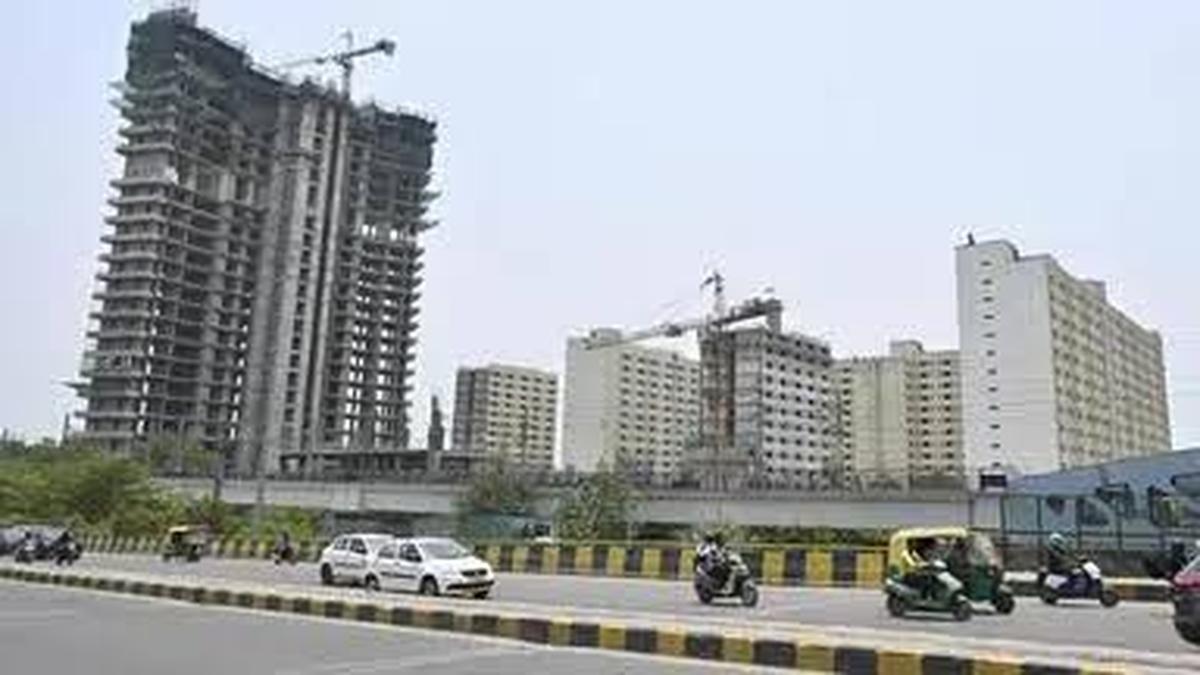
REITs could benefit from expanding commercial portfolios and demand for income-generating assets in FY27, said Chanakya Chakravarti, Global Real Estate Investor and Capital Strategist
| Photo Credit:
istock
Fundraising through Real Estate Investment Trusts (REITs) nearly doubled to ₹9,300 crore in FY26, even as the number of issues remained low at three, indicating larger capital mobilisation through individual offerings. In contrast, Infrastructure Investment Trusts (InvITs), despite seeing an increase in the number of issues, saw fundraising decline by 21 per cent to ₹21,026 crore.In FY25, REITs had raised ₹4,728 crore through two issues. Consequently, the average amount raised per issue in the year ended March 2026 rose 31 per cent to ₹3,100 crore from ₹2,364 crore a year ago.Even the year before, in FY24, only three issues had taken place, collectively raising ₹5,905 crore. Fundraising has remained uneven over the years, peaking at ₹11,985 crore in FY21 before falling to ₹950 crore the next year.The larger issue sizes indicate that capital mobilisation is becoming more concentrated in individual REIT transactions. Chetan Chichra, Partner, Grant Thornton Bharat, said the rise in average issue size suggests that larger pools of institutional and long-term capital are being deployed through individual transactions, reflecting increasing maturity and investor comfort with the asset class.Smaller transactionsInvITs, meanwhile, raised ₹21,026 crore in FY26, down from ₹26,714 crore in FY25 and ₹33,119 crore in FY24. The number of issues, however, increased to 12 in FY26 from 11 the year before. The fall in fundraising was mainly due to the dip in the average issue size. While it was ₹2,429 crore in FY25, it fell by 28 per cent to ₹1,752 crore in the year that followed.The divergence between the number of issues and funds raised suggests that InvIT fundraising is being spread across smaller transactions rather than being driven by a few larger issuances. Chichra said this reflects a more calibrated fundraising environment, with issuers raising capital through smaller transactions aligned with specific funding requirements such as acquisitions, refinancing, or expansion.Growth driversChanakya Chakravarti, Global Real Estate Investor and Capital Strategist, said the REIT numbers indicate a maturing market, with capital concentrating around larger platforms with established portfolios and predictable rental income. For InvITs, the decline in fundraising should not necessarily be read as weaker investor appetite, but rather as a more asset-specific fundraising model in which sponsors monetise operating assets and recycle capital.For FY27, Chakravarti expects both the segments to remain relevant, though their growth drivers are likely to differ. REITs could benefit from expanding commercial portfolios and demand for income-generating assets, while InvITs are expected to be supported by infrastructure investment and asset monetisation.Published on August 28, 2026