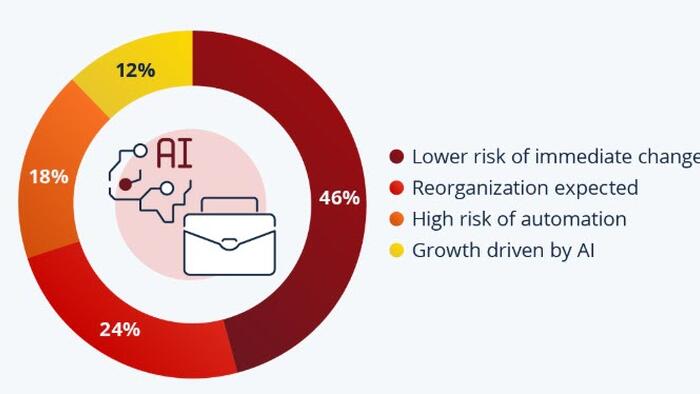
The BLS projects 58 jobs at high risk of exposure to AI will lose under a million roles by 2035gettyThe U.S. Bureau of Labor Statistics just named 206 jobs that carry very high AI exposure risk. Of those roles, 58 are projected to shrink, losing a combined total of 862,600 roles by 2035.That might look overwhelming, but on the flip side, there’s something pretty fascinating going on. About 139 jobs classified as having “very high” AI exposure are forecasted to grow, leading to a net gain of 1.06 million roles over the next nine years.This aligns with the World Economic Forum’s projections that automation would eliminate 92 million roles while adding a net increase of about 78 million.What Are The Jobs Most Exposed To AI?Now, I know you’re naturally concerned. What are the 58 job titles that are forecasted to shrink by 2035? Is my role one of them?Well here’s the full list, ranked in order from highest job reduction at 34.4% to as low as 0.1%:Word processors and typistsSwitchboard operators, including answering serviceData entry keyersTelemarketersOrder clerksPayroll and timekeeping clerksFile clerksDesktop publishersAdult basic education, adult secondary education, and English as a second language instructorsDoor-to-door sales workers, news and street vendors, and related workersBill and account collectorsInterviewers, except eligibility and loanProcurement clerksBroadcast announcers and radio disc jockeysBrokerage clerksCredit authorizers, checkers, and clerksComputer programmersDrafters, all otherOffice and administrative support workers, all otherAdvertising sales agentsLibrary techniciansHuman resources assistants, except payroll and timekeepingSecretaries and administrative assistants, except legal, medical, and executiveOffice clerks, generalNews analysts, reporters, and journalistsBookkeeping, accounting, and auditing clerksCorrespondence clerksClaims adjusters, examiners, and investigatorsCustomer service representativesLegal secretaries and administrative assistantsExecutive secretaries and executive administrative assistantsSurvey researchersCredit analystsNetwork and computer systems administratorsInsurance underwritersAdvertising and promotions managersComputer user support specialistsElectrical and electronics draftersLoan interviewers and clerksPolitical scientistsInsurance claims and policy processing clerksStatistical assistantsGraphic designersReceptionists and information clerksProduction, planning, and expediting clerksEditorsTax examiners and collectors, and revenue agentsSales representatives, wholesale and manufacturing, except technical and scientific productsProofreaders and copy markersDispatchers, except police, fire, and ambulanceLegal support workers, all otherCareer/technical education teachers, postsecondaryWriters and authorsRetail salespersonsSocial scientists and related workers, all otherTutorsDatabase administratorsBilling and posting clerks Why Are These Jobs Highly Exposed?What’s interesting is that the data shows exposure is uneven even within related professions. For example:Bookkeeping clerks lose about 85,000 jobs, while accountants and auditors see an increase of 79,000.Computer programmers lose 8,000 jobs, even as software developers add 175,000 new roles.Office clerks see a loss of 156,000 jobs, but management analysts add 109,200.AI exposure doesn’t necessarily mean your job will be extinct; in some cases, demand rises gettyA pattern is emerging: jobs focused on processing, routine repetitive execution, and recording activities are being squeezed out of the labor market. Meanwhile, roles that may include some processing and routine admin execution but are also more strategically focused on judgment, systems thinking, interpretation, etc., are seeing net increases, even though they are equally AI-exposed.For example, software developers, management analysts, HR, and training and development specialists are also at risk of AI exposure, yet the BLS still projects job growth for them.“Is My Job Exposed To AI?” Is A Poor QuestionSo when you ask, “Is my job exposed to AI?” you’re asking the wrong question because that, in itself, is a poor unit of measurement to determine whether your specific job will be extinct within the next decade. Because AI exposure doesn’t necessarily mean your job is guaranteed to disappear.What you need to evaluate instead is this:Are autonomous systems and agents fully capable of completing my role on their own?Not only can they, but should they?For example, Robert Half revealed in a 2026 report that admin and customer service roles are in high demand for hiring. And yet, decade-long projections point to a decline. This can be explained in two ways:First, the BLS measures changes over 10 years, not YoY, and doesn't account for changes that could occur in between, so industry reports can vary because they reflect the immediate reality.Second, even if AI can fully perform customer support and admin roles, some levels still require a human to do the work, augmented by AI. So just because AI can do it doesn't mean it should. For example, a customer success manager who builds and maintains relationships with existing B2B customers, or a senior customer support specialist who handles more complex queries, is still needed to retain trust and reduce the risk of customer attrition.Your job is relatively untouched by AI's negative impacts if you focus on developing and amplifying the human side of your role.More than task execution, think about the intrinsic qualities that make you better able to perform your role than an AI ever could: skills like relationship-building, trust, systems thinking, communication, leadership, and critical thinking and judgment.If you enjoyed reading this article, you’ll also love: ForbesBill Gates Says Some Jobs Should Be Off-Limits To AI—Who’s Impacted?By Rachel Wells
58 AI Exposed Jobs Projected To Shrink By 2035—Is Your Job Listed?
The BLS predicted 58 jobs that have high exposure risk to AI, which are projected to shrink and lose under a million roles by 2035. Find out if your job is included.
805 words~4 min read