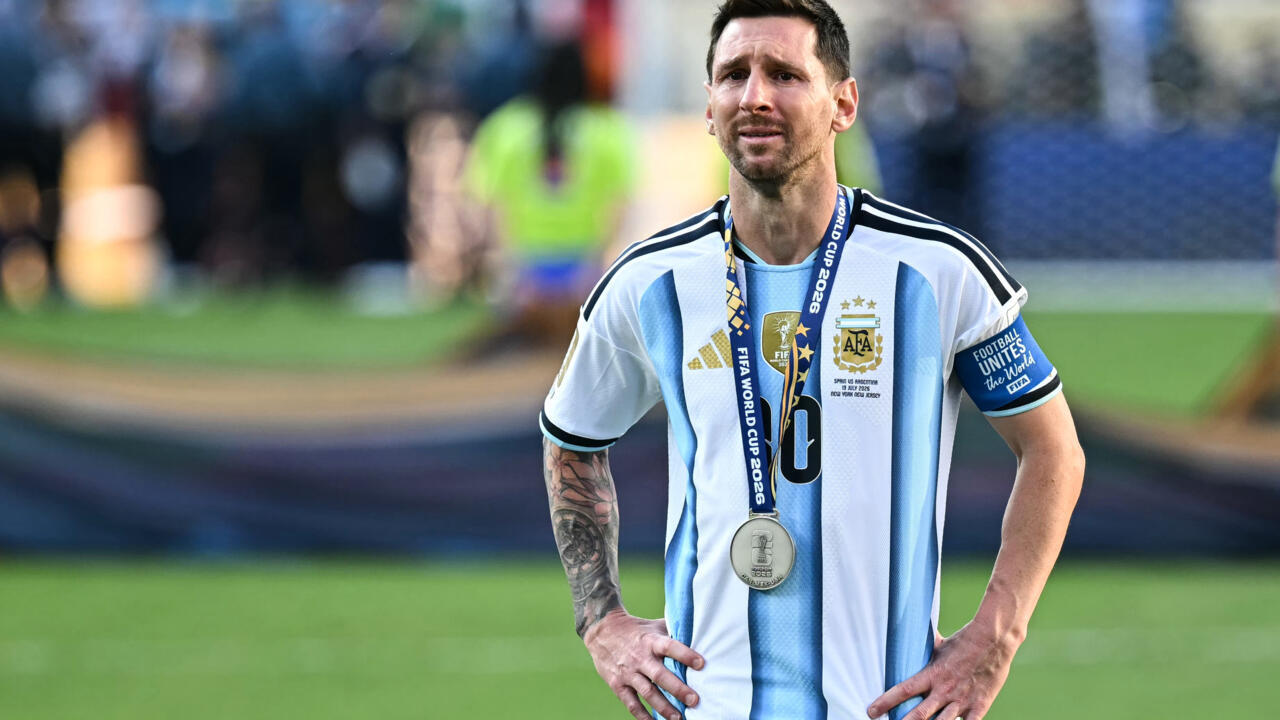
The sycamore trees sway and the chain-link fences rattle. It’s a cold July day in Arroyo Seco, in the depths of the Argentine winter, and the wind blowing off the Parana River brings a chill to the spectators gathered in the bleachers for a fourth-division game at the Antonio Di Giacomo Stadium.Union Arroyo Seco are the local team here. But on this particular Saturday, they’re not playing at home. They share the ground with Leones, a club founded by Lionel Messi a little over a decade ago. One of his brothers, Matias, is their president. In the away dressing room, Central Cordoba are getting changed. One of their players pulls on a navy blue shirt. ‘Messi’ and ’10’ are printed on the back. This Messi, Joaquin, is no relation. And when the crowd begin to chant “Me-ssi! Me-ssi! Me-ssi!”, it isn’t for him. Instead of watching the game, fans are turning to look at a hooded figure in the stands.It’s less than a week after the 2026 World Cup final; defending champions Argentina suffered a 1-0 defeat to Spain after extra time. From the sold-out MetLife and arguably the most expensive ticket in football’s history, Messi is now sat among his people. Forty minutes’ drive from his home on the sleepy, bucolic outskirts of Rosario, the Di Giacomo has a capacity of barely 1,000 black and white bucket seats. The match, broadcast live on YouTube, gets 775 viewers, around 37 million fewer than U.S. network Fox recorded for what could well prove Messi’s last appearance at a World Cup.To try to stay warm, Messi sips maté. His team lose again. Joaquin Messi does not make the scoresheet but his team-mates Marcos Cordoba and Franco Fernandez are not quite as distracted or overawed by a namesake’s presence. Central leave Arroyo Seco as 2-0 winners. Messi, meanwhile, doesn’t depart until the final whistle, descending the stadium steps as shirts and notepads are thrust in front of him to sign. He gladly scribbles his “LEO” signature, climbs into a black car and heads back to the country club in nearby Funes where the Messi family reside.As he passed Rosario, another game was concluding. Newell’s Old Boys, the club Messi had joined as a boy, were getting the Clausura championship underway against Talleres. A year ago, as Messi turned 38, the Lepers, as they’re known, renamed the Tribuna Sur (South Stand) as the Lionel Messi Stand. At the time, it was considered a gesture designed not only to honour Messi but to tempt him to come home. He had not yet committed his future to Inter Miami.“Thank you Seleccion for uniting and making the Argentine people happy,” a banner read. The result against Spain didn’t alter their opinion of him. They were proud of the national team and some Old Boys of their own; Argentina’s head coach Lionel Scaloni, his assistant Walter Samuel and Messi. Argentina flags fluttered in the old Tribuna Sur. Streamers in Newell’s black and red colours bent under the weight of another choreography showing the kid Messi, ball under his arm, and the man holding the World Cup he lifted in Qatar four years ago.Unlike many of his team-mates, Messi did not fly back to Buenos Aires immediately after the World Cup final. He did not board the Aerolineas Argentinas plane, with its distinct No 10 tailfin painted in the sky blue and white of their home shirt. A red carpet was rolled out for the 16 players who did. An army band played the ‘Muchachos’ song and while there weren’t five million jubilant Argentines on the streets like in December 2022 after that Qatar triumph, thousands still lined the route from Ezeiza airport to the Argentine Football Federation’s training facility.Argentina are warmly welcomed home, despite falling at the final hurdle (Juan Manuel Foglia/Xinhua via Getty Images)On X, Argentina’s president Javier Milei announced plans for a national holiday in consultation with the AFA. In the event of a win against Spain in New Jersey, he had promised to vacate his palace, the Pink House, and hand it over to the team for a party. Sadly for him, and Argentina in general, that was not necessary.With the World Cup concluded, Messi eventually made his way back to Rosario. After the final, he did not stop for interviews. His team-mates avoided the mixed zone at MetLife Stadium. They did not walk through hoods up, headphones on. Instead, they left by another exit. Only Scaloni braved the media throng.“I already cried my heart out in the dressing room,” he said. The man known as the llorona (crybaby) needed to compose himself three times in his press conference. Waves of emotion kept sweeping through him. He choked under them. “I’m very sorry,” Scaloni sobbed. He claimed not to have spoken to Messi since the game ended. He did not know if the final was his last ever appearance for Argentina. “I hope that everyone feels very proud of him, of what he’s achieved, because he’s the best player ever to step foot on a football pitch.”Lionel Scaloni and his players begin to process defeat in the World Cup final (Rodrigo Valle/Getty Images)The first anyone heard from Messi, at least in public, was on Instagram.On the eve of the final, he posted: “Whatever happens tomorrow, this group has already written a story we will never forget and no one can erase.”The day after it, his tone was understandably more anguished. “The pain is so great and it’s going to be hard for me to close this wound,” he admitted. It was the second time he had been on the losing side in a World Cup final, the previous one 12 years ago against Germany in Brazil.Experience did not make it any easier. He resolved to “hold onto the good stuff too”. The asados in Kansas City. A hat-trick against Algeria. Breaking Miroslav Klose’s World Cup finals goals record. The knockout-stage comebacks against Egypt and, above all, England.AFA president Claudio ‘Chiqui’ Tapia claimed to TyC Sports that Argentina had, in some respects, already achieved a sense of fulfilment before reaching the final. The rivalry with England is such that the semi in Atlanta was framed as much more than a football game. Tapia argued this was “because of the emotional weight” from the 1982 Falklands Conflict, a forever war in the Argentine imagination, and winning it was, in Tapia’s words, “like winning the World Cup” again. He argued that “the responsibility of not letting the Argentinean people down (in that match) was overwhelming compared with playing against Spain”.Messi celebrates making the World Cup final with team-mate Lautaro Martinez (Li Ming/Xinhua via Getty Images)On one level, there was very little in the way of mystery about Argentina’s defeat.Spain outclassed them, and Messi congratulated the country that had, effectively, adopted him as a boy at Barcelona and made him who he is today.
Lionel Messi, loss and the cruellest month of his career
Messi suffered a loss far heavier than the one in the World Cup final a month ago. All the world can do is grant him time and space
3,292 words~15 min read