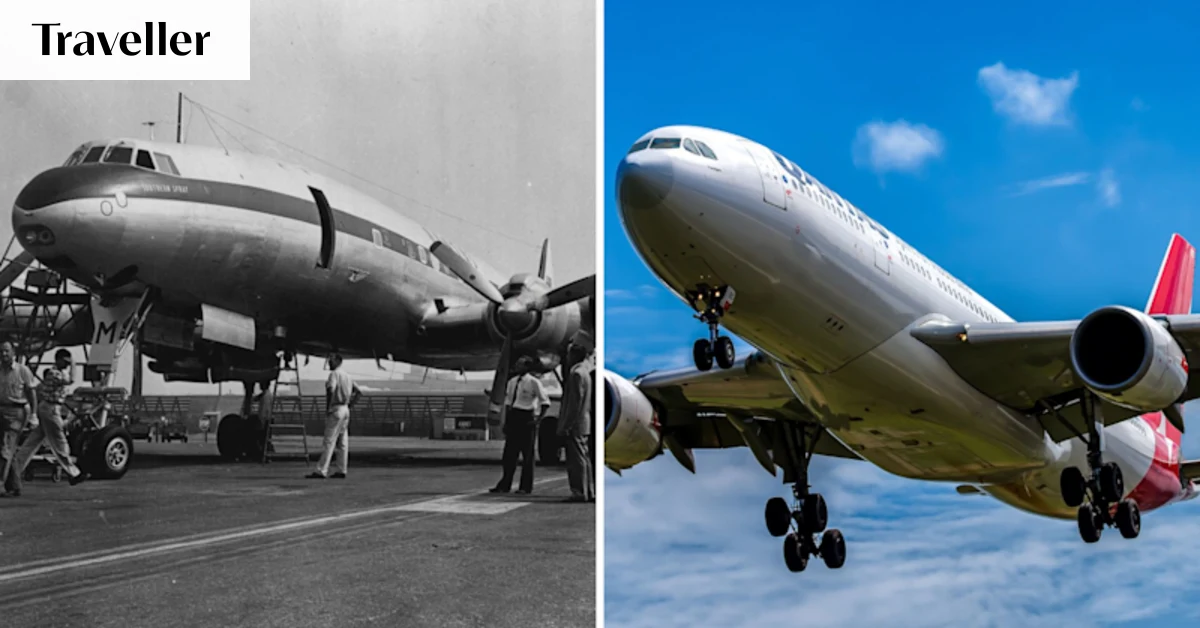
August 28, 2026 — 5:00amYou can already sense it as we board the plane: this flight is not like other flights. Head to Sydney Kingsford Smith Airport on any other day and you will notice the waiting passengers’ impatience. They want to get on their flight, get to their destination, and get going. Their adventure won’t begin until they land at the other end.For us, it is different. All 131 passengers stepping aboard flight QF337 to London on this sunny Sydney morning are here for the journey, not the destination. That’s because we don’t have an easily defined destination. Yes, our trip will ultimately end in London but instead of a one-stop, 24-hour journey, we have signed up for something much slower: a nine-stop itinerary that stretches the trip to a total of 14 days.The route for the journey which was undertaken earlier this year.Before this is over, we will have tasted the tropics in Darwin, wandered through Singapore’s colourful neighbourhoods and been awed by the moonlight gleam of Kolkata’s white-marble Victoria Memorial. We will have explored Colombo’s old town on foot, posed in front of the Sphinx and dined overlooking the Egyptian pyramids. We will have strolled through the pretty centre of Toulouse, and had the Vatican Museums all to ourselves on a nocturnal tour.Our multi-stop journey is more than just a geographic odyssey; it is also a trip back in time. Designed by Captain’s Choice, our Pioneering Spirit of the Kangaroo Route itinerary harks back to the days before planes were capable of long-haul flights, when travelling between Sydney and London involved a series of short “hops”.Our routing is a close, rather than an exact, replica of the flight path launched by Qantas in 1947, given that some former stops – such as Libya – are now on the do-not-visit list.Sign up for the Traveller Deals newsletterGet exclusive travel deals delivered straight to your inbox. Sign up now.The retro-style boarding pass.Ute JunkerIt is a dream itinerary for the aviation nerds on board, and we have plenty of those. Some are former pilots and flight attendants; some date their passion for flying back to childhood plane-spotting sessions. Most of us, I suspect, have indulged an occasional daydream or two about an era of air travel we never experienced – those long-ago days when flying was an elegant experience.We yearn for a time before endless airport security scans, before economy cabins squeezed strangers into enforced intimacy. We dream of an era when a flight was an experience to be celebrated rather than endured.This trip – on a chartered Qantas Airbus A330-300, on which only half the economy seats were available for sale, ensuring every passenger had room to spread out – is perhaps the closest we will come to those long-lost days.It turns out that we should be thankful for that. On this trip, we are accompanied by a range of experts who liven up our flights with their insights. Among my favourites is Greg Fitzgerald, a long-time Qantas pilot, who reframes my ideas of what passengers could expect from flights back in the day.Rome, one of the stops on the Kangaroo Route.Elise HasseyHe reminds us that in the early days of travel, terminals were tin sheds and meals were limited to sandwiches, there being no such thing as ovens onboard. That latter revelation plays on my mind the next time I tuck into one of the business-class meals served to all passengers, an array of dishes that includes a chicken masala with saffron rice and creamy yellow lentils, and a salad of Tasmanian smoked salmon, kale and sweet potato with green goddess dressing.The route included a three-day stay in Colombo.Elise HasseyMore than any other facts shared by Fitzgerald – including the revelation that crew and passengers alike used to sleep in dormitory-style accommodation along the way – it is the idea of eating sandwiches for five days as you travel halfway across the globe that shatters my rose-coloured glasses.That is not the only revelation that lies in store. During a three-day stay in Colombo, Sri Lanka’s largest city, I join an excursion to the Sri Lanka Air Force Museum, where dozens of aircraft on display include remnants of World War II Japanese aircraft, classics such as the De Havilland Tiger Moth and Soviet MiG fighter jets.At the museum, we are greeted by the dashing Captain Elmo Jayawardena, one of Sri Lanka’s most celebrated pilots. He started his five-decade career giving lessons in a vintage Tiger Moth. Later he worked his way up to chief pilot for Air Lanka (now SriLankan Airlines) before teaching at the Boeing Flight Training School.Jayawardena gives us a crash course on a chapter of aviation history that is new to me: the Double Sunrise route of the 1940s. After Singapore fell to the Japanese in 1942 during World War II, finding a new way to move passengers and mail between Sydney and London was vital.A 1947 poster for the Kangaroo Route.The British and Australian governments agreed on a new air route. Qantas would fly between Australia and Ceylon (as Sri Lanka was then known), while the British Overseas Airways Corporation would conduct a connecting air service to Britain.At 3500 nautical miles (6482 kilometres), the Qantas leg was the world’s longest commercial air service at the time, a precursor to the Project Sunrise flights coming next year. It was known as the Double Sunrise flight because those on board saw two sunrises during the 30-plus hours it took to complete the flight.I nod my understanding, but apparently I haven’t quite grasped the point. Jayawardena spells it out more clearly. Because Japanese forces spread across much of the Pacific, radio communications were banned – no pilot wanted to make himself a target for enemy forces. Operating without modern satellite guidance or any other form of support, and carrying just enough fuel to reach Sri Lanka, the crew had no room for error when it came to navigation.Qantas staff wear vintage Emilio Pucci-designed uniforms for the recreation of the route.Max Mason-Hubers“[They] just looked at this,” Jayawardena says, his fingers tracing a line on a map across the huge stretch of ocean between Australia and the southern tip of Sri Lanka, where the planes landed at RAF Base Koggala near Galle.“If you fly too far west and miss your target, the next landfall is Africa. You won’t have enough fuel to reach it. If it were me, I would be aiming right for the east coast to give myself a margin of error.”There is no need for such feats of white-knuckle flying on our tour. As the trip goes on, however, I begin to get an inkling of some of the logistical challenges involved in our epic journey.“We are a self-contained ark carrying tons of support material,” says Captain’s Choice chief executive Bas Bosschieter, part of the 12-strong Captain’s Choice team (including two doctors) that accompany us. “We must carry every bottle of wine or water, blankets, pillows – the only things that get uplifted in ports are fresh food and drinking ice.”A Qantas Lockheed Constellation, which used to fly the Kangaroo Route. It is the opposite of travelling light. In addition to the Captain’s Choice team, we are also accompanied by catering staff, engineers and three containers of engineering parts. Fortunately only one replacement part is required during the trip – a control box for the moving map display.We develop a camaraderie with the flight crew, who are with us the whole trip and who bring a sense of fun to the adventure, dressing up to welcome us on board at each new stop. Flicking through photos from our India leg, I see crew dressed as everything from maharajas to sacred cows.Halfway through our trip, I develop a renewed appreciation for the ease of modern air travel. It is not just the standard of the food served on board, or the endless entertainment options that help you while away the hours. Nor is it the speed of today’s aircraft, the way our plane carries us from Kolkata to Colombo, from Colombo to Cairo, in just a few hours.With images of the tin sheds and dormitory beds of yesteryear in my head, I have a new sense of gratitude to the small armies of workers that keep today’s airports running smoothly, whether it is maintaining the air-conditioning that shields us from torrid tropical temperatures or delivering our bags from the plane straight to the carousel.That appreciation will stay with me, along with fresh memories of an array of dazzling destinations and, most importantly, some new friendships. Before our final landing in London, Captain Chris Brooke shares his take on the trip.“It’s not the destinations – it’s the people, the stories you’ve shared, the laughter in the cabin,” he says in his farewell announcement. “It has felt less like a charter, more like a family, and it reminded all of us why we fell in love with aviation in the first place.”MOREThe Captain’s Choice Pioneering Spirit of the Kangaroo Route Private Jet Journey took place in February 2026. This journey is just one example of the experiences Captain’s Choice is renowned for, with an array of Australian and international departures available for 2026 and beyond. See captainschoice.com.auThe writer was a guest of Captains Choice.Ute Junker is a freelance writer and editor who has been covering travel for more than 20 years.From our partners
A 14-day flight to London: On board the recreation of the historic Kangaroo Route
You can already sense it as we board the plane: this flight is not like other flights.
1,563 words~7 min read