I run a handful of personal websites. A book catalog, a blog, a few project sites. Not long ago, keeping those running the way I wanted meant one of two things. Either I did everything myself, badly and slowly, or I assembled a small team: a web developer for the layout and build, a copy editor for the writing, a graphic designer for the covers and banners. Three specialists, three sets of handoffs, and a lot of waiting on other people for a site that earns nothing.
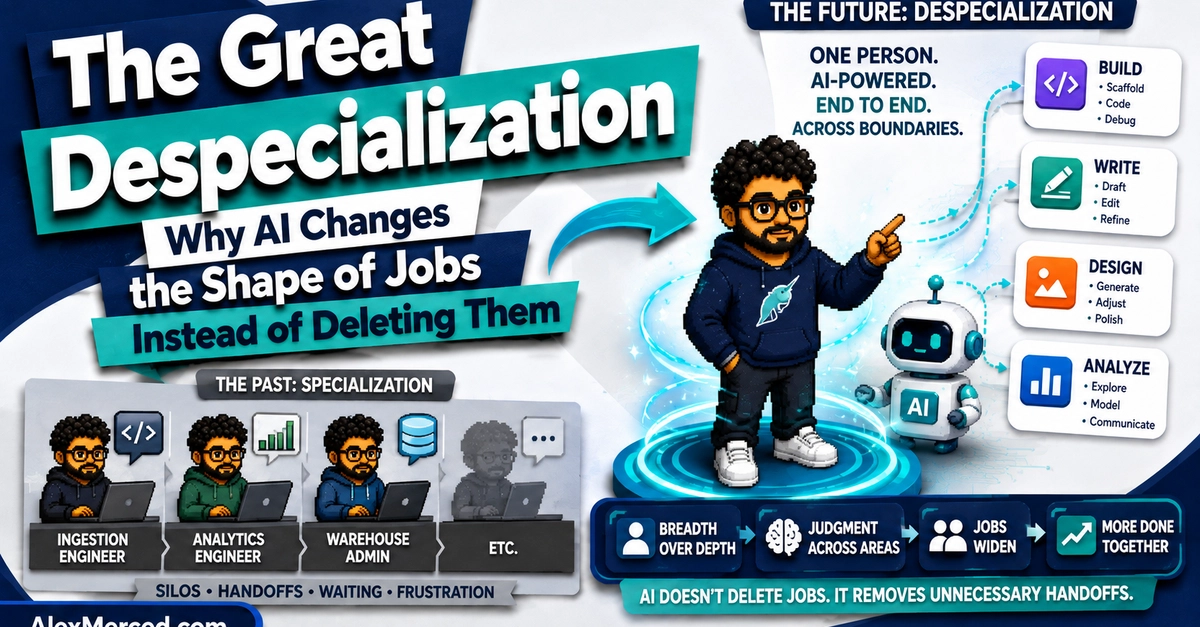
Today I do all three jobs myself with AI assisting on each one. The layout gets scaffolded by a model, the copy gets a first editing pass from a model, the graphics get generated and adjusted with a model. None of that works unless I know enough about web development, editing, and design to describe what I want and to recognize when the output is wrong. The specialists did not get replaced by software. Their procedural work got absorbed into a wider version of my job, and what the job now requires of me is judgment across three areas instead of skill in one.
That is the real subject of this article. The conversation about artificial intelligence and work keeps asking one question: how many jobs will AI eliminate? I think that is the wrong question, and the wrong question is producing wrong answers. My argument is that we are entering a period I call the great despecialization. For roughly two centuries, productivity gains came from splitting work into narrower roles. AI reverses the incentive. When one person with the right tools can carry a piece of work across boundaries that used to require handoffs, the economics favor breadth over depth. Jobs do not vanish. They widen. And if my websites ever grow to the point where I need a team again, that team will not be specialists. It will be generalists, each owning additional end-to-end workflows toward the same goal.