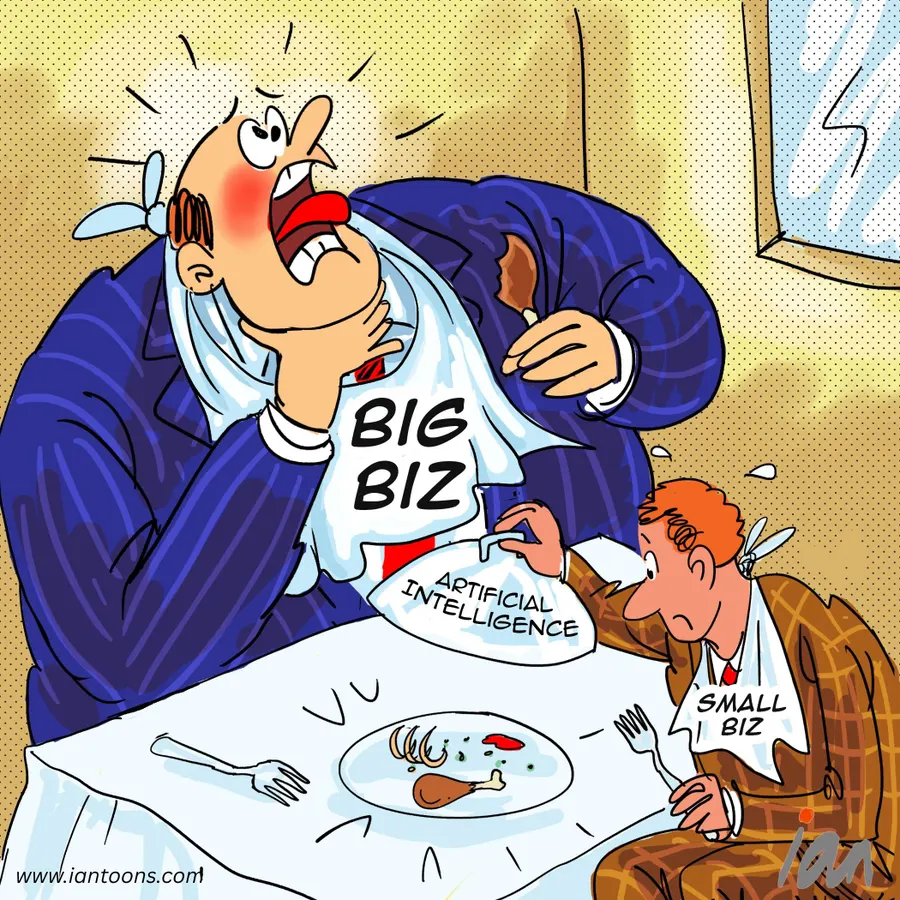
Kerrie Jordan is Chief Marketing Officer at Epicor. Host of the Manufacturing the Future podcast.gettyEveryone assumes big companies will lead the AI revolution due to their size, scale and capital. But those may be the very things holding them back from transformative AI adoption.Our “Voice of the Essential Worker 2025" report asked 1,038 frontline workers across industries worldwide how they’re using technology to increase productivity and mitigate supply chain risk in their daily work. In analyzing AI use, one insight stood out: Although revenue doesn’t seem to matter when it comes to AI investment and use, company staff size does.Let’s dig into the data. Of those who use AI in their day-to-day tasks and who say their company is increasing their AI investments over the next one to three years, the majority work at companies with between 50 and 249 employees or 250 and 999 employees. Of those who do not use AI in their day-to-day work and who say their company is decreasing or has no plans for AI investments, the majority either work at companies with 5,000 or more employees or companies with 1 to 49 employees.The frontline workers surveyed are telling us something important: Medium-sized businesses are accelerating AI adoption and use in ways that small and large businesses can’t seem to simulate. Let’s look at why this is—and what small and large businesses can do to address this AI stagnation.Why Midsize Businesses Are Becoming AI LeadersLarge businesses should be driving AI transformation because they have the capital to do so, and small businesses should be driving AI transformation because they have the agility to adopt and test with few constraints—right? Yet, our findings suggest a different story: Midsize organizations are the ones deploying AI tools on the front line, empowering workers directly with AI and seeing immediate gains in productivity, decision-making speed and resilience.This is likely because they’re landing at a sweet spot of capital, complexity and decision cycles. Midsize businesses have enough capital to invest in emerging technologies like AI—not just in back-office dashboards, but in tools that go directly into the hands of frontline workers. They’re also big enough to experience the operational complexity that AI solves so well. They also have a small enough staff to deploy AI tools and training without too many hurdles. Shorter decision cycles can result in the faster deployment of AI technologies all the way down to the front lines, with leadership in close enough proximity to understand frontline needs. These businesses are big enough to already have structured feedback loops on new technologies in place, yet small enough to pivot on the insights that feedback delivers.In comparison, large companies may have the most to gain from rolling out AI technologies across the organization, but they seem to have the least ability to execute. Because of their size, AI pilots or initiatives may get stuck in planning or at the corporate level, never making it down to frontline workers in warehouses, stores or factory floors. The prospect of training thousands of employees on new AI technologies may be a barrier, as well. There’s often an all-or-nothing mindset hurdle to AI investments, as deploying across an entire enterprise feels too big, risky or expensive. A recent McKinsey report found that nearly two-thirds of businesses that use AI in at least one business function are still in the experimentation or piloting phase and have not yet begun to scale AI across the enterprise.Small companies sit at the other end of the extreme, in that they either can’t justify the cost or perhaps don’t think AI applies to them. Rolling out a full AI initiative may feel like too big of a change for a small operation, especially if that operation is steeped in “the way it’s always been.” In a smaller organization where leadership is more hands-on and the team feels like family, there may be resistance to the more impersonal nature of AI or automation. There may not even be the budget for new digital transformation initiatives, especially if they see AI as a system overhaul rather than an additional tool. A recent report from Robert Press found that only 8.8% of small businesses are using AI.Does this mean that large and small companies could be left out of the AI revolution? Not necessarily, but it does mean they need to take some cues from the midsize business AI playbook.What Large And Small Companies Can Learn From The MidmarketIt’s not necessarily size, but strategy that’s driving accelerated AI adoption. In this case, both large and small businesses have plenty of opportunity to leverage AI; they just need to know how to approach it.Larger businesses that view size and scope as hurdles can start small. Choose one department or even a single use case where an AI pilot would benefit: a mobile AI-powered dashboard in the warehouse, for example, or a chatbot answering questions about supply chain status. If company-wide training is a hurdle, look at adopting AI tools that are intuitive out of the box, with interfaces similar to the smart technology your workers use every day. Our report found that even without formal training, frontline workers are using AI tools daily and seeing measurable cost reductions.Small businesses can follow a similar direction: Start with AI adoption for a very specific use case that makes sense for your business. You don’t have to roll out enterprise-level AI tools and replace the operations and processes that make your small business unique. Even very defined workflows like inventory counting, scheduling and quoting can benefit from AI help.AI Adoption For Any Size BusinessUltimately, AI isn’t reserved for only one type or size of business. AI is versatile enough to bring benefits to a number of different use cases. It may mean adopting a midsize business approach to AI as you go—and following their lead on how to manage capital, complexity and decision cycles so that AI becomes an exciting new capability instead of a burden.Forbes Technology Council is an invitation-only community for world-class CIOs, CTOs and technology executives. Do I qualify?
Why Midsize Businesses May Win The Frontline AI Race
You don’t have to roll out enterprise-level AI tools and replace the operations and processes that make your small business unique.
1,009 words~5 min read