Nigeria’s growing reliance on domestic borrowing to finance government spending has reduced its exposure to foreign-currency risk, but it has also made the government more sensitive to the price of naira liquidity. The Central Bank of Nigeria’s decision to reopen Open Market Operations to individuals, corporates and non-bank financial institutions introduces another high-yield instrument competing for the domestic savings the Treasury relies on.
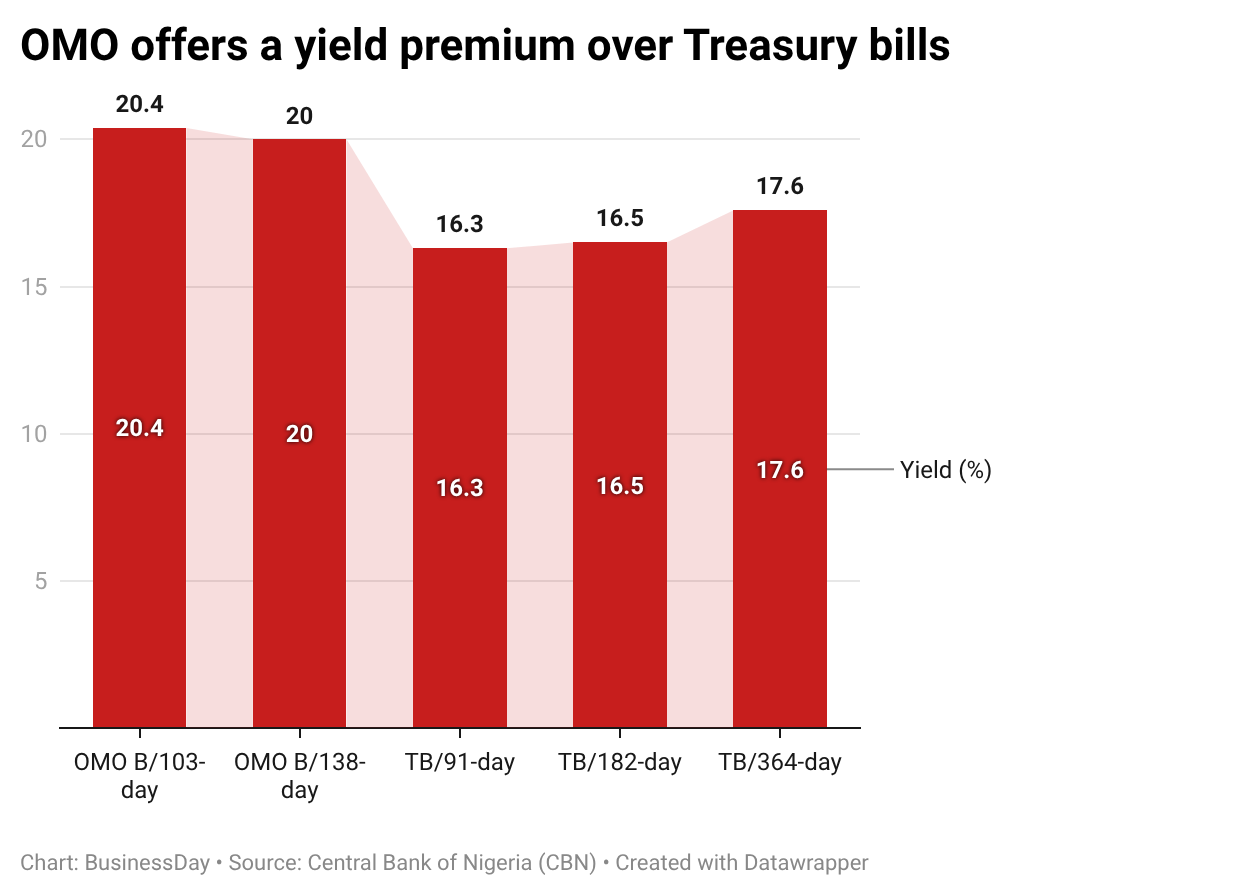
At the first OMO auction after the reopening, investors submitted N4.93 trillion for N600 billion offered. The 103-day instrument cleared at 20.39 percent and the 138-day bill at 20.01 percent, compared with Treasury bill yields of 16.30 percent, 16.50 percent and 17.59 percent for 91-day, 182-day and 364-day bills respectively. The yield gap gives investors a strong incentive to consider OMO over comparable Treasury bills.
The Treasury does not have to lose investors outright for the development to matter. If OMO remains significantly more attractive, it could eventually require the government to offer higher yields to retain demand for its own short-term debt.
That creates a new tension in Nigeria’s domestic borrowing strategy. Foreign borrowing carries exchange-rate risk because a weaker naira increases the domestic cost of servicing external debt. Domestic borrowing avoids that mismatch, but leaves the government exposed to movements in local interest rates and investor demand.