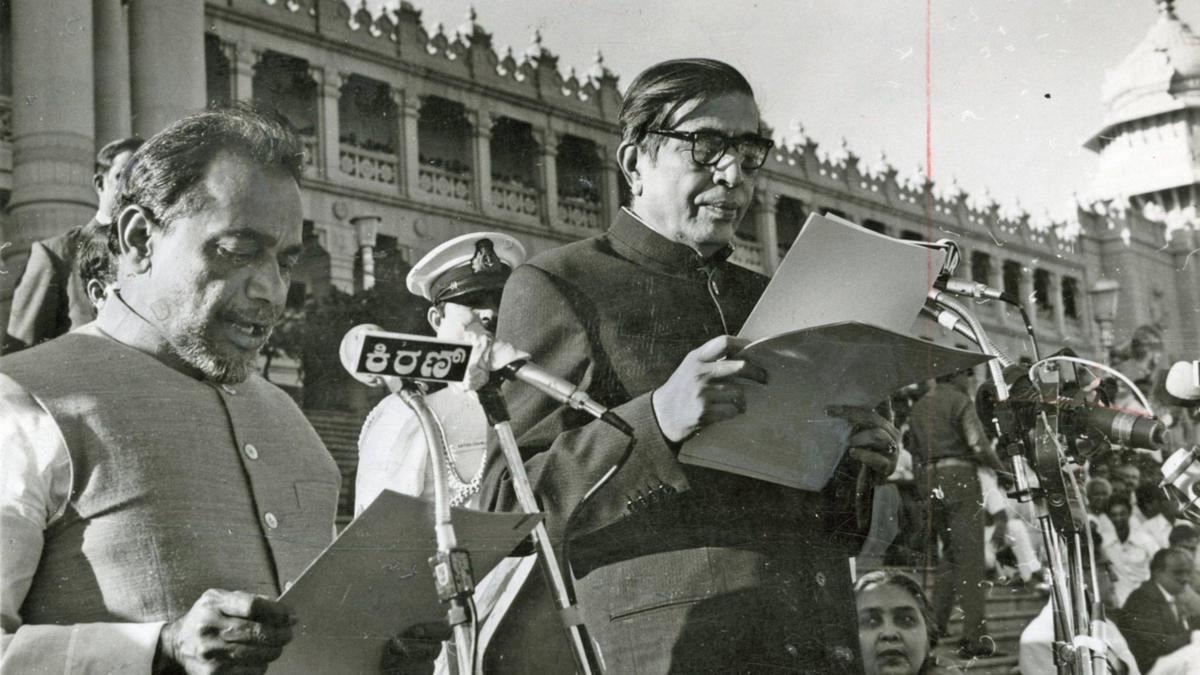
Ramakrishna Hegde being sworn in Chief Minister of Karnataka by Governor A.N. Banerji in Bangalore on March 8, 1985.
| Photo Credit: The Hindu Archives/T.L. Prabhakar
The birth centenary of former Karnataka Chief Minister Ramakrishna Hegde, who is remembered for decentralisation, institutional reforms, and value-based politics, will be celebrated in Bengaluru on August 29.Vice-President C.P. Radhakrishnan will be the chief guest at the function, while Governor Thaawarchand Gehlot will preside over the event at the Banquet Hall of the Vidhana Soudha at 4 p.m. Chief Minister D.K. Shivakumar, former Chief Minister Siddaramaiah, and several leaders of the erstwhile Janata Parivar are expected to attend.Hegde’s daughters, Mamta and Samta, are organising the event with several of their father’s long-time associates. Hegde was married to Shakuntala Hegde.First non-Congress CMBorn on August 29, 1926, at Siddapura in Uttara Kannada, Hegde became Karnataka’s first non-Congress Chief Minister after the Janata Party emerged as the single largest party in the 1983 Assembly elections. His victory ended the era of single-party dominance in the State and paved the way for a multi-party political alternative.In 1984, following the Janata Party’s poor performance in the Lok Sabha elections, he resigned as Chief Minister to seek a fresh mandate. The party secured a clear majority in the 1985 Assembly elections.One of Hegde’s most significant contributions was the introduction of a three-tier Panchayat Raj system, which devolved financial and administrative powers to local bodies.His government also established the Karnataka Lokayukta in 1984 to strengthen accountability. Hegde presented the State Budget 13 times during his career as Finance Minister and Chief Minister.Telephone-tapping controversyKnown for advocating value-based politics, Hegde’s career was not without controversy. He offered to resign as Chief Minister in 1986 following criticism over the government’s handling of arrack bottling contracts and eventually stepped down in 1988, taking political responsibility amid a telephone-tapping controversy.He also ordered inquiries when allegations emerged involving his elder brother and his son, and introduced a rule preventing Ministers from appointing relatives or members of their caste as personal assistants or office staff.Hegde also championed several social and administrative reforms, including reservation for women in local bodies, the Antyodaya scheme for poor families, public grievance redressal through Janata Darshan and greater public access to the Vidhana Soudha. He promoted tree planting across Karnataka and the creation of green-belt zones in Bengaluru.National politicsHegde continued to play an influential role in national politics after leaving Karnataka. He served five terms as an MLA, once as an MLC and two terms as a Rajya Sabha member. He also served as Deputy Chairman of the erstwhile Planning Commission and as Union Minister for Commerce and Industry in the NDA government from 1998 to 1999.Following differences within the Janata Dal, he was expelled from the party in 1996. He subsequently founded the Rashtriya Nava Nirman Vedike and later his own political party, Lok Shakti. In 1999, Lok Shakti merged with the Janata Dal (United).More than two decades after his death, Hegde’s legacy remains associated with decentralisation, accountability, cooperative federalism, citizen participation and institution building. Several incumbent legislators who knew him continue to admire his contribution to public life.A lawyer by profession, Hegde participated in the Quit India Movement and entered public life as a Congress leader. He later joined the Opposition movement during the Emergency and emerged as a prominent leader of the Janata movement.Unlike many contemporary politicians, Hegde believed in God but did not consult astrologers or perform ritualistic homas and pujas, according to those familiar with his personal and political life. Published - August 27, 2026 07:44 pm IST