Purpose-built for physicians
Earlier successful discontinuation of continuous renal replacement therapy may provide benefits for patients with preserved urine output, according to study data published in the Clinical Journal of the American Society of Nephrology.
Continuous renal replacement therapy (CRRT) can be a lifesaving but invasive procedure, highlighting a need to determine optimal timing for a liberation trial — an attempt to discontinue therapy without needing to restart it, according to Dana Y. Fuhrman, DO, MS, associate professor of pediatrics in the division of critical care medicine at the University of Cincinnati, and colleagues. However, data to support liberation decisions for pediatric patients on CRRT are limited, they wrote.
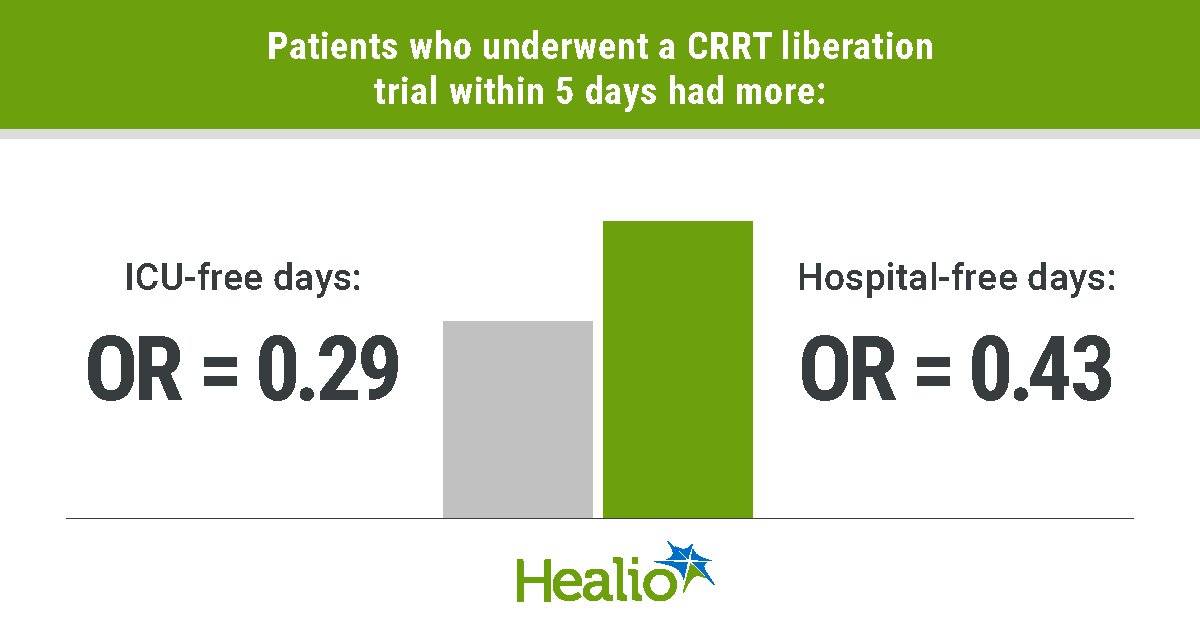
In a retrospective cohort study, the researchers assessed outcomes among 366 patients younger than 25 years (mean age, 8.66 years; 43% female) on CRRT in the international multicenter WE-ROCK registry from 2015 to 2021. Patients underwent a liberation trial if they had urine output greater than 0.5 mL/kg per hour for at least 24 hours within the first 5 days of beginning CRRT.
The primary outcome was a hierarchical composite of four endpoints. Using a win ratio approach, each endpoint was ordered based on clinical and patient importance: 90-day mortality (first), 90-day kidney replacement therapy dependence (second), ICU-free days within the first 28 days of CRRT initiation (third) and hospital-free days within the first 60 days of CRRT initiation (fourth).