Babasaheb is Waiting for His VisaI’m thinking of the man behind the iconOf the fight before the victoryOf the child before the legendI’m trying to understand a seeker’s life in retrospect A man rocking away in his wicker chairDonning his Mayfair dinner jacketLearning to play the violin, The polyglot, the bodhisattva, Whose speech was like the firing of pistol shots“The Most Hated Man in India”The implacable realist who loved to readWho liked to paintFrom the facts of his life I try to gleanA fistful of inspiration, an ounce of verve and make a monument of love. What garden did you tendThat the flowers from its boughsAre still blooming, fragrant in the morning air? How am I supposed to repay the debtThat accumulates like fine dew in January? Who am I if not a pulse in your shadow, A twinkle of your eternal starlight? Let the turmoil of words around you cease So that I can say with pride—You are my history, my today andAll the days I am yet to see. adagioI want to write a poem for you but I want to meet you moreso that’s what I do the poem can wait. I text you, ask if you are freeYou tell me not today: you are busybut you call me in the evening, you say We’ll meet.And I say Okay.And everywhere poets are writing poems for their loversAnd me, I’m meeting you today. The First EmperorShih Huang Ti, perhaps, tried to abolish the entire past in order to abolish one single memory: his mother's infamy. – Borges, The Wall and the BooksShih Huang Ti decreed that all the books of the past be destroyed;So that he be called the first king,And he names all things for the first time. Perhaps it was jealousy of the past rulersWho achieved so much, jealousy for Confucius and othersWho gave culture and knowledge its nameI want to know the kind of thoughts he had in his floating palace—One room for each day of the yearWhether he had a lover and the wounds he inflicted on herFor reminding him of his motherWhether his dreams were about the WallAnd would it keep the memories Of the past away which made him relentless in his struggle to beImmortal? Did he abolish pain from his mind tooIn his attempt to keep out the past?Or did he become like you and me Forever writhing, snake-likeWith only a Wall to call his beloved?First published in print in Welter journal (University of Baltimore) in 2018.Poemamor fati, said Nietzschenot knowing how his own endwill come about (clutching the neckof a horse, weeping).what he did knowwas, some are destinedto be born posthumously.Zarathustra surveys the pitiless landscape—Go, he says, having led youto the thresholdof your solitary home,and without waiting for an answer,turns back to leave.in this version of the story,Lou-Salome does not break his heart.in this version of the story,she nurses him back to health.but with God already killedthey do not know who to credittheir happiness with.so, they live to be eighty.they die in their villaon the outskirts of Sils Mariawishingthey had never met.Originally appeared in Issue 3 of the journal Name and None, adjudged finalist for their prize (2019). Poem for a Memehave u seen that meme where the picture depictsa myosin protein dragging an endorphinto the inner part of the cortexwhich leads to the feeling of happinessin the human brain?just like Sisyphus pushing his rock up the mountain.and i think, how apt,happiness is indeed a pursuit,something to be chased till eternitywhile grief comes to us in torrents, or secretly,like a landlord poking his head in to see what our plans areand then reluctantly,we make a kind of home even out of hurt.we say out of gritted teeth, to answer Jean Genet’s question,yes, i am ready to see things as they are,yes, i agree to gaze at the world tranquilly, and acceptresponsibility for my gaze,whatever it might see.Awarded the first prize in the poetry challenge competition by Young Poets Network, UK, in 2019.Excerpted with permission from The Peacock-Eaters, Chanchal Kumar, Red River Press.
‘I’m thinking of the man behind the icon’: These poems counter cultural and historical exclusions
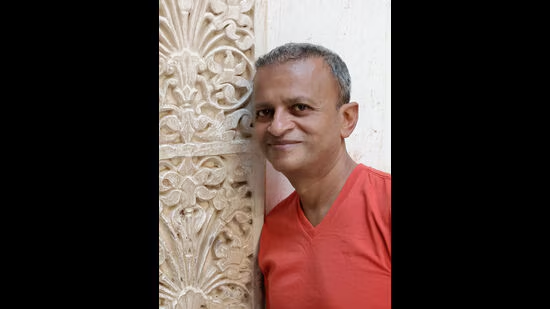
An excerpt from ‘The Peacock-Eaters’, by Chanchal Kumar.
672 words~3 min read