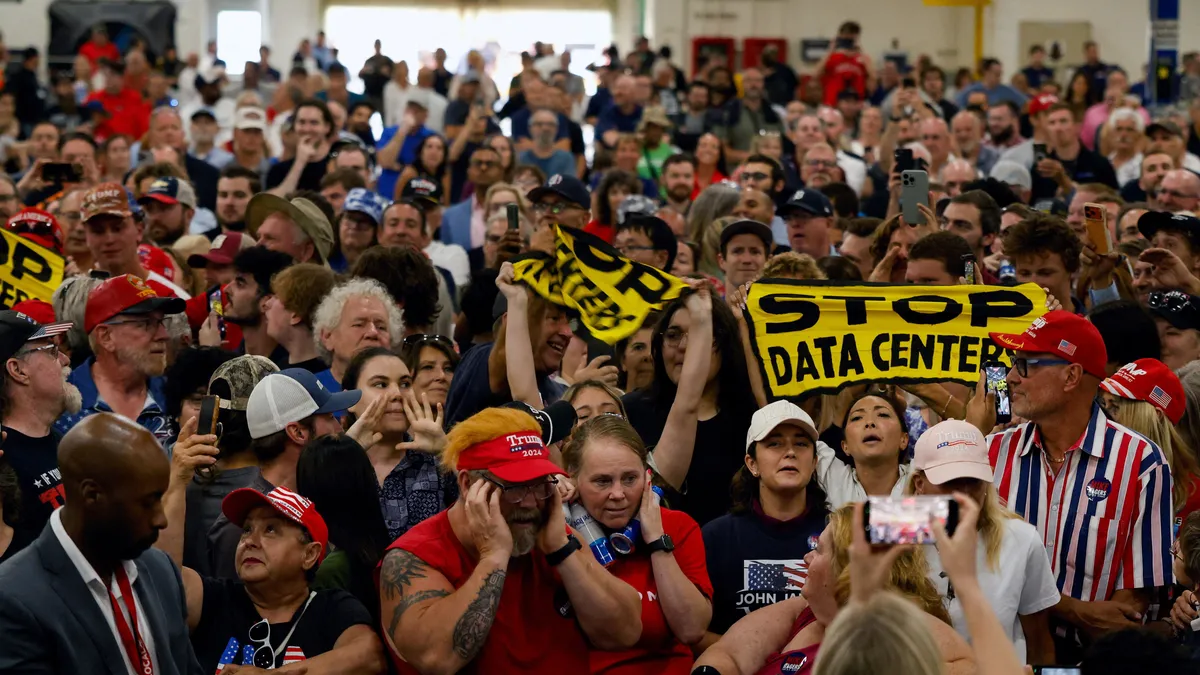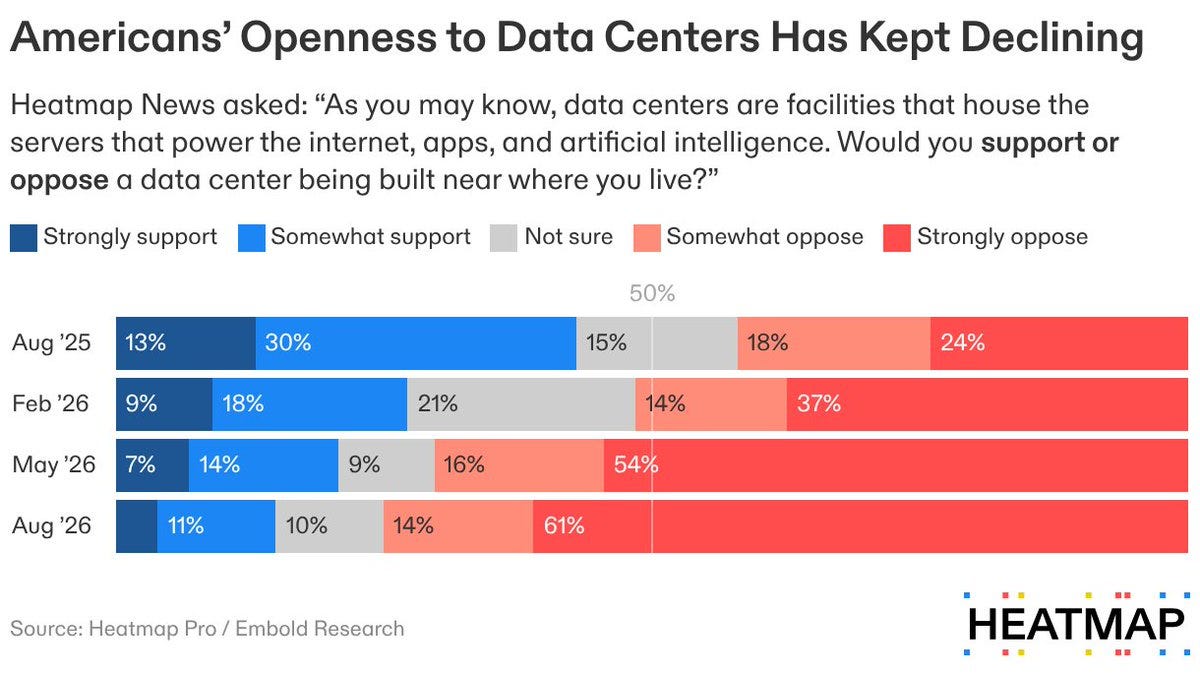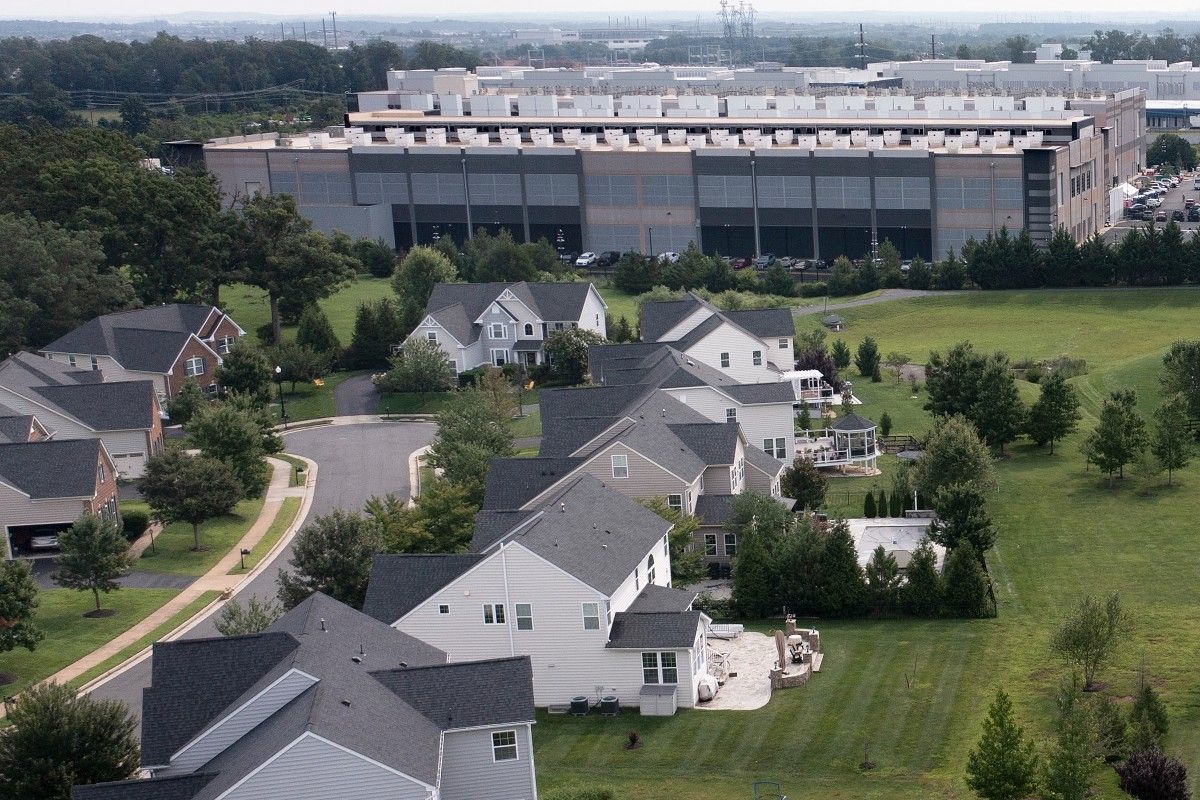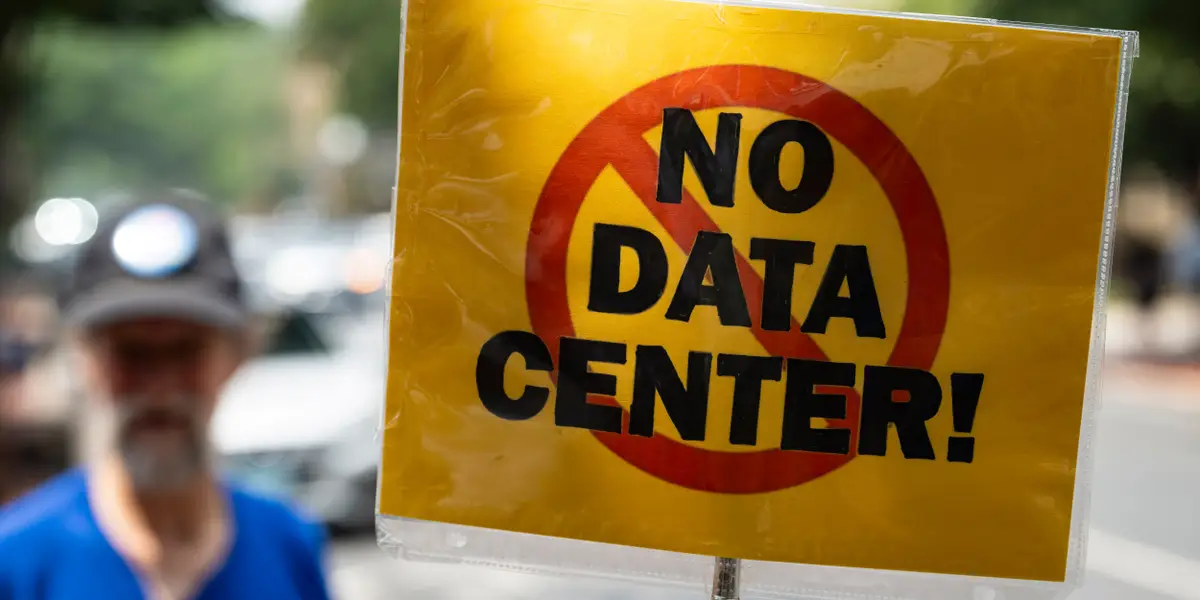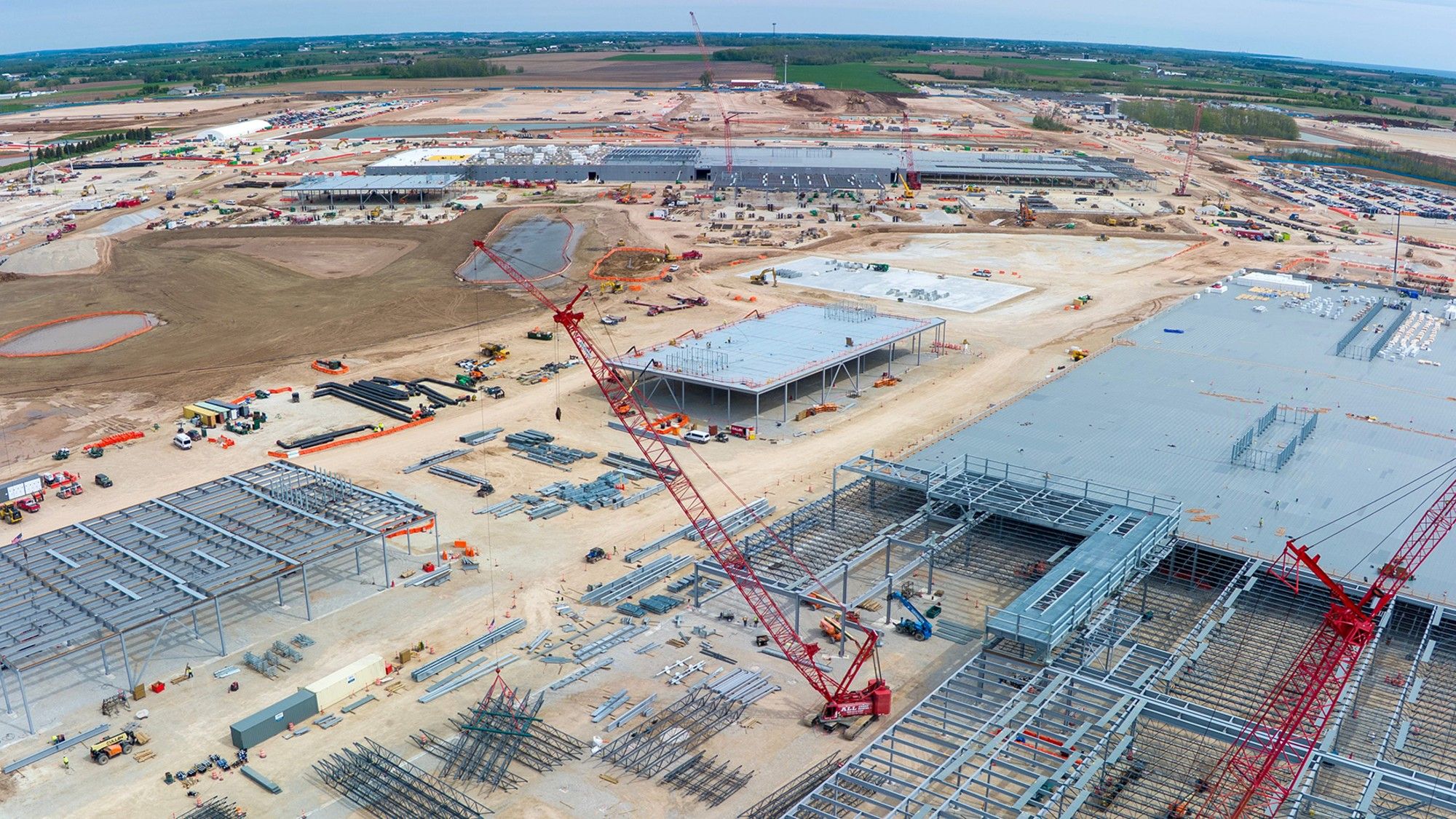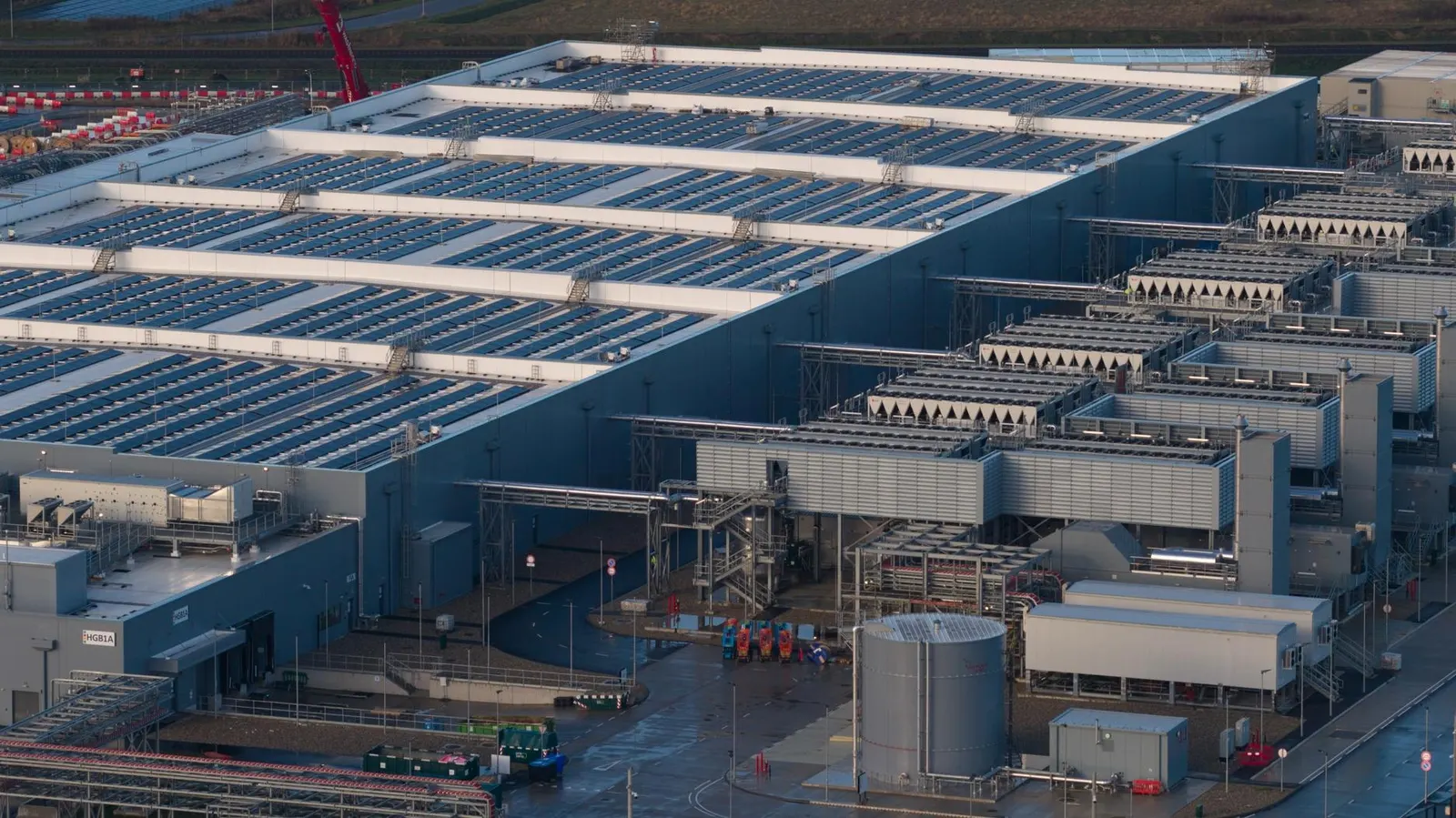
A certain segment of American elites has recently realized that people don’t like AI, data centers, and the Silicon Valley oligarchy that is foisting these things upon this country.One of the many blinking red lights for the AI industry came in the form of a Gallup survey in May. It found that a whopping 71 percent of Americans oppose the construction of new data centers in their communities to support the AI industry, with 48 percent of those polled saying they were strongly opposed. For comparison, Gallup noted that the peak opposition to nuclear power plants in one of its long-running surveys was only 63 percent. Heatmap’s Robinson Meyer reported earlier this month that his own outlet’s survey found an extraordinary depth and breadth to public opposition to AI data centers. “Data centers are 43 points underwater with Republicans, 65 points underwater with independents, and 75 points underwater with Democrats,” he wrote. “Notably, local data centers are 63 points underwater with rural voters, a group that has skewed more Republican over the past decade.” In an age of hyperpartisanship, there’s something almost comforting about how many people, from all walks of life hate AI.This opposition has translated into electoral blowback for AI companies and data center proponents. In Utah, longtime state senate president J. Stuart Adams lost his seat in a Republican primary in June over local opposition to a planned sprawling complex that would’ve transformed 40,000 acres in a rural county into the nation’s largest data center. Residents in Virginia, the world’s largest hub of data center infrastructure, and nearby Maryland have also ousted local officials over their support for the proposals.Leaders in blue, purple, and red states are now scrambling to impose moratoriums and audits on future construction. Multiple state legislatures are considering bills that would repeal lucrative tax exemptions. Members of Congress have proposed a wave of new bills to halt data center construction, impose new environmental and energy restrictions on them, and/or tax them to offset the harms they represent.AI’s problem is threefold. First, it is a fundamentally harmful product for American society. Second, it has been relentlessly marketed over the last few years as a fundamentally harmful product for society. Third, the AI industry’s grip on the economy and our nation’s politics is fairly brittle—at least for now.We’ll start with the harms. The biggest one is jobs. Roughly 340 million people live in the United States. About 210 million of them working-age adults. They need employment to provide food, housing, transportation, and all the other necessities of life, both for themselves and the 72 million children they are raising. A further 75 million people depend on their payroll taxes to fund Social Security and to maintain the American economy, which keeps millions of Americans’ retirement portfolios from reaching zero.I point out the obvious here because, according to the AI barons, their product threatens to wipe out a huge portion of those jobs, and with it, a large portion of the real economy. Anthropic CEO Dario Amodei told Axios last year that AI could eliminate half of all entry-level white-collar jobs in the next five years and spike unemployment levels to as high as 20 percent. That rate would rival the worst of the Great Depression. “Most of them are unaware that this is about to happen,” he told the news outlet. “It sounds crazy, and people just don’t believe it.”Amodei now says he overstated the potential damage caused by AI, but he is far from alone. The dominant messaging from AI companies is that they will make large swaths of the American economy automated and their current workforces obsolete. Numerous companies have fired thousands of employees hoping that AI could pick up the slack—or disguising layoffs by blaming AI—while applying for jobs is now a Kafkaesque nightmare. AI’s ultimate purpose is to create a world without labor costs—salaries, health insurance, paid time off, and so on—without really caring what happens to labor itself along the way. As The New Republic contributor Brian T. O’Connor noted back in June, certain CEOs have turned the layoff process into a reason for braggadocio—the better to demonstrate to investors that they’re only too eager to replace their workforce with AI.Some AI proponents, like xAI’s Elon Musk and OpenAI’s Sam Altman, have suggested from time to time that universal basic income could offset these problems. Even if that were true, they have also taken practically zero steps to make it happen. (Musk, for his part, has argued vociferously against a social-safety net since his far-right turn over the last decade.) Instead these tech barons have put tremendous resources into building their own personal compounds designed to keep out angry mobs and ride out a potential societal collapse. AI could allow rogue scientists to generate lethal super-viruses. It could hack into companies, banks, and governments to steal your personal and financial information. (An OpenAI test model, in fact, hacked a rival company’s servers just a few weeks ago.) It could wage cyberwarfare against national infrastructure without hesitation or conscience. It could wage actual wars by operating fleets of armed drones, as we’ve seen in the war between Russia and Ukraine. It could enable dystopian levels of government surveillance, as seen by the parallel ongoing backlash against Flock cameras.All of this is before I get to what AI is actually used for. What it really allows is fabrication, in the sense that people can do or make fake things. AI encourages a society where people lie about their own capabilities. It can simulate knowledge and intelligence without any of the thought or effort that make it possible. At worst, it offloads a person’s mental capabilities and may ultimately diminish them, causing “cognitive atrophy.” Schools and universities are confronting an epidemic of AI-driven cheating and plagiarism by students, harming their long-term educational performance. In short, AI appears to be making people dumber and less trustworthy.AI companies know this and don’t care. Google briefly allowed people to use AI to generate false images on Google Maps earlier this summer, including scenes of destruction of major landmarks. I cannot possibly imagine a good use for this; tech companies are just releasing products into the wild to see what happens at this point. Elon Musk’s xAI company is suing the state of Minnesota to challenge its anti-deepfake law, arguing that it has a First Amendment right to algorithically generate fake nude images of real people without their consent. (Imagine explaining that sentence to James Madison.) The Trump Justice Department is supporting them in federal court.There is no real social value or moral justification for using AI. Some proponents now claim that it could be used to invent new medicines or diagnose illnesses more quickly, hoping that this would blind us to the deeper harms. More troubling is how aggressively AI proponents actively praise its harms. It’s as if the good people at Phillip Morris and R.J. Reynolds wouldn’t shut up about how much their cigarettes cause cancer or bragged about how much secondhand smoke they produced.Silicon Valley used to be good at designing and marketing products that people want to use. Now it is almost cartoonishly bad at it. An insulated coterie of Bay Area venture capitalists and CEOs appear largely detached from what ordinary people want and need.Earlier this month, ChatGPT CEO Sam Altman offered what he thought was a fun use-case for his company’s product. “Cool use case of chatgpt work I heard last night: connect your family calendars and explain your kids’ interests,” he wrote. “Every morning for the drive to school, have it make a podcast that talks about one kid’s soccer game that afternoon, one kid’s upcoming birthday, some news, etc.”Twitter’s reaction was sharply negative, as best summarized by a response from Gravity Falls creator Alex Hirsch: “What if you just talked to your children?” Some AI enthusiasts and proponents seem eager to replace vital aspects of the human experience with soulless, heartless computer interactions. Many Americans are so far unwilling to do so.Back in 2023, Silicon Valley investor Marc Andreessen wrote an essay titled “Why AI Will Save the World.” His eagerness to promote AI as a public good is unsurprising since his venture-capital firm is intertwined with so many AI startups that the Justice Department has reportedly opened an antitrust investigation into it. I wrote about his essay-slash-manifesto a few years ago in the context of our Second Gilded Age, in which Andreessen plays a central role.In the essay, Andreessen asked readers to consider “what it would mean for literally all existing human labor to be replaced by machines.” He argued that it would lead to an “absolutely stratospheric” increase in “economic productivity growth,” one where “prices of existing goods and services would drop across the board to virtually zero” and “consumer spending power would skyrocket.” I am unsure how an economic system can have all three things of those things at the same time.To usher in this imminent utopian age, Andreessen said, Americans need only let his AI companies do whatever they want as long as it didn’t threaten other AI companies and their investors. “Big AI companies should be allowed to build AI as fast and aggressively as they can—but not allowed to achieve regulatory capture, not allowed to establish a government-protect[ed] cartel that is insulated from market competition due to incorrect claims of AI risk,” he argued. And if you don’t, he said, China will win the AI race instead, injecting a little bit of nationalistic fervor into the mix. Meta’s Mark Zuckerberg published his own AI manifesto earlier this month that was, to his credit, slightly more down-to-earth. He emphasized the widespread value of agentic AI, where each person would have an “exceptionally capable personal agent that understands your goals, and everything you care about,” all through a Meta-equipped device. This agent would “work 24/7 on your behalf to improve your relationships, health, career, finances, home management, hobbies, and more. It will free up time for the things you enjoy, and help you accomplish more than you could otherwise.”That doesn’t sound so bad, right? One problem is that there isn’t really a need for it beyond mere convenience. I am skeptical that the AI industry has spent trillions of dollars to help me figure out who the Los Angeles Dodgers are playing this week or when my wife gets home from work, especially when Silicon Valley’s existing products already help me with those tasks. I’m sure there are some people who would enjoy that. No doubt a few of them will email me about it after this is published. But it seems like an extraordinary gamble to assume there will be a critical mass of users willing to pay for it, and insufficient to justify the knock-on harms that AI will also bring.All of those manifestos may sound good to Silicon Valley venture capitalists but hold little water for anyone else. For the average American, AI destroys far more than it creates. Most Americans can’t do much about LLM model guardrails or Silicon Valley capital allocation, but they can do something about data centers. The physical incarnation of our prophecied digital overlords are the soft underbelly of Silicon Valley’s dominant business model.Data centers by themselves do not create many jobs. Constructing them does create growth in construction sectors while they are built, of course, but they do not produce lasting economic benefits for a community. AI proponents tend to obscure this by lumping together the short-term construction work needed to build them and the permanent staff needed to maintain them. The Wall Street Journal reported last year that an OpenAI facility in Abilene, Texas, employed about 1,500 people to build it and will only need about 100 employees to operate it.Another perennial concern is the energy cost of running a data center. Many Americans now associate them with rising utilities costs. New York Governor Kathy Hochul announced the nation’s first statewide moratorium on data centers partially in response to concerns about the impact on electricity and water resources for New Yorkers. “As data center development threatens to hike up utility bills, deplete our natural resources, and create uncertainty for New Yorkers, it’s my responsibility to take action and lead,” she said in a statement.So too did Texas Governor Greg Abbott, whose state has a separate electrical grid from the rest of the nation. His office revealed earlier this month that ERCOT, the state grid operator, was considering “approximately over 474 gigawatts of requests to connect to the Texas grid,” which alone represents more than five times the state’s record for peak electricity demand. About 90 percent of that energy would go to planned data-center projects, the governor’s office said.Tech companies have tried to allay these concerns by building on-site power generation as well. In theory, this should be a win-win: Data centers get the power they need without driving up costs for nearby residents, while operators can theoretically shunt the excess load into the grid and lower costs all around. But this has only created other problems: Many data centers, especially in red states, have opted to quickly build gas plants to provide those power needs.A report by InsideClimateNews earlier this week estimated that roughly a dozen gas plants in the planning stages for data centers in Texas would emit more than 100 million tons of carbon emissions every year, which the outlet compared to the annual emissions of a “mid-sized industrialized country.” This problem is not exclusive to Texas, either: The Guardian recently reported that two planned data centers in central England would produce more carbon emissions than ExxonMobil. Even if the AI doomers are wrong about its apocalyptic capabilities, the infrastructure behind AI might make it impossible to stave off the worst effects of climate change.The Trump administration also plans to make it harder for Americans to learn about and respond to the impact of these plants on their local communities. Earlier this week, the Environmental Protection Agency reportedly moved to scrap a federal rule that requires states to announce and receive public feedback on air-pollution permit applications for data centers and their power plants. This would make it much harder for communities to challenge the construction of plants that would release hazardous chemicals into the air, with a host of downstream health effects for residents.Tradeoffs are common when talking about modern industry, and we often accept them if only on a subconscious level. Abolishing oil and gas consumption would solve climate change overnight while also collapsing our civilization. With AI, any benefits for the average American are marginal at best, while the immense personal and societal costs are immediate and increasingly visible.The data-center backlash, which The New Republic contributor J.J. Anselmi explored in interviews with people across several states who have have had their lives upended by these projects, has helped expose just how fragile the pro-AI coalition currently is. For one thing, AI’s small personnel footprint also shrinks its power as a political constituency. It is easy for elected officials to turn against AI when so few of their voters are employed by the industry or benefit from its existence. Widespread adoption of AI has also been largely involuntary, meaning there is a limited groundswell of genuine users to champion it. Were it not for our largely deregulated campaign-finance system, the AI industry would likely be in far greater peril than it currently is.Silicon Valley’s top leaders also made a disastrous choice two years ago by throwing in their lot with President Donald Trump. There may have received some immediate benefits from this alliance in the form of deregulation and federal funding. The long-term costs of the association will likely be far greater. Linking the industry with the most divisive figure in American public life, one whose majority-level public support after the 2024 election eroded almost immediately. Ironically, his illegal war against Iran also caused an energy price shock that many red-state Americans are probably more willing to blame on AI data centers than Trump’s Middle East mistakes.If there is one thing to take heart from, it is that the AI backlash exists at all. After the 2024 election, there was a palpable sense in elite tech circles that they had somehow permanently solved politics—that their newfound alliance with the MAGA movement would supercharge a new golden age for the American tech industry, making all of them important and influential and fabulously wealthy. What they are experiencing now is a blunt, painful reminder that 340 million other people live in this country with the oligarchs, and they still get a say in how things work for now.
The Data Center Backlash Is a Rare Bright Spot in American Politics
The AI industry gleefully sold its products as harmful to the interests of ordinary people. Thankfully, ordinary people decided that there would be consequences for that.
2,766 words~13 min read