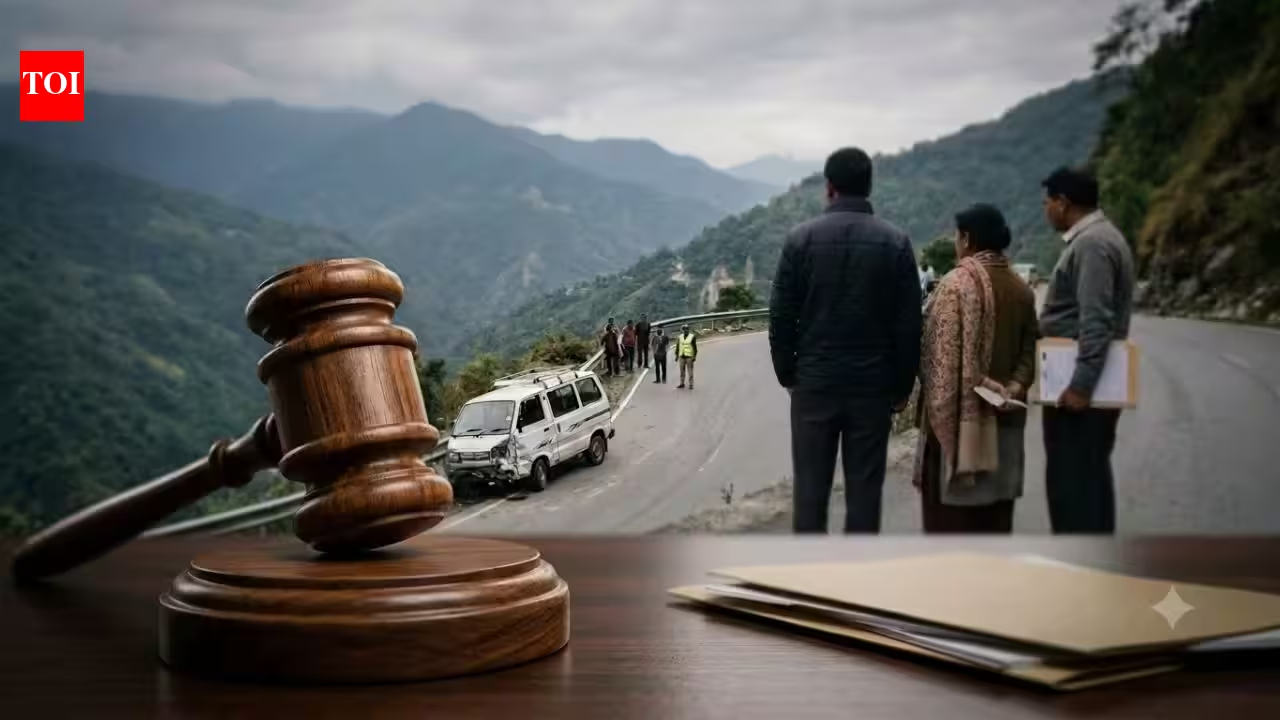
AI generated image used for representative purposeNEW DELHI: The Sikkim high court has upheld an award of Rs 85.59 lakh to three siblings who claimed compensation after their sister-in-law and her husband and two children died in a road accident in Sikkim. The court rejected the insurer's argument that the siblings were not financially dependent on their sister-in-law and said dependency has to be decided on the facts and evidence of each case. The judgment was pronounced on August 10, 2026.Why did the insurance company challenge the compensation?According to the court order, Toran Suresh Punamiya, her husband Suresh Punamiya and their two minor children were tourists from Maharashtra visiting Sikkim. They had hired a vehicle insured by National Insurance Company. While travelling to Lachung in North Sikkim, the vehicle fell around 700 feet off a cliff, killing all four instantly.Toran's three siblings-in-law — Hasmukh Pannalal Punamiya, Mahipal Pannalal Punamiya and Chitralekha Jitendra Jain — sought compensation as her dependents. The claimants had also separately been awarded compensation over the deaths of Toran's husband and their two children; that award is currently under challenge before the Supreme Court.The Motor Accident Claims Tribunal, Gangtok, directed the insurer to pay Rs 85,59,880 with 6 percent annual interest. The insurance company challenged the award before the high court.The insurer argued that the claimants were adults, had their own sources of income and were not financially dependent on Toran. It also said the claimants had inherited the business run by Toran and her husband, meaning there was no actual loss of dependency.Can siblings-in-law claim compensation as dependents?Chief Justice A. Muhamed Mustaque said a person claiming compensation under Section 166 of the Motor Vehicles Act does not necessarily have to be a legal heir. A legal representative can also maintain such a claim.The court said the real question was whether the three claimants were financially dependent on Toran."There is no hard and fast rule for defining the expression 'dependent'. Dependency is essentially a question of fact and must be determined based on the evidence available in each case," the court observed.The court also noted that the claimants had specifically stated that they depended on the income from the business run by Toran and her husband. They had also produced Toran's income-tax returns showing that the business was the family's source of income.The insurer, however, did not produce evidence showing that the claimants had independent sources of income or that they had continued running the business after Toran's death."In the absence of such rebuttal evidence, the Court will have to incline towards accepting the plea of dependency, particularly in view of the evidence that the business was being conducted by the deceased and her husband for the benefit of the joint family," it further observed.The Chief Justice then considered another issue because Toran, her husband and their two children had died in the same accident. It referred to Section 21 of the Hindu Succession Act, under which the younger person is presumed to have survived the older person when it is not possible to determine who died first. The court said this could mean that Toran's children inherited her rights before they too died, after which those rights could pass to the three claimants."Presumption in cases of simultaneous deaths.— Where two persons have died in circumstances rendering it uncertain whether either of them, and if so which, survived the other, then for all purposes affecting succession to property, it shall be presumed, until the contrary is proved, that the younger survived the elder," the court said."Applying the statutory presumption contained in Section 21 of the Hindu Succession Act, if the deceased mother is presumed to have predeceased her children, the children would have become entitled to succeed to her estate, including any claim arising out of her death. Since the children also lost their lives in the same accident, and are presumed to have survived the deceased mother, they would, in turn, have been entitled to claim compensation arising from her death. Upon their subsequent demise, the Claimants, being their natural legal heirs under the applicable provisions of the Hindu Succession Act, would have succeeded to their estate," it further added.The court said that even if the insurer's argument about dependency were accepted, the claimants could potentially have inherited the right to claim compensation through the deceased children.It ultimately found no reason to interfere with the tribunal's award.The high court dismissed the insurance company's appeal and upheld the compensation of Rs 85,59,880, with 6 percent annual interest from the date of filing of the claim petition.
Can siblings-in-law seek accident compensation? Sikkim HC upholds Rs 85 lakh award
NEW DELHI: The Sikkim high court has upheld an award of Rs 85.59 lakh to three siblings who claimed compensation after their sister-in-law and her husband and two children died in a road accident in Sikkim. The court rejected the insurer's argument that the siblings were not financially dependent on their sister-in-law and said dependency has to be decided on the facts and evidence of each case.
759 words~3 min read