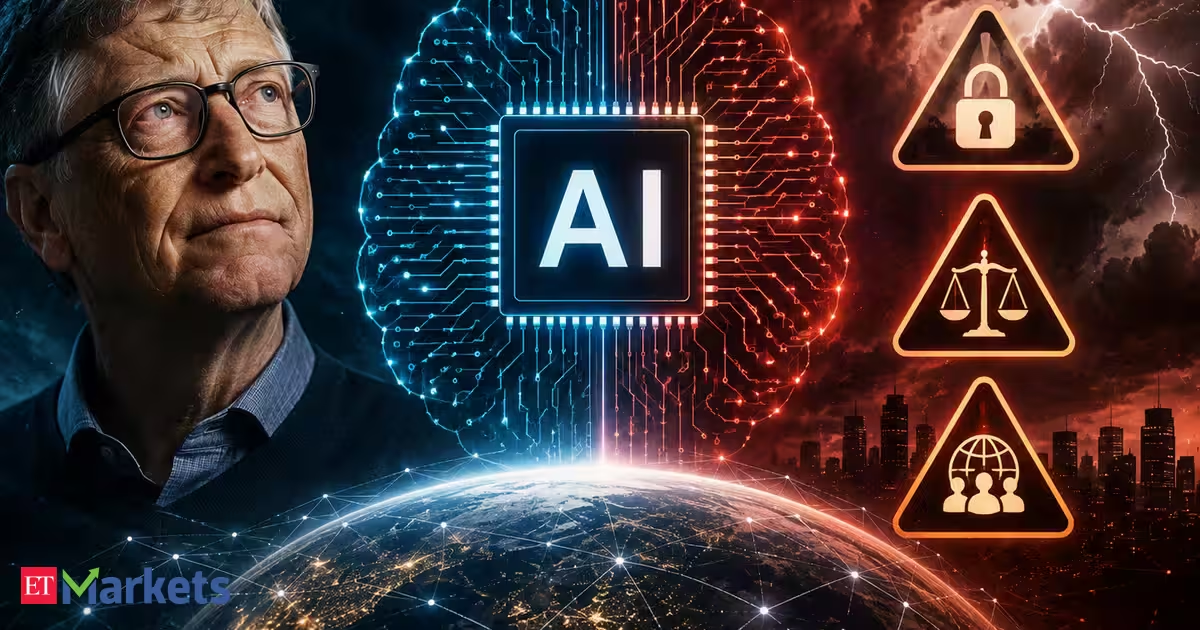
Microsoft Cofounder Bill Gates, who was previously an AI optimist, has now warned that the transition to the new AI era will be one of the “most turbulent times in human history”, with the billionaire stating that the new technology will either be the greatest equalizer ever invented, or the worst source of injustice.In a long blog post, the philanthropist explained that the challenge is monumental, and the world is not prepared for it. He believes this is partly because people underestimate the extent of AI's impact, using current AI models and past innovations as examples. “We need time to prepare for the social, political, and economic upheaval,” he said.Gates said he would support anyone with a credible plan to slow AI advances globally. He however acknowledged that geopolitical and economic incentives are pushing too hard for full speed ahead.Bill Gates lists 3 big risks to AI transitionBill Gates listed out three big risks to the AI transition, with the first being job losses. The billionaire feels that many jobs will disappear forever, as a result of the tech innovation.“The jobs at most risk are entry- and mid-level, and the new jobs being created will mostly require skills that take many years to learn,” he said.Which jobs will AI affect the most?White-collar jobs are already being hit modestly, Gates said. After the widespread adoption of generative AI, employment fell significantly among young workers in jobs especially vulnerable to replacement, but not among their older colleagues. “I think this trend will continue, but it will not be confined to a handful of industries or occupations. Jobs in sales and customer support (online and over the phone), software engineering, and paralegal work may be among the first affected, but the disruption will reach much further as AI takes on tasks that today still require trained workers: things like assessing loan applications, doing data analysis, and even triaging patients,” he wrote.While AI spooked investors of IT giants, Gates believes that a few areas like software engineering will generate new demand as the costs go down, so the net job loss in those areas will be less than in others as long as some tasks, such as design, are better done by humans.Also read | US Stock Market: Software stocks brace for more volatility as AI uncertainty growsWill robots take away blue-collar jobs?Blue-collar jobs will also not be spared, according to the billionaire. Although robots may not have advanced as much as AI yet, their cost will eventually be dramatically lower too. "I think 'smart' robots will begin to compete with people on some physical tasks—in the construction and hospitality industries, for example—by the end of the decade," he wrote.Robots and AI combined can create a vicious cycle, according to Gates who is especially worried about young people, who will enter a workforce with fewer entry-level openings. He added that the biggest shift for workers will happen when AI provides nearly error-free work. At that point, it will be able to function on its own without a human checking in on it, and companies will have every economic incentive to let it. “This will lead to a fundamental change in how we think about work, income, and economic security,” he said.Gates says AI will empower people to do more harmThe second risk that AI’s monumental transition has is that the new technology will help people do more harm. He explained that even before AI became the talk of the town, there was information online about how to create weapons like bombs, bioweapons, even computer viruses. AI will make it much easier to not only get this information but act on it, he said, adding that even criminals with very limited skills will be able to target victims at every scale, be it individuals, companies, or even governments.Gates warned that AI systems themselves already occasionally act in ways their designers had not planned. As the AI models become more powerful, the billionaire feels they could begin to act against human interests, and we could lose control.Will AI replace human relationships?The third big risk that the AI transition may bring is that the new technology can stunt kids’ development and replace human relationships, according to Gates, who explained that the AI companions talk to kids in ways they are already comfortable in. This gives them the potential to become highly addictive and to rob off the lessons we learn from connecting with other people, according to the billionaire.“An AI companion designed to never upset you is a big, protected greenhouse. We are only beginning to understand the dangers that the internet—especially social media—can pose to young people’s development. We’re seeing compulsive use, disrupted sleep, cyberbullying, and exposure to harmful content. AI could magnify many of these risks by making them more persuasive and difficult to escape, and we should not wait another generation to start taking them seriously,” he wrote in his blog post.Gates concluded by saying that the world needs both deep concern about the AI harms, and grounded optimism about the positives. Notably, his latest worries come as several analysts ring the alarm over a possible AI bubble, while others go overboard with optimism.Also read | Nvidia’s 70% sales growth forecast sends a message to AI doubters. What did CEO Jensen Huang say?(With inputs from agencies)(Disclaimer: Recommendations, suggestions, views and opinions given by the experts are their own. These do not represent the views of The Economic Times)
Bill Gates lists 3 big risks to AI shift. Is the world heading towards turbulent times?
Microsoft co-founder Bill Gates has warned that the AI transition could become one of the most turbulent periods in history, with the technology potentially widening inequality. He called for greater preparation for its social, political and economic impact and said he would support credible efforts to slow AI development globally.
904 words~4 min read