The whole world calls them mutual funds, except the UK and some other Commonwealth countries, which call them unit trusts.Here, from the days when Di Turpin ran the industry body 20-plus years ago, we have been supposed to call them by the clunky name “collective investment schemes”. Just as about 30 years ago we were supposed to start calling banks deposit-taking institutions.Whatever you want to call them, unit trusts are a huge industry. On June 30, the halfway point of 2026, mutual funds had R4.6-trillion in assets, about R1-trillion more than the total assets run by the state-owned Public Investment Corporation.Sunette Mulder, now portentously known as the “chief of staff” of the Association for Savings & Investment South Africa (Asisa), says it was a tale of two quarters, with a decline in assets in the March quarter. But there was growth in assets in the June quarter despite the headwinds of a weak equity market and the Iran war.Mulder says local investors were “surprisingly undeterred” by market volatility. Are we starting to take a long-term approach to investing in Mzansi at last?There were inflows of R63.6bn into unit trusts in the second quarter, but these numbers are padded out. Only R30.4bn is what you and I would call inflows; that is to say, new investments. The rest are reinvested income declarations (dividends and interest), which contributed R33.2bn.But most of us make the decision upfront to reinvest the income, especially in a tax-protected vehicle such as a retirement annuity and living annuity, where the income is untaxed until there’s a withdrawal.Taking the 12 months Mulder (or do I mean Scully?) says there were total net inflows for the 12 months to June of a respectable R227bn, though 60% of this was R135bn in reinvestments, so, not strictly speaking, “inflows”. And this was split between a mind-numbing 1,945 rand denominated unit trusts.I am glad to see that balanced or multi-asset funds are the lifeblood of the industry. For years, when Turpin and then Leon Campher were the industry czars, the message was “invest in the JSE come hell or high water”.South African shares — whatever siren voices such as Magnus Heystek might claim — have been the best investment in the long term. Better even than global shares, according to research by Nedgroup Investments.Mulder says multi-asset funds are designed to offer investors single diversified portfolios aimed at absorbing the highs and lows of the equity and bond markets. They provide shock absorbers for investors who don’t have the appetite, or time, for sudden market losses.It’s quite a complicated process, as the days in which balanced funds all had a 65%-75% exposure to the JSE are long gone. There are now no fewer than eight categories. In descending order from the riskiest, they are Flexible, High Equity, SA High Equity, Medium Equity, Low Equity, Income, SA Income and Unclassified. Probably best to avoid the Unclassified.South African multi-asset portfolios attracted R138bn of the R227bn in net inflows for the 12 months to June. In the second quarter alone these portfolios attracted R39bn in net inflows. But the name “South African” is misleading. These funds can still invest in rand-hedge shares on the JSE, such as Naspers, Canal Plus, BHP and AB InBev.South African multi-asset high-equity portfolios — what you and I call “balanced funds” — attracted the bulk of the net inflows over the 12 months, at R53.3bn.The South African multi-asset income portfolios got R51.7bn. I didn’t take much notice of this sector until I set up my living annuity. They are perfectly suited for investors who need dependable, regular income.General equity, which used to be the heart and soul of the unit trust sector, isn’t entirely neglected. There was a modest R5bn inflow into general equity portfolios. But this was the first net inflow for general equity portfolios after three months of outflows.Multi-asset funds make up 51% of assets under management in South African portfolios. Cash and bond funds, or as they are clunkily named, South African interest-bearing portfolios, held 29% of assets. SA Equity funds have been steady at 19%, and SA Real Estate portfolios, which have been out of fashion for some time, make up just 1%.Asisa also oversees the legally registered foreign portfolio, known as Section 65 funds. These grew assets under management to R1.2-trillion over the 12 months to June 30. This was a year after breaking through the R1-trillion threshold around June 2025.There were outflows of R5.6bn from these funds in the June quarter after attracting net inflows of R2.7bn in the first quarter of 2026. The net inflows since July 1, 2025, have been R19.5bn.These funds are denominated in foreign currencies, predominantly dollars but also sterling, euros and occasionally yen or Australian dollars. Often they are offered by foreign unit trust companies that don’t always have strong brand recognition in South Africa. Exceptions would be the likes of Schroders, JP Morgan, Morgan Stanley and Franklin Templeton.Investors might get some comfort as these funds can only be actively marketed in Mzansi if they’re registered with the Financial Sector Conduct Authority. There is quite a bewildering array of funds to choose from — 813 foreign currency-denominated funds are on sale here.This helps explain why self-directed investors usually prefer the simplicity of choosing an index tracker in a convenient exchange-traded fund wrapper.• Cranston, a veteran financial journalist, is the author of ‘The Mavericks’, a new book about South African fund management.Business Day
STEPHEN CRANSTON | Balanced funds lead as general equity rebounds
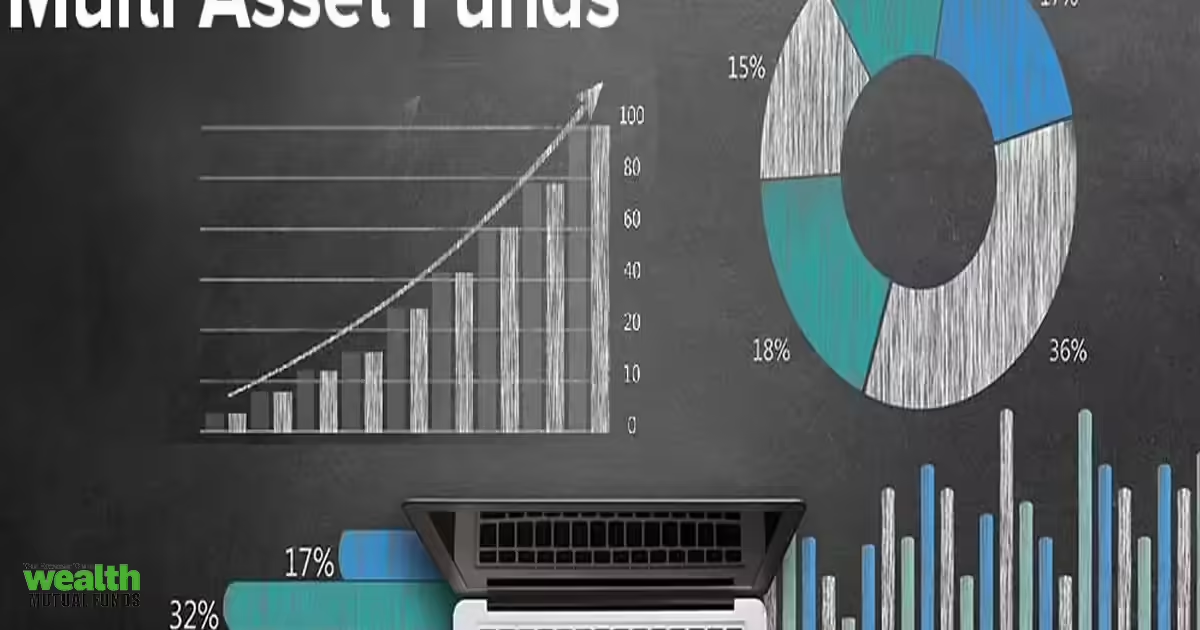
Multi-asset funds absorb market shocks as local investors show resilience
902 words~4 min read