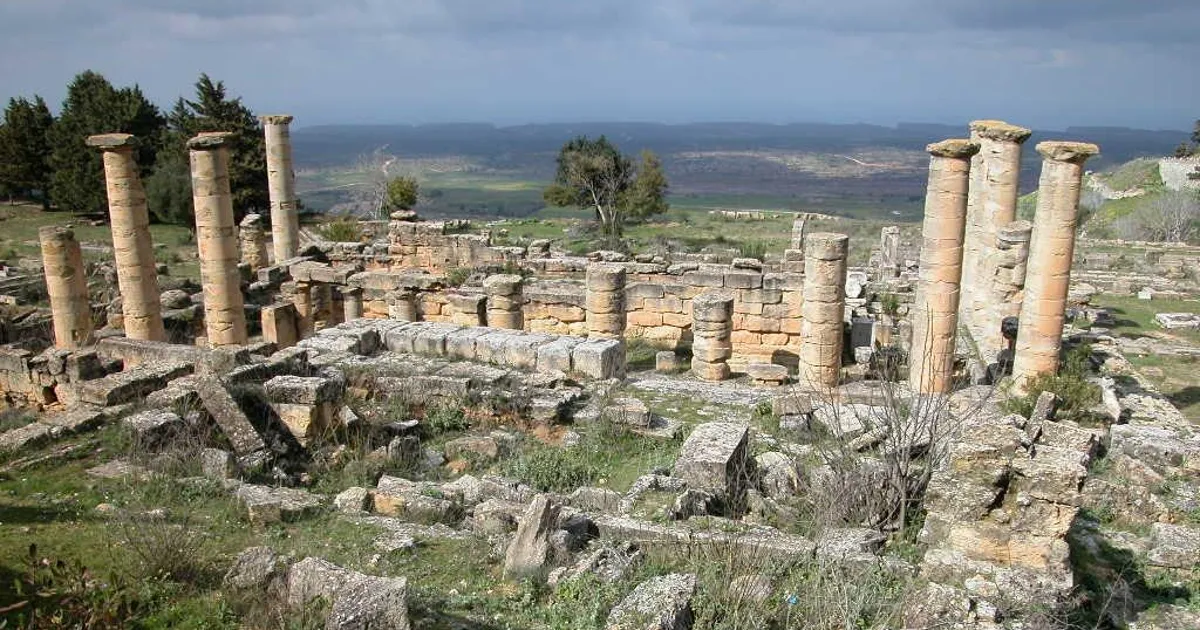
Current sectionArchaeologyBetween the First and Second known revolts against Rome was another, by Jews outside Israel. Few sources survive but those that do describe the horror, on the Roman sideShare to FacebookShare to XArticle printing is available to subscribers onlyPrint in a simple, ad-free formatSubscribeComments: Zen reading is available to subscribers onlyAd-free and in a comfortable reading formatSubscribeArchaeological site of Cyrene (Libya) Credit: Giovanni Boccardi / UNESCOArchaeological site of Cyrene (Libya) Credit: Giovanni Boccardi / UNESCO10:16 PM • August 26 2026 IDTTwo Jewish revolts against Rome have a firm place in Jewish memory. The first is the Great Revolt of 66 C.E., which ended with the destruction of the Temple in Jerusalem and was written up, at great length and not always modestly, by the Jewish-cum-Roman historian Josephus. The second is the Bar Kokhba revolt of 132 C.E., which left behind caves full of letters as well as coins minted by the Jewish leaders, Roman siege works, and rabbinic memories.But between them was another revolt. It was large, bloody and disastrous, but few have heard of it, mostly because almost no one wrote down what happened.Beginning in 115 or 116 C.E., while the Roman emperor Trajan was campaigning in the east against the Parthians, Jewish communities in Cyrene (in what is now eastern Libya), Egypt, Cyprus and Mesopotamia rose against Rome. These risings may have influenced one another; the evidence does not show whether they were centrally coordinated, or whether similar pressures produced similar explosions in several places. In any case, by 117 C.E., they had been crushed; also, Trajan died that year. Hadrian inherited an empire in which several of the largest and oldest Jewish communities outside Judea had been devastated.The difficulty in reconstructing the chain of events is that neither Josephus nor any rabbinic author left a narrative of this war, and nothing like a rebel manifesto, Alexandrian diary or speech by a Jewish leader has survived. This is inconvenient if we want to understand a war.The evidence, however, is not quite as meager as the revolt's obscurity suggests. When the historian Miriam Pucci Ben Zeev assembled it in a 2005 catalogue, she gathered 86 separate testimonies: inscriptions, papyri and texts from pagan, Christian and rabbinic sources. That sounds plentiful until we begin to read them. Many of the items she cites are only a line or two, and very few narrate events. That said, the reconstruction depends mainly on six bodies of evidence: Cassius Dio, Eusebius, Appian, Egyptian papyri, Cyrenaican inscriptions and rabbinic references.'Pompey's Pillar' of ancient Alexandria, abutting the modern city Credit: Hatem Moushir'Pompey's Pillar' of ancient Alexandria, abutting the modern city Credit: Hatem MoushirThree hostile sentencesThe most famous ancient account of the revolt is also one of the shortest. Cassius Dio, a Greek senator writing a history of Rome in the early third century C.E., gives it three sentences. Even those sentences reach us indirectly, through an abridgment of Dio's lost books made in the 11th century by the Byzantine monk Xiphilinus. The rebels themselves do not get a speaking part.According to Dio, the Jews of Cyrene put a man named Andreas at their head and attacked Romans and Greeks. He accuses them of cannibalism, skinning victims and other horrors. In Egypt, he says, they committed similar outrages. In Cyprus, under a leader named Artemion, another massacre took place, after which, Dio adds, no Jew was allowed to set foot on the island, and even a shipwrecked Jew would be killed.Dio's numbers are enormous: 220,000 dead in Cyrene and 240,000 in Cyprus, but they are almost certainly not literal counts. Ancient historians often used round casualty figures to convey scale and horror, and the atrocity catalogue has parallels in older Greek and Roman writing about rebels and enemies. William Horbury, the Cambridge scholar whose "Jewish War under Trajan and Hadrian" is the fullest recent account of the revolt, treats Dio's passage as a formulaic description of a rebel community's crimes; at most, he writes, it confirms the merciless character of the conflict and the fear around it.Still, Dio preserves three names: Andreas, Artemion and Lusius. Lusius, at least, appears elsewhere too, attached to a Roman general really sent against the Jews.Roman theater in Alexandria Credit: Gérard Ducher / NéfermaâtRoman theater in Alexandria Credit: Gérard Ducher / NéfermaâtA paragraph of church historyThe Christian historian Eusebius of Caesarea, writing his "Ecclesiastical History" around 325 C.E., gives the revolt a whole chapter, though a short one. He places it in the 18th year of Trajan's reign, 115 to 116 C.E., and describes "another disturbance of the Jews," in which a great multitude perished.Eusebius supplies details absent from Dio. The leader of the Cyrenian Jews he calls Loukouas, not Andreas, and scholars often take the two names to refer to the same man, though the relationship between them is not clear. He also names the Roman generals. Marcius Turbo was sent against the Jewish uprising in Egypt with infantry, cavalry and a fleet, killing many thousands of Jews. Lusius Quietus was sent against the Jews of Mesopotamia and was rewarded afterward with the governorship of Judea, which tells us what kind of work the Romans thought he had done.Eusebius calls Loukouas the rebels' "king." E. Mary Smallwood, in her standard history "The Jews under Roman Rule," saw that title as highly significant and probably messianic, a sign that a local Jewish-Greek conflict had become a war against Rome itself. Pucci Ben Zeev is more cautious. Unfortunately, Eusebius does not explain what he means by "king," and the word may not bear all the weight later historians would like to put on it.Statue of Trajan Credit: Hartmann Linge / Wikimedia CommonsStatue of Trajan Credit: Hartmann Linge / Wikimedia CommonsThe survivor was GreekAppian of Alexandria, a Greek historian, lived through the revolt in Egypt as a young man. Decades later, in a fragment preserved only because later writers quoted it, he recalled escaping by water. He got lost at night near Pelusium with an Arab guide, missed the boat he had meant to take, found another waterway at dawn and boarded a trireme. The boat he had missed was captured.This is the only surviving first-person literary account from the war. Appian offers no cause, chronology or Jewish testimony; his short recollection is valuable precisely because it preserves something so ordinary and immediate: a Greek Alexandrian, caught in the fighting, describing how narrowly he got away.Paperwork in the desertRegarding Egypt, the most important evidence is not literary at all. From the dry sands of Middle Egypt come Greek papyri from the years around 115-117 C.E. and the aftermath: tax records, family letters, property documents and official correspondence. Among them are papers from the archive of Apollonios, a Roman administrator in a district called the Heptakomia, whose family was caught up in the violence. His wife wrote to him after he suddenly departed into danger; he prepared for military service; and after the war he reported property damaged by Jewish attack.The Edfu material is especially suggestive. Jewish residents of Upper Egypt paid the special Jewish tax and received receipts. A run of these receipts survives year after year, then breaks off on May 18, 116 C.E. Later papyri record something different: revenues from land and houses that had belonged to Jews, apparently confiscated after the revolt and filed by Roman clerks under the "Ioudaikos" logos, the "Jewish account."That is what catastrophe looks like when it reaches the filing cabinet.'Destroyed and burned in the Jewish tumult'Along the coast of Cyrenaica, inscriptions from Hadrian's reign record the rebuilding of roads, baths and public buildings damaged in the revolt. Several use a Latin formula: refecit quae tumultu Iudaico diruta et exusta erant - he restored what had been destroyed and burned down in the Jewish tumult.The inscriptions name roads, baths, the temple of Hecate, the temple of Apollo and the Caesareum. They were set up by Hadrian's governors over a period of years, which means the rebuilding took years, which in turn means the damage was extensive. Dio's atrocities are a literary form. The rebuilding was a line in a provincial budget.Hadrian inscription at the thermae of Cyrene Credit: Klaus-NorbertHadrian inscription at the thermae of Cyrene Credit: Klaus-NorbertThe war of QuietusThe Jewish evidence is both later and more broken. The Mishnah, the rabbinic law code edited around 200 C.E., lists three wars in sequence and the decrees associated with them. The second is Pulmus shel Kitos, the war of Kitos, during which the sages banned brides' crowns and teaching one's son Greek (Sotah 9:14).The standard printed editions of the Mishnah read "Titus," as does the parallel in the Tosefta. But when we look at the ancient manuscripts of the Mishnah, the Kaufmann and Cambridge manuscripts, which are the two of the best witnesses to the Mishnah's original text, they say "Qitem," and some Genizah fragments read "Qites." These indicate that the original text did not say Titus but Lusius Quietus, the Roman general named by Dio and Eusebius. In the Mishnah, the revolt is a chronological marker rather than a story. Megillat Taanit, the ancient Aramaic scroll of festivals, lists the twelfth of Adar as Yom Turyanus, often connected with Trajan. The Babylonian Talmud later attached to the date a story about two brothers, Lulianus and Pappus, executed at Laodicea under Trajan, though the narrative is tangled enough that it may combine memories from more than one period.Later Palestinian rabbinic literature preserves legendary memories of catastrophe in Egypt, including the destruction of Alexandria's great synagogue and a massacre counted, as massacres in ancient literature often are, in enormous round numbers. Generations separate these traditions from the revolt, and their details are stylized, but they show that some memory of Trajanic repression of Jews in Egypt continued to circulate among the rabbis.From the Jewish communities that fought in Egypt, Cyrene, Cyprus and Mesopotamia, no continuous account survives. What the rabbinic tradition kept were names, decrees and legends; the rebels themselves left almost nothing in their own words.The silence of AlexandriaSet side by side, these sources show a revolt across the Greek-speaking diaspora, large enough to force Rome to divert generals from the Parthian war. The known leaders bore Greek names, as we would expect in Hellenized Jewish communities. By 117 C.E., the rising was over.They are least helpful on the question we most want answered: why did the Jews revolt? There is no secure evidence of coordination between the regions, though coordination cannot be ruled out, and no reliable statement of rebel aims. Messianic hope, local grievance, anti-Roman revolt, ethnic violence, panic and revenge may all have played a part in different places. We know what was destroyed. We do not know what they hoped to build.The largest consequence may have been in Alexandria. Before the revolt, the Jews of Alexandria formed one of the greatest Jewish communities in the world, larger than Jerusalem's, by some ancient estimates. For three centuries it had been a center of Greek-language Jewish writing and philosophy. Alexandria was where the Torah was first translated into Greek, the beginning of what became the Septuagint. It was the world of the Letter of Aristeas, Aristobulus and Philo.Jews did not completely disappear from Egypt after 117 C.E. The papyri show individual Jews again within a decade, scattered here and there across Egyptian towns, and there was probably even some Jewish remnant in Alexandria itself. But the great Greek-speaking Jewish civilization of Alexandria never did recover. What ended was not Jewish life in Egypt altogether, but a particular Jewish world: learned, Hellenized, scriptural and philosophical, confident enough to write Judaism in Greek and imagine that this was a perfectly reasonable thing to do.The people survived the war. The civilization that produced Philo of Alexandria never produced another Philo.In the NewsThe Forgotten Jewish Revolt That Erased a CivilizationSnakes on a Plate: Could Reptile Consumption Have Freed Us to Settle Down?A 1,600-year-old Village, a Dazzling Mosaic and a New Story of Ancient JudaismIslamic-era Industrial Complex in Central Israel Puzzles ArchaeologistsLoneliness Before Reddit: Ancient Rome Invented the Architecture of AlienationRemembering and rebuilding two years laterICYMIAn Israeli Startup Is Reinventing Salmon Farming. It May Upend a Global IndustryHasan Piker Talks Hamas, anti-Zionism and Why Americans Are Fed Up With IsraelBeing Israeli Abroad Has Become Embarrassing. You Don't Talk About ItDavid Remnick on Netanyahu, Mamdani and Israel's 'Failure to Face' GazaGermany Found Its Israeli Villain. Will It Continue to Ignore What Produced Him?Ben-Gvir's Ambush Shook Netanyahu – and Unleashed a War for Right-wing Votes
The forgotten Jewish revolt that erased a civilization
Between the First and Second known revolts against Rome was another, by Jews outside Israel. Few sources survive but those that do describe the horror, on the Roman side
2,074 words~9 min read