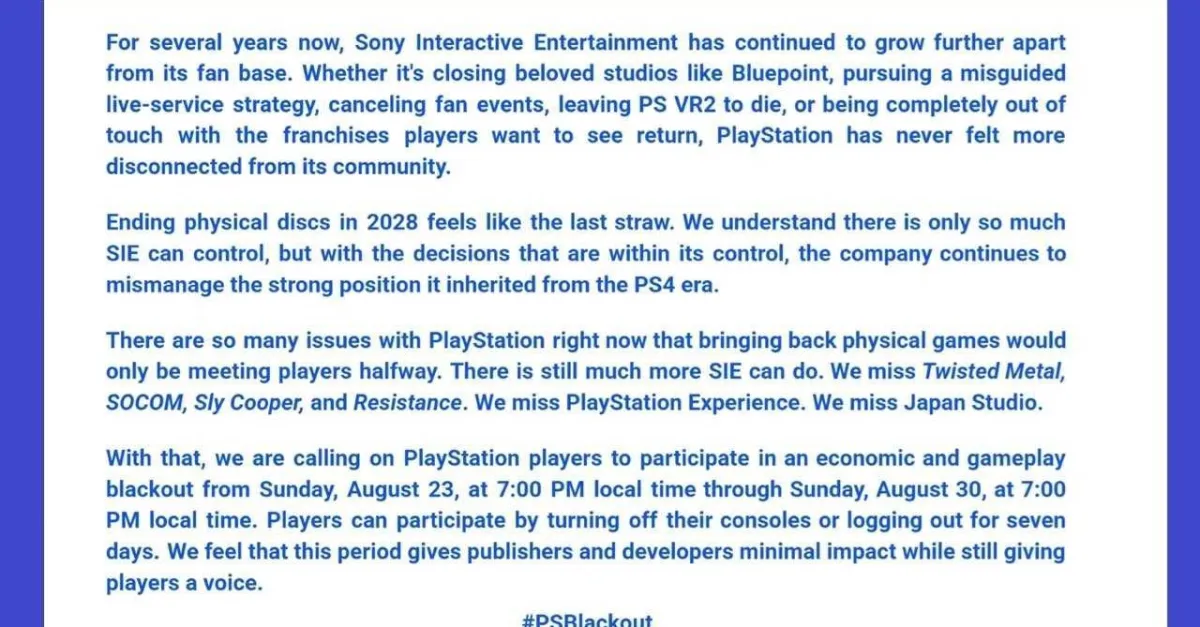
At the time of press, there is a well-publicised protest taking place in the video games community. PlayStation 5 owners are being encouraged to log off from their consoles between 23 and 30 August – no playing games, no downloading new titles. The motivating factor is Sony’s decision to cease physical game disc production from January 2028. After that, games will only be released as digital products. In an act of poor timing or wilful defiance, Sony chose this week to send out a mass email reminding customers of their PS5 terms and conditions: “The software is licensed to you, not sold,” states the relevant clause. “You are granted a limited, non-exclusive, non-transferable, and personal license to play … ” It knows, of course, that most customers won’t open the email, let alone read it.There has always been a tension between game players and game publishers – an underlying sense of mutual mistrust. Players are wary of their favourite franchises being canned, or games being delayed or released with bugs. Publishers and manufacturers are wary of piracy and the capricious tastes of consumers. But now the atmosphere among many game players feels more starkly political than ever. Microsoft has been targeted by the Boycott, Divestment, Sanctions movement for its ties to the Israeli military; the consumer advocacy group Stop Killing Games is gaining support; players have protested over the purchase of Electronic Arts by a Saudi-led consortium – boycotts have been proposed in part due to the possible ramifications regarding LGBTQ+ content in titles such as The Sims. As the games industry has grown and globalised, its impact on culture, society and politics has increased. Yet, on an individual level, gamers and consumers are feeling increasingly powerless.The end of physical games … time to go retro. Photograph: ShutterstockIs it possible to divest from the mainstream games industrial complex as a player? Yes, but with obvious sacrifices. Your PS5 still runs physical discs (if it has an optical drive) and will also play almost all PS4 games, so you have enough single-player titles to see you out for several decades. You could buy a secondhand Xbox, PlayStation or Nintendo machine from any era and find games that are still wildly pleasurable. Instead of playing online, you could rediscover couch co-op via evergreen titles such as Micro Machines and Worms. Alternatively, it’s possible to build a functional gaming PC for about £500, especially if you source secondhand components, that will let you play most current titles on lower graphics settings, while Steam, Itch.io or GOG all give you access to the vast, rich independent gaming scene.Short on cash? Love retro games? Apart from buying an old console, you could also invest in a Raspberry Pi 4 or 5 mini computer. I bought the Pi Hut’s starter kit for £99, which gives you everything you need hardware-wise. Install the OS, download an emulator such as RetroPie, Batocera or Recalbox and, hey presto, instant retro gaming machine! (Although you’ll need to find a way to download game Roms). There is also a huge range of dedicated retro consoles and handhelds, including the lovely EverCade (which lets you buy licensed, authentic versions of classic titles) and the pocket-sized Retroid, Ayaneo and Miyoo Mini devices.If none of this matters to you, that’s fine – keep enjoying the games you love. But for gamers truly worried about the impact of their consent and consumption, it may be time to think of video games in the same way we think of food: as something requiring ethical sacrifices. It is all too easy to succumb to a sense of powerlessness in the modern era – the systems seem to be stacked against us. But one thing games have always tried to teach us is that we have agency, we are imaginative creatures, we can challenge and beat the system in ways no one foresaw.As for PlayStation, it’s true that a huge majority of game sales are now digital (a point Sony has made in its defence) but this week has reminded us, in stark clarity, what convenience and compliance will cost us in the end.What to playMini metropolis ... Combolands. Photograph: Crux GamesAs a fan of games that combine different genres in interesting ways, I have just downloaded Combolands, an ingenious combination of roguelike deck builder and city-building sim. Here, you construct cute towns on procedurally generated islands by placing complementary building types next to each other, triggering combos that help grow your mini metropolis. The pixellated visuals recall the glory days of Sim City and Civilization, and I like how sessions last less than an hour before it’s time to rebuild. Oh, and it runs on a basic PC setup.Available on: PC
With the end of physical media in sight, gamers have had enough
An increasing tension between players and publishers about ownership of titles could lead to a divestment from the system the big companies are trying to enforce
1,332 words~6 min read