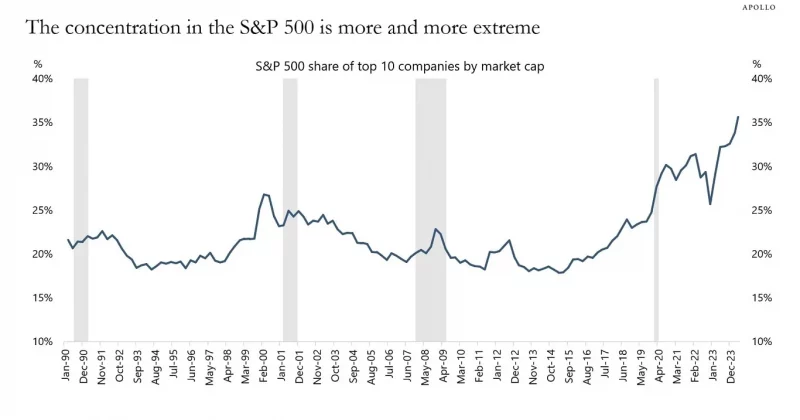
The US stock market has continued to hit record levels in 2026. The S&P 500, Nasdaq Composite and Dow Jones Industrial Average have all gained more than 20% over the past 12 months, as of August 2026. A major reason behind the strong market rally has been the rapid growth of artificial intelligence (AI) stocks.S&P 500 faces a 60-year concentration warning as Nvidia, Apple, Microsoft, Amazon and Alphabet drive the market amid rising AI bubble fears. (Pexel/Representative image) (Pexel)Investors have poured money into companies linked to AI because they expect the technology to drive strong growth in the coming years. But the same AI boom is now creating concerns about a possible AI bubble. Bank of America's latest Global Fund Manager Survey found that fund managers see an AI bubble as the biggest tail risk facing the market right now, according to The Motley Fool.S&P 500 faces mega-cap riskOne of the biggest concerns is how much of the S&P 500 is now controlled by a small group of mega-cap technology companies. The 10 largest companies make up around 40% of the S&P 500, according to data from S&P Global cited by The Motley Fool.This is an unusually high level of concentration. The last time the S&P 500 was this concentrated was around 1965, according to S&P Global data. Even during the height of the dot-com bubble in March 2000, the 10 biggest companies made up only about 26% of the index. This means the S&P 500's performance is now much more dependent on a small number of companies than it was during the dot-com bubble.Why this concentration could be a problemWhen the biggest companies perform well, they can push the entire S&P 500 higher. That has helped the index deliver strong returns during the recent AI boom. But the same concentration can become a major problem if these companies suddenly fall.A sharp decline in just a few mega-cap stocks could put pressure on the entire S&P 500. Investors may therefore face greater market risk even if many smaller companies are performing well. In simple terms, the market has more eggs in fewer baskets.Also read: Will Nvidia stock rise or fall after earnings? Options price $280b swingNvidia, Apple, Alphabet, Microsoft and Amazon are at the centre of the riskThe five biggest holdings in the S&P 500 are Nvidia, Apple, Alphabet, Microsoft and Amazon, according to The Motley Fool. All five companies have made major investments in AI. That creates a direct link between the performance of the S&P 500 and the future of the AI industry.If AI continues to grow as expected, these companies could continue supporting the broader market. But if investors start questioning AI spending, growth expectations or company valuations, these same stocks could come under pressure. That could then affect the wider S&P 500 because of their huge weight in the index.The AI boom is not just about software and chatbots. Big technology companies are spending huge amounts of money on data centers and other AI infrastructure. Amazon spent nearly $100 billion on data centers in the first half of 2026 alone, according to The Motley Fool.Such spending shows how aggressively major companies are preparing for the AI economy. But it also creates a major question for investors: Will these massive AI investments generate enough profits in the future? If the answer is no, companies could face pressure to reduce spending, which could hurt businesses connected to the AI boom.The market may be showing another warning signThe current situation is also raising concerns because stock valuations are extremely high. One measure investors use to study this is the S&P 500 Shiller CAPE ratio. CAPE stands for Cyclically Adjusted Price-to-Earnings ratio. It compares the S&P 500's current price with its average inflation-adjusted earnings over the previous 10 years. A higher CAPE ratio generally means stocks are more expensive compared with their long-term earnings.CAPE ratio is far above its historical averageSince the 1870s, the CAPE ratio has averaged around 17, according to The Motley Fool. The ratio rose above 30 before the Great Depression. It later reached an all-time high of about 44 just before the dot-com bubble burst. As of the report, the CAPE ratio is above 41. That puts the current market at levels that have historically been associated with very high valuations.The 40-plus CAPE level has happened only twiceThe CAPE ratio has remained above 40 since May 2026, according to The Motley Fool. This is only the second time in history that the ratio has stayed above that level. The first time happened in January 1999. The ratio continued rising after that and remained elevated until the dot-com bubble finally burst in March 2000.The current situation does not prove that another crash is about to happen. But the historical comparison is raising concerns because today's valuation levels look similar to one of the most expensive periods in stock market history.Also read: How did bitcoin turn Strategy’s $9.5b loss into a $4.7b profit?Does this mean an AI bubble will burst in 2026?There is no way to know exactly what the stock market will do in the coming months. The high CAPE ratio and extreme concentration in mega-cap technology stocks are warning signs, but they are not crash predictions. The current market could continue rising if corporate earnings remain strong and AI produces the growth investors expect.At the same time, investors should remember that market downturns are a normal part of investing. The CAPE ratio cannot tell investors exactly when a correction or bear market will happen. It can, however, suggest that many stocks may currently be priced at very high levels.A market downturn does not mean investors will permanently lose money. The Motley Fool points out that the S&P 500 has produced more than 700% in total returns since the beginning of the dot-com bear market in March 2000. Many individual companies have performed even better over the same period. This shows why investors should think beyond short-term market crashes. Strong businesses can recover and continue growing even after major market downturns.What investors should do nowThe key lesson is not necessarily to sell everything because of fears about an AI bubble. Instead, investors should focus on quality companies with strong fundamentals. Businesses with healthy finances, strong competitive advantages and sustainable growth may have a better chance of surviving a market downturn.Some highly valued technology stocks could struggle badly if the AI boom loses momentum. But companies with strong underlying businesses may be better positioned to recover over the long term. The Motley Fool therefore recommends focusing on healthy companies rather than simply chasing the hottest AI stocks.The bigger market warningThe main warning for investors is that the S&P 500 has become unusually dependent on a handful of mega-cap companies. At the same time, many of those companies are heavily tied to the AI investment boom. The index is also trading at historically high valuation levels, with the CAPE ratio above 40.The combination of high valuations, heavy market concentration and huge AI spending creates a risk if investor expectations suddenly change. Nvidia, Apple, Microsoft, Amazon and Alphabet have helped drive the market higher, but their size also means weakness in these stocks could have an outsized effect on the broader index.History does not guarantee that a crash is coming in 2026, but it suggests investors should be prepared for periods of higher volatility. For long-term investors, the focus should remain on strong businesses and sound fundamentals rather than trying to predict the exact day an AI bubble might burst.
Stock market warning: S&P 500 repeats 60-year pattern as Nvidia, Apple and big tech raise market risk
S&P 500 faces a 60-year concentration warning as Nvidia, Apple, Microsoft, Amazon and Alphabet drive the market amid rising AI bubble fears. | Business News
1,250 words~6 min read