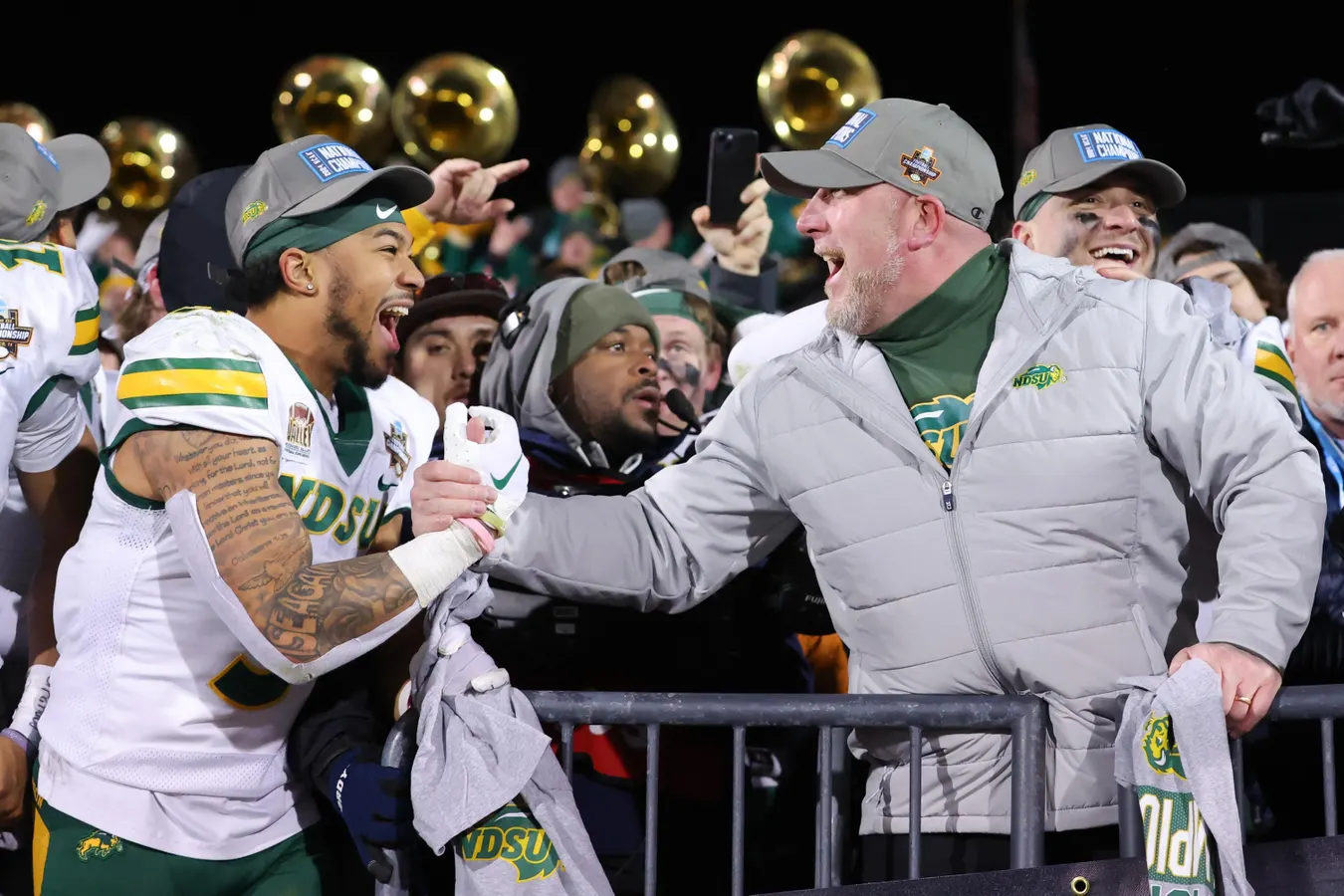
FRISCO, TEXAS - JANUARY 6: RaJa Nelson #3 of the North Dakota State Bison celebrates with head coach Tim Polasek of the North Dakota State Bison after defeating the Montana State Bobcats to win the Division I FCS Football Championship held at Toyota Stadium on January 6, 2025 in Frisco, Texas. (Photo by C. Morgan Engel/NCAA Photos via Getty Images)NCAA Photos via Getty ImagesTwelve years ago, Matt Larsen made a major career decision, moving 1,500 miles to become North Dakota State’s athletics director. Larsen had spent more than two decades as a student, football player and administrator at Stony Brook University in Long Island. N.Y. He was comfortable in the area. Still, he knew North Dakota State had become the premier Football Championship Subdivision program and had room to grow even further.On Saturday, the Bison will host Jacksonville State in their first game as a member of the Football Bowl Subdivision, college football’s top level. It is the culmination of several years of planning and making sure the team could be competitive in the FBS from an on-field and off-field perspective. And that meant a massive financial commitment.The University paid a $5 million fee to the NCAA to move up to the FBS from the FCS, where the Bison had won 10 football titles since 2011. That standard charge is up from the $5,000 that the NCAA used to assess on programs transitioning to the FBS before changing the rule in 2023. North Dakota State also is on the hook for a $12.5 million membership fee to the Mountain West Conference, which is adding the Bison only in football.North Dakota State has already paid $7 million to the Mountain West and owes an annual payment of $1.1 million in each of the next five years. The school’s other sports remain in the Summit League, except for wrestling, which is in the Big 12.When analyzing what it would take to move to FBS, Larsen estimated North Dakota State would need to generate $60 million in additional revenue over six years to be competitive in the Mountain West. That includes $10 million in facility enhancements and $45 million to $50 million in operational improvements such as raising salaries, hiring more support staff, adding scholarships and increasing Name, Image and Likeness opportunities.MORE FOR YOUTo date, North Dakota State has received $28 million in commitments, mostly from donors, according to Larsen. The school is looking to increase revenue in various ways, including higher ticket sales, philanthropic and donor support, sponsorships and multimedia rights.“I don’t want to wait until year six to finish raising the money,” Larsen said. “I'd like to get ahead of that, so then we can start really looking at how do we continue to move the program forward.”North Dakota State Dominates The FCSFor North Dakota State, the transition to the FBS is a long time coming. The Bison won five Division II football titles from 1983 through 1990 before moving up to the FCS in 2004. Coach Craig Bohl led North Dakota State to its first FCS title in 2011 and then helped them win two more in a row before he left in December 2013 for Wyoming.In September 2014, North Dakota State hired Larsen, who had attended the program’s national title game victory in January 2013 over Sam Houston State in the Dallas suburb of Frisco, Texas. The game took place 200 miles from Sam Houston State’s campus and nearly 1,100 miles from North Dakota State’s campus. But there was no comparison in terms of who had more supporters.“All you saw was green and gold all over the Dallas area,” Larsen said. “It was just a sign of ‘Wow, this fan base is incredibly rabid. They’re supportive. They’re passionate.’"He added: “I think we saw a place where people care. There’s the ability to take the institution to new heights and the program to new heights, and so I saw it as a really great opportunity, a great challenge.”Soon, Larsen realized the fans were eager for more.“Most of the questions I got from fans my first six months were, ‘When are we going to join the Big Ten?’,” he said. “I said, ‘OK. Let’s pump the brakes.’”Even with Bohl gone, the Bison didn’t miss a beat. Chris Klieman, Bohl’s defensive coordinator, was promoted to head coach and led the program to national titles in 2014, 2015, 2017 and 2018 before leaving to become Kansas State’s coach. Matt Entz, Klieman’s successor, led North Dakota State to championships in 2019 and 2023 before departing to USC as assistant head coach for defense. The Bison won another title in 2024 under current coach Tim Polasek and went 12-1 last season.North Dakota State’s Home Attendance DeclinesAll told, North Dakota State has gone 198-22 since 2011, winning 90% of its games. Still, as the victories continued piling up, attendance at home games declined.During Klieman’s last season, the Bison had more than 18,000 fans at each of their regular season games at the Fargodome, their on-campus indoor stadium that has a capacity of about 18,500 seats. But last season, North Dakota State had fewer than 15,800 fans at each of its final four regular season games.The Bison also drew just 10,464 for an FCS second round playoff loss in December to Illinois State even though North Dakota State was 12-0 and the top seed. That wasn’t an anomaly, either. North Dakota State had about 10,300 fans at each of its first two playoff games in 2024, as well, a season in which it won another title.“It’s not that our folks don’t care anymore,” Larsen said. “It’s not that they’re not passionate. But I think they were looking for something different, too, maybe a greater challenge.”So was Larsen, who had worked with his staff in recent years to put North Dakota State in position to move up to the FBS. The Bison in 2022 opened a more than 117,000-square-foot indoor training facility for football and other sports that cost $54 million and was privately funded. Nodak Insurance Co., a large employer in the state, led the funding and received naming rights.Larsen spoke with other FCS schools that have made successful transitions to the FBS, including Appalachian State, Georgia Southern and James Madison. And he received the support of former school president David Cook, who left for Iowa State earlier this year. Marshall Stewart, Cook’s replacement who was previously an executive vice president at Kansas State, is on board with the move, as well.North Dakota State and the Mountain West began seriously talking last fall, according to Larsen. The school accepted the conference’s invitation in February. The league’s other football programs are Air Force, Hawaii, Nevada, New Mexico, Northern Illinois, San Jose State, UNLV, University of Texas-El Paso and Wyoming. The Bison will play on national television 10 times during this year’s regular season, up from once last year.“I think they both recognized and realized this was so much bigger than just a move for football,” Larsen said. “This was an opportunity to align with medium to large public institutions, flagship institutions in their states.”He added: “When you think about visibility and reach and brand, I think our outgoing president and our incoming president both saw this as a way to not just elevate athletics, but to help elevate the University in a really good way.”North Dakota State Increases Financial Commitment North Dakota State last year opted into the House settlement, meaning the school can participate in revenue sharing with athletes, a crucial component to competing at the FBS level where players often make decisions based on how much they’re getting paid to play. Although Larsen said that the Bison are “not pushing” the $21.3 million cap for this school year, he said that they are “investing at a level that we can be competitive against Mountain West opponents” and other programs in the Group of 6 leagues: the American, Conference USA, Mid-American, Pac-12 and Sun Belt.North Dakota State now has 85 to 90 scholarships in football, up from the previous FCS limit of 63. The school has also hired additional trainers, strength and conditioning coaches, sports medicine personnel and academic support staff, added its first director of scouting and player personnel (Josh Rosenthal) and increased salaries to be near or above their new peer programs.“We wanted to have success right away,” Larsen said. “There were a lot of things that we felt we were going to need, and a lot of it came through.”That includes the financial backing from alums, supporters and local businesses, which doesn’t surprise Klieman, whose son, Devin, is in his third season as North Dakota State’s safeties coach. The state, which has the fourth-smallest population in the U.S. just ahead of Wyoming, Vermont and Alaska, doesn’t have any major professional sports franchises. As such, North Dakota State is the top sports program around and is in a growing area. The population in the Fargo-Moorehead region stood at 269,528 last year, according to the U.S. Census Bureau, up 10% from 2018. During that same time, the U.S. population increased 4%.“I’m impressed but not surprised, just because football is king up in Fargo and at North Dakota State," Klieman said. “People want to follow the Bison. People want to support the Bison, and I think them going to FBS probably opened the doors for a lot of other donors.”He added: “I think that’s the thing that excites a lot of people is you’re not going to go and watch five home games where they're going to beat somebody 52 to 10. They're going to have really competitive, good games with new schools coming into the Fargodome that have not been there. I think the excitement is at an all-time high there.”Since announcing the move to the Mountain West, North Dakota State has seen a surge in ticket sales. The school expects sell-outs for each of its six home games.“There’s definitely a palpable energy and passion around town, around the state, with this move,” Larsen said. “There’s a lot of pride in the state, and so to be able to compete at the highest level is something our fan base and the citizens of North Dakota are pretty excited about.”North Dakota State Prepares For First FBS SeasonIn June, North Dakota State received welcome news when the NCAA allowed former FCS programs transitioning to the FBS immediate eligibility to participate in bowl games and the College Football Playoff. Those schools were previously not allowed to compete in the postseason for two years. The Bison are also eligible to play in this year’s Mountain West championship game if they qualify.Since joining FCS in 2004, North Dakota State has gone 9-5 against FBS opponents, including six consecutive victories from 2010 through 2016. But since then, it has only played two FBS teams, losing to Arizona 31-28 in 2022 and Colorado 31-26 two years ago. FBS programs didn’t see any upside in scheduling the Bison considering a loss to an FCS school would look bad and was a possibility based on North Dakota State’s previous success against more well-funded programs.Now, as part of the Mountain West, the Bison are guaranteed eight league games and have a chance to see where they stand at the sport’s highest level. Three North Dakota State players were selected to the preseason All-Mountain West team in offensive lineman Griffin Empey, defensive lineman Keenan Wilson and defensive back Darius Givance, while kick and punt returner Jackson Williams was named the league’s preseason special teams player of the year. The Bison are No. 75 in ESPN analyst Bill Connelly’s SP+ preseason rankings of the 138 FBS programs, putting them third in the Mountain West behind UNLV (No. 55) and New Mexico (No. 68). As usual, North Dakota State is relying on players from in-state or nearby states, including 19 from North Dakota, 21 from Wisconsin and 40 from Minnesota. Depending on how the Bison fare, they could have more of an impact recruiting other parts of the U.S. than they did when they were in the FCS.“I think from a resources standpoint and from a fan base standpoint, they’ll be in the upper-third to start with already,” Klieman said. “Now they’ve got to figure out how is the best way to be successful on the field in this league? Is it up front running the football and stopping the run — that’s what they’ve always done. Do they have to get more skilled kids to compete with these other teams? I think that’s the million dollar question that they’re going to find out an awful lot this first year in the league.”North Dakota State will know more starting on Saturday when it faces Jacksonville State, a team that has won nine games in each of its first three seasons in the FBS. The Gamecocks went 7-1 in Conference USA in each of the past two seasons, winning the championship in 2024 and losing in the title game last year. The Bison have spent years preparing for this moment, a chance to not only improve the football program but the school as a whole.“From our perspective, this was a 40-year decision, not a five-year decision,” Larsen said. “This is putting our University on a different level long-term. It’s going to really provide benefits. Hopefully, we look back 10 years from now and say that was the best decision we've ever made because of all these opportunities and doors that have opened.”
How North Dakota State Invested Millions In Move To Football Bowl Subdivision
On Saturday, North Dakota State will host Jacksonville State in the Bison's first game as a member of the Football Bowl Subdivision, college football’s top level.
2,232 words~10 min read