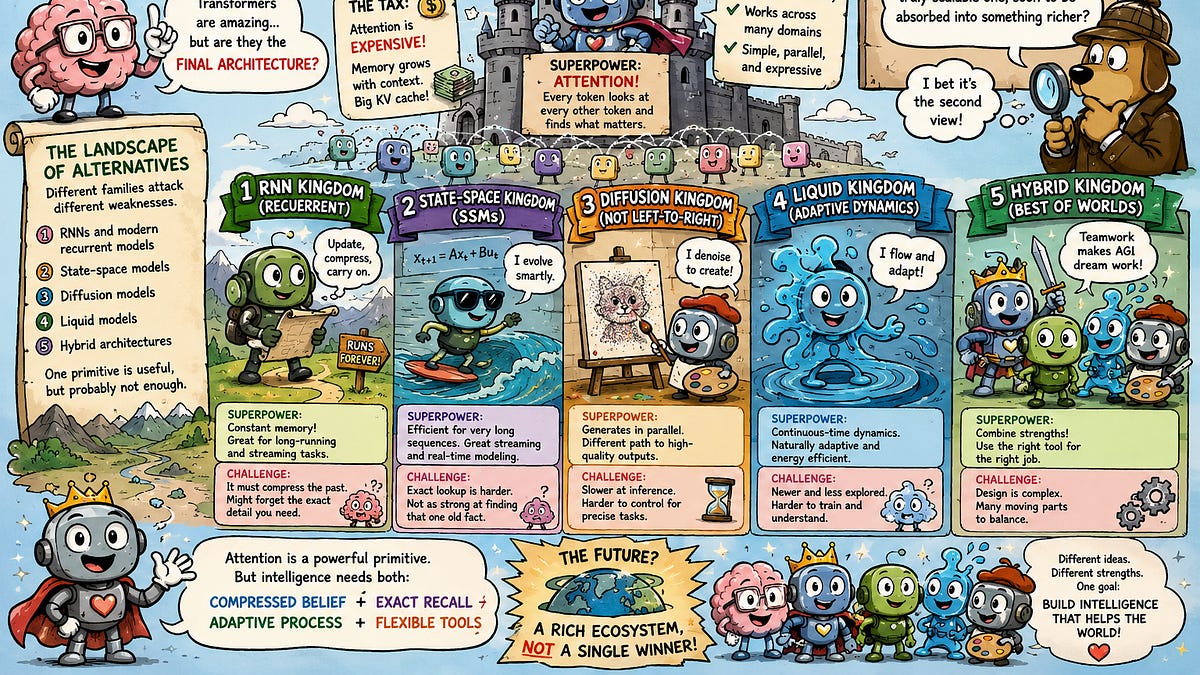
There's a moment in AI architecture when someone stops asking how to make Transformers scale better and starts asking whether Transformers are the right shape for the problem at all. Caltech's Anima Anandkumar and Benedikt Jenik just had that moment, and they've founded a company around it.
Accelerated Understanding Inc is built on neural operators, a fundamentally different approach to how AI systems represent and process data. Instead of the token-by-token attention mechanism that defines every frontier model you've used, neural operators treat problems in continuous space and learn mappings between functions. The physics is cleaner. The math lets you scale differently.
Here's the concrete claim: in tests, their system ingested 5 trillion data points in a single prompt. For context, Anthropic's Claude and Google's Gemini flagships handle roughly one millionth of that in the same scenario. That's not a percentage difference. That's a different league.
The company is marketed as "enterprise physics AI", built to solve the kind of differential equation and fluid dynamics problems that matter to oil & gas, materials science, and industrial optimization. These are domains where you actually need to process massive datasets of continuous measurements and output physically plausible results. A Transformer trained on text will hallucinate. An operator network trained on physics doesn't really have that problem. The loss function enforces structure.