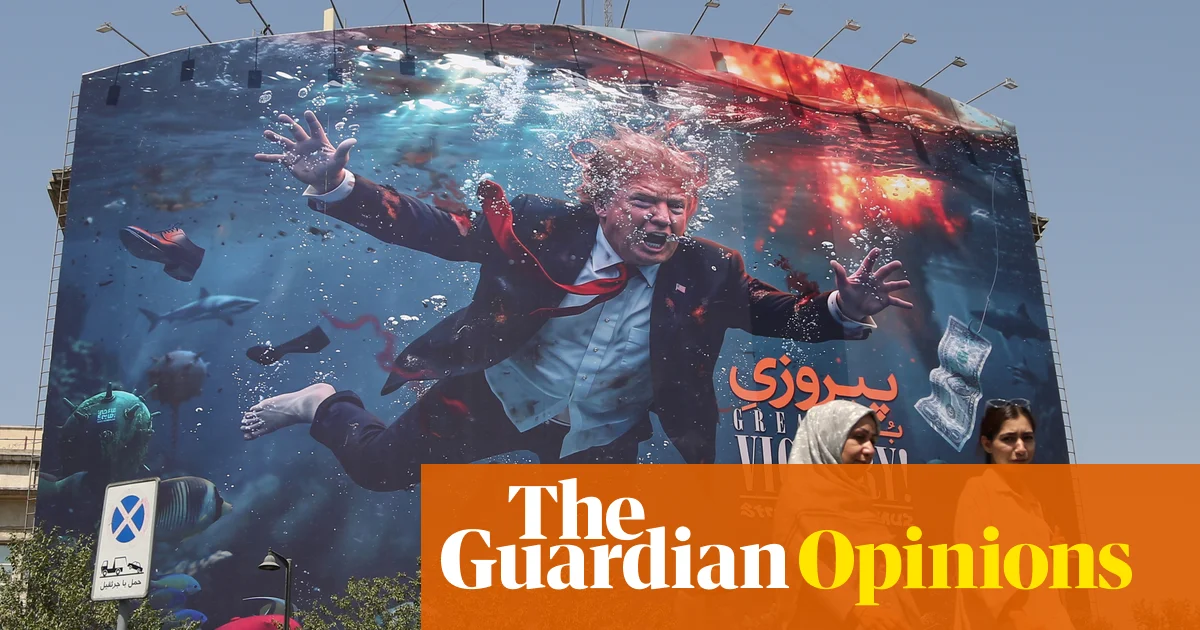
Now is the twilight of Donald Trump’s supremacy. The US is still the richest and most heavily armed nation on Earth. That status is secure. The current president, contemptuous of law and indulged in lawlessness by a supine Congress, enjoys even greater power than the constitution allows.With those advantages it takes a special talent for incompetence to look as thwarted and impotent as Trump does with more than two years of his second term still to run.History will record the war against Iran as a turning point in the fortunes of the current US administration and a grievous wound to national prestige.Pumped with hubris after the audacious military operation to kidnap Venezuelan president Nicolás Maduro, Trump believed an equally brisk triumph was available in the Middle East. The Tehran regime would be decapitated. The country’s hydrocarbon resources would then be available for US exploitation.Six months later, Iran is controlled by a new generation of hardliners. Emboldened by resilience under US and Israeli bombardment, they demand financial concessions from Washington as the price for peace – reparations and a right to toll the strait of Hormuz.The war is not over, it has just turned cold. Trump believes Iran’s fragile economy is close to collapse. He threatens to push it over the brink with “D-day” sanctions. The metaphor of second world war amphibious assault is supposed to make yet another round of financial coercion succeed where past embargos have failed.It is true that ordinary Iranians are suffering terrible privations, but repression limits their capacity to translate discontent into demands for political change. By contrast, US consumers, aggrieved by the inflationary consequences of the war, and confused about its purpose, get to express their unhappiness in midterm elections in November.The calculation in Tehran is that American tolerance for economic pain is low enough that Trump will be forced to blink first. It is a reasonable assumption: the need to declare mission accomplished to a domestic audience – even on terms that amount to defeat by any objective measure – drive an impatient president’s actions more than long-term strategy.If sanctions fail, diplomatic climbdown is the only remaining move. The Pentagon couldn’t revert to the all-out military option even if Trump ordered it, because Operation Epic Fury burned too much of the national munitions stockpile.This is where an asymmetry of cost and capability comes into play. Iran can frighten ships out of the Gulf with a few mines. It can harry neighbouring states with drones knocked together for less than $50,000 and dispatched from mobile launchers that are hard to target. The Patriot interceptors that protect US forces and their allies in the region cost $4-5m apiece. (More than 1,500 Patriots are thought have been fired in the war so far, leaving fewer than 830 in the US inventory.)That depletion has global repercussions, most pressingly in Ukraine where top-end US interceptors are essential for shielding civilians from Russia’s most sophisticated ballistic missiles.Trump’s attitude to that conflict has evolved from craven pro-Kremlin partisanship and an assumption of inevitable Russian victory to grudging respect for Volodymyr Zelenskyy’s fortitude and ingenuity in proving that assumption wrong. But the shift is not stable. It depends on undertakings by Nato’s European members to cover the cost of arming Kyiv.If Trump had used normal diplomacy to cajole European democracies into financing the defence of their eastern flank, it would count as a foreign policy success – rebalancing the relationship to both sides’ benefit. But he did it with credulous admiration for Vladimir Putin and deranged demands for territory in Greenland. As a result, the European drive to autonomy looks less like burden-sharing and more like a hedge against American perfidy.It isn’t just Europe where US allies feel burned. Gulf states that found themselves on the frontline of Iranian retaliation in a war they didn’t start or want, expected a more reliable umbrella of protection. They feel unrewarded for their decades of service, hosting US military bases and functioning as proxies for American interests in the region.Last week Trump abruptly cut short a joint military exercise with South Korea – a loyal Asian partner to the US. A rational explanation, and the one preferred by Seoul, was that US forces were overstretched by their Middle Eastern entanglement. Trump framed it instead as an amicable gesture towards North Korean tyrant Kim Jong-un, whose regime he judged to be “unthreatening and respectful”.skip past newsletter promotionafter newsletter promotionSuch civility, lavished on a monstrous dictatorship, is withheld from Canada, a benign democracy. Trump dismisses his northern neighbour as an economic freeloader, barely even a proper country; a mislabelled territory that should be the 51st US state.Unsurprisingly, that attitude sours relations. Canadian prime minister Mark Carney pulled out of trade talks last weekend, citing unreasonable last-minute demands from US negotiators. Trump responded with punitive tariffs, to which the Canadians promise “dollar-for-dollar” retaliation.The smaller economy is likely to suffer more from a trade war. But for Carney the cost in reduced commerce had to be weighed against the political damage he may incur if seen to capitulate to Trump’s bullying. He knows the US president takes concessions as an invitation to come back with yet more demands. He also knows that November’s midterm elections are likely to flip the House of Representatives to Democratic party control, and possibly the Senate too.Trump cannot be chastened by unwelcome election results. He would rather deny their validity. But irrefutable evidence of failure at the ballot box may at least stir some Republicans out of stupefied obedience to a commander-in-chief whose way of governing has made their party less popular and left their country friendless.Even if the constitutional mechanisms that are supposed to keep a president in check are only partly rehabilitated, the spell of impunity is broken. The cult of personality that once made Trump look like an irrepressible force of nature has shrunk to a sycophantic sect. An administration that styled itself as a national revolution looks more like a kleptocratic junta, using the privileges of office to pilfer what it can as the clock runs down.The president still has followers across the country. A hard core bring unshakable devotion to the cause. But even some of them can surely sense the decay of purpose and whiff of panic in a man running out of ammunition.Trump’s reign is far from over. With his hands on the levers of American power he can still do a lot of damage. But the rest of the world has learned to read his lurches, anticipate his spasms, manoeuvre around him. The phase of deference is past. Now is the time of planning for whatever comes next in the dimming light of a waning star.
With no friends left to burn, Trump is running out of diplomatic ammunition | Rafael Behr
Everyone can see that the Iran war has been a strategic disaster for the US, while a failing president pretends he is winning, says Guardian columnist Rafael Behr
1,116 words~5 min read