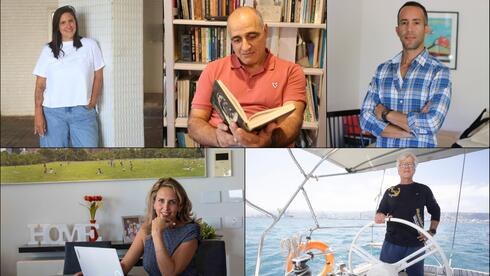
Tens of thousands of academics have participated in the Ministry of Education's teaching retraining programs over the past decade; Despite the sharp drop in salaries, they don't regret it for a moment: 'Partners in shaping the people and society of the future'They have already “made it” in high tech, the capital markets, the military and other fields. But it was not enough, and they chose to begin a second career in education: 70,872 academics have participated over the past decade in the Education Ministry’s teacher retraining programs.One of them is Moni Carmeli, 65, of Kiryat Yam, a former vice president for development at Elbit and leading medical companies, who spent decades managing engineers and technological development projects and even holds a patent in the medical field. He is also an international commercial skipper who volunteered to help rescue Israelis from Cyprus after October 7 and also volunteered at the home of hostage Matan Angrest’s family.GalleryMoni Carmeli: 'If you do not feel that this is your calling and mission, do not start'(Photo: Gil Nehushtan)Carmeli recently completed his studies at the Levinsky-Wingate Academic Center in the Delta Program, a unique teacher-training track for outstanding academics with bachelor’s degrees in mathematics and science.“I see teaching as the fulfillment of a passion and a mission,” Carmeli said. “I developed a strong desire to teach mathematics and science and to bring my extensive technological knowledge and innovation into the classroom.”On September 1, he will begin teaching at Rabin High School in Kiryat Yam, where his three sons studied, and will also teach at ORT Rimon High School in Kiryat Bialik. In his lessons, he plans to incorporate interactive applications using artificial intelligence tools.“I came to lift the students up. Anyone who wants to learn will get a whole world from me,” he said. “Students today are different. Sometimes they do not understand the power of education and come just to pass the time. My goal is to save and empower those who want to learn. I came from the periphery, my parents were Holocaust survivors with no education and I built myself up on my own. Now I’m here to lift them up.”On the salary gap, he is candid: “I worked hard for 40 years and accumulated enough to finance my ambitions, but it is a difficult barrier for younger people. My message to anyone considering retraining as a teacher is: If you do not feel that this is your calling and mission, do not start.”The Education Ministry runs a unique program called “From High Tech to Teaching,” aimed at expanding the pool of high-quality teachers in STEM subjects — mathematics, computer science, physics, chemistry, biology and English — and integrating artificial intelligence initiatives into the education system.Last year, 613 academics were recruited, and this year the recruitment track was expanded with the goal of adding another 500 participants. A special administration established within the Education Ministry supports students with technical matters such as calculating seniority for salary purposes, as well as pedagogical issues related to employment during their first years in the education system.Shiri Margalit is beginning her sixth year at Yachad High School in Modi’in, where she teaches mathematics, computer science and software engineering. Margalit, who holds a bachelor’s degree in computer science and a master’s degree in business administration, worked for years in high tech and enjoyed the work, but was looking for meaning.Shiri Margalit worked for years in high tech and enjoyed the work, but was looking for meaning(Photo: Tal Shachar)“I never thought of leaving the ‘golden cage,’ and certainly not of turning to teaching,” she said. “During the COVID period, I was laid off like many others, and I enrolled in a teacher retraining program just in case. Very quickly, I realized this was my calling.”Margalit studied at the Hebrew University with support from the “From High Tech to Teaching” administration.“The studies gave me the initial tools to enter the classroom and teach, and the administration helped me a great deal in making the decision, choosing the subject and transitioning into the education system,” she said. “The salary difference compared with high tech is well known, but the meaning, the personal connection and the impact on students are worth everything. I wake up happily every morning, and I believe the combination of a genuine passion for teaching with maturity and experience from industry gives students tremendous added value.”Assaf Ash, 60, from Rosh HaAyin, also left the high-tech world after 26 years to fulfill a long-held dream and join the education system as a high school teacher of history and Bible studies. He will teach history at the Moshe Arens school in Petah Tikva after completing the teacher retraining program at the Levinsky-Wingate Academic Center.Assaf Ash left high-tech after 26 years to fulfill long-held dream and join education system as a high school teacher of history and Bible(Photo: Motti Kimchi)“I felt I had exhausted the software world, and for me the time had come to move on to something for the soul,” Ash said. “The step comes with a salary cut of more than 50%, but there are things in life worth earning less money for. I came from the world of software and discovered human beings. I met a dedicated staff, from an uncompromising professional principal to every caring staff member, showing personal sensitivity to each and every student. I was surprised to discover students who love to learn and know.”The decision to change course took shape for Tal Shamir, 39, of Tel Aviv, a lawyer and litigator, through her experience of motherhood.“I raised both of my children with home schooling until age 4, by choice, because I did not want to put them into the unregulated private preschool system. Those years taught me how much I love working with children, speaking their language, initiating things, creating a space for them and truly seeing them.”At age 37, she decided to give up a successful legal career with excellent pay and good conditions and move into education. Shamir studied for a master’s degree at Kibbutzim College, and after a year teaching and serving as a ninth-grade homeroom teacher, she knows the choice was the right one.“The impact I have on my students is enormous. A deep relationship of trust, appreciation and love has developed between us,” she explains.Tal Shamir decided to give up a successful legal career with excellent pay and good conditions and move into education(Photo: Avigail Uzi)Shamir said that “on June 20, I was very happy to go on vacation and felt I had honestly earned it. The job is much harder than I thought,” but she is nevertheless excited about the coming school year.“These children are our future, and teaching may be the most important form of engineering,” she said. “We are partners in shaping the people and society of the future. I am happy I chose to be part of that.”After several years at the Defense Ministry and service in an elite IDF unit, Asaf Arditi, 42, of Ramat Hasharon, developed a career in finance. After working in New Jersey at leading global investment banks, he returned to Israel with his family about six years ago. Following October 7, he felt a need to channel his energy back into public service.Arditi completed a master’s degree in education at Kibbutzim College and, while working as a vice president at an investment bank, also taught at Galili High School in Kfar Saba. Recently, he decided to leave the bank and work as a full-time teacher, accepting a significant financial sacrifice. Following October 7, Asaf Arditi felt a need to channel his energy back into public service.(Photo: Mickey Schmidt)“Teaching is the tool for influencing the next generation in the State of Israel,” he said. “Working with teenagers over the past year gave me the inspiration to go all in. We are living in a period when acquiring knowledge is becoming readily available and easy, so the values-based side of teaching has taken on even greater importance for me.”Dr. Lili Russo, head of the Education Ministry’s Academic Training Division, said those joining the program are a valuable asset. “This is high-quality human capital arriving with knowledge and experience from other employment fields, and we are working on how to make use of that knowledge and experience - alongside the academic degrees they bring with them - for teacher training.”She said that as part of efforts to integrate these teachers effectively, they are accompanied by two mentors: one a graduate of the “From High Tech to Teaching” program who has already joined the system, and the other a veteran teacher.“Retraining academics for teaching is one of the most significant channels the education system currently has for recruiting high-quality, educated people with professional experience," according to Professor Smadar Donitsa-Schmidt, president of Kibbutzim College, who has conducted a long series of studies on academics retraining as teachers. "The studies I have conducted over the years show that graduates of retraining programs not only enter the system, but also manage to remain in it over time.”According to her, 55.7% of graduates of retraining programs taught for between six and 10 years, compared with 41.9% of graduates of regular teacher-training tracks.Dr. Rony Ramot, director of planning, strategy and academic development at Kibbutzim College, said career changers have become a significant part of the education system in recent years.“This has long since stopped being a marginal phenomenon. It is a population the system relies on,” she said. “These are people who generally do not enter teaching by default. They make an active choice in midlife, after they have already built a career and accumulated professional experience, and they are looking for meaning, a sense of mission and change.”
From high tech to the classroom: Israelis trade lucrative careers for meaning
Tens of thousands of academics have participated in the Ministry of Education's teaching retraining programs over the past decade; Despite the sharp drop in salaries, they don't regret it for a moment: 'Partners in shaping the people and society of the future'
1,611 words~7 min read