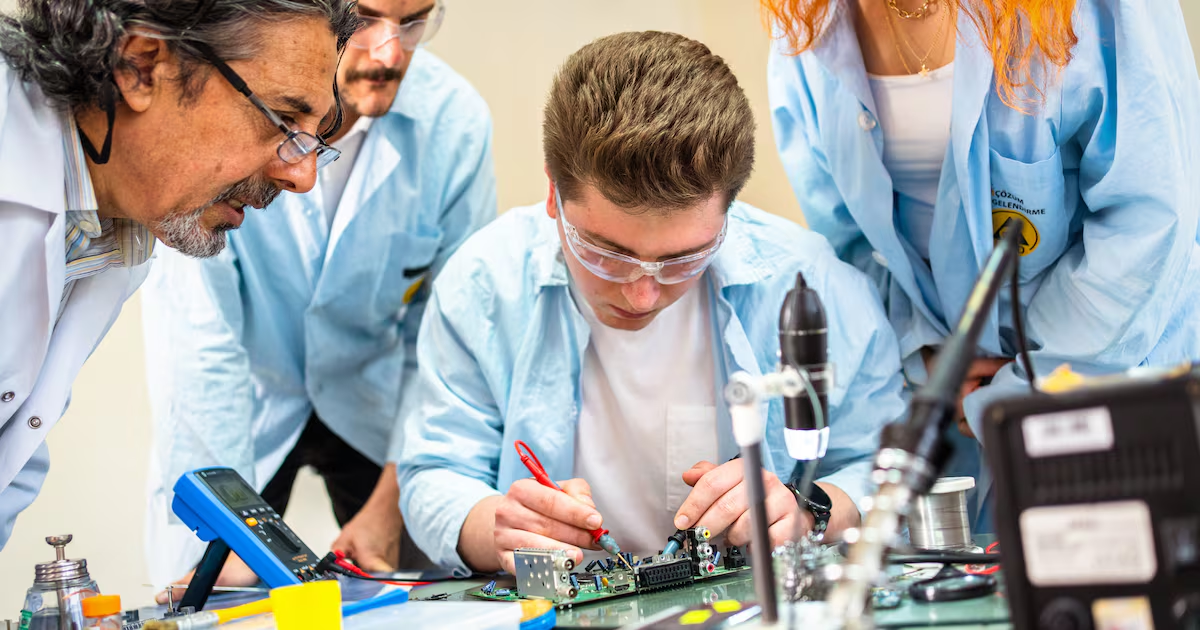
University. Savour the hallowed word, for it is here that you will reach the pinnacle of your learning, because only university students... What a load of crap.University was once, indeed, the best place to complete your formal education. It’s not so long ago that Fás, which was Ireland’s main training agency and provided Post-Leaving Certificate (PLC) courses, was a punchline, used by teachers as a threat: “If you don’t do well in your Leaving Cert, you’ll end up in Fás.” This was unfair, given that it did provide routes to employment for tens of thousands. But a series of governance scandals shattered its credibility so, by 2013, Fás was as dead as the jokes that once surrounded it. Solas replaced Fás as Ireland’s further education and training (FET) agency, and it set its ambitions high. Importantly, it still provides PLC courses as a route to employment, but its mission today also includes apprenticeships, traineeships and continuous professional development (CPD). [ Should you be considering further education and training as an attractive pathway? Opens in new window ]Crucially, Solas also offers a route to third-level outside the CAO system, so that someone can get their level five qualification and use it as a stepping stone to start in college, irrespective of the amount of points they got in their Leaving Cert. By any metric – and despite a scandal in 2025 over alleged cheating in electrical apprenticeship exams – Solas has been a success. But can it compete with the apparent prestige offered by a college course?On the other hand, in an age when durability, flexibility and skills are more important to employers than ever before, might it even have an edge?Deirdre McDonnell, chief executive of Solas, says that jobs are changing. “Employers need people who can combine technical ability with communication, adaptability, critical thinking and a capacity to keep learning,” McDonnell says. “These are not ‘soft skills’. They are central to Ireland’s future competitiveness. They will shape whether people can use artificial intelligence well, challenge it wisely, and adapt with confidence. FET is already delivering that mix. The vocationally focused learning offered is aligned with labour market needs, making it an attractive option for school leavers and employees seeking to upskill.”In 2025, more than 224,000 unique learners engaged in FET, including over 31,000 apprentices across 78 programmes.“Apprenticeships have experienced rapid growth as alternative ‘earn and learn’ routes to careers and a good quality of life,” McDonnell says. “Over 90 per cent of graduates who completed Post-Leaving Certificate courses in mid-2022 were in employment, education, or both one year later.”The unavoidable backdrop to all of this is artificial intelligence, and how much it will impact on the lives of today’s graduates. McDonnell says AI will lead to job changes, with about 63 per cent of jobs in Ireland affected to some degree, but that FET is well-placed to respond. “AI is expected to largely enhance rather than replace most occupations by automating repetitive and administrative duties, enabling workers to focus on more complex problem-solving and tasks requiring cognitive skills such as judgment, strategic foresight or resource allocation.[ FET: a pathway to endless opportunities for studentsOpens in new window ]“Implementing the new FET Strategy 2026–2030, Creating Futures, will build on that: more lifelong learning, more flexible pathways and provision that keeps pace with a changing economy. In an AI age, that speed matters.”Whether a learner chooses further or higher education, or a work-based apprenticeship pathway, it won’t be the end of their education, and almost every worker is already engaged with some form of continuous professional development throughout their career.“Education can no longer be something that ends in early adulthood,” says McDonnell. “Skills must be renewed throughout life. If we get this right, AI will not simply disrupt work; it will help create better jobs, stronger businesses and wider opportunities. In the age of AI, Ireland’s greatest advantage will not be the technology we adopt, but the people we equip to use it.”Skills development is, perhaps, where FET has the greatest edge.“Skills – practical, flexible and lifelong – must be at the centre of our national response,” says McDonnell. “These are real routes into opportunity.”LEARNER PROFILEJacob Haskins: 'The PLC taught me how to reference properly, how to search for academic journals like PubMed, how to write in a more formal style, and how to work in a group.' Jacob Haskins(From further education to first class honours)When I started at the Bray Institute of Further Education (BIFE), I didn’t think I was college material. After sixth year during Covid, my confidence was in pieces. The constant switching between online and in-person learning, the masks and the uncertainty around calculated grades left me feeling like I’d lost control of my own education. I went into the PLC thinking it was just a holding pattern while I waited for another CAO offer. I told myself I’d see what happened, but deep down I didn’t believe I belonged in university.‘I went from feeling demoralised after the Leaving Cert to believing I could not only get into university, but excel there’— Jacob HaskinsThat mindset started to shift almost immediately. There were just 12 of us on the PLC course. The lecturers were approachable and the atmosphere was supportive, and I was surrounded by people who, like me, were trying to find their way back into education. For the first time, I wasn’t juggling English, Irish, and DCG alongside science. I could focus purely on what interested me: biology, chemistry, physics, anatomy and laboratory skills. The PLC taught me how to reference properly, how to search for academic journals like PubMed, how to write in a more formal style, and how to work in a group. In secondary school, everything was handed to you; in university, nobody holds your hand. I think a lot of students get whiplash making that jump. I didn’t. Because of BIFE, I already knew how to learn independently, how to collaborate, and how to manage my time. When I eventually got my UCD offer – unexpectedly, in round four – I felt ready.[ Post-Leaving Certificate courses play growing role as routes to work and higher educationOpens in new window ]And I wasn’t starting from zero. I’d already done chemistry in the PLC, which meant I didn’t have to learn it from scratch in first year. I’d already done group projects, so I wasn’t intimidated by them. I’d already written academic assignments, so I knew what was expected. I walked into university scared, yes, but scared of the workload, not of the system. That made all the difference.'If I’d gone straight to UCD with 500 points, I think I would have felt like I’d scraped in. Getting distinctions in the PLC made me feel like I’d earned my place.' By the end of my degree, I had achieved something I never thought possible in sixth year: a first-class honours. Not only that, I was top of my class, and was proud to be awarded the UCD School of Biomolecular and Biomedical Science’s Hussey Award (named in honour of the late scientist and former UCD registrar, Caroline Hussey) given every year to the leading BSc graduate.I worked harder than I ever had before, but I also believed I deserved to be there. That belief started in BIFE. If I’d gone straight to UCD with 500 points, I think I would have felt like I’d scraped in. Getting distinctions in the PLC made me feel like I’d earned my place.Now I’m starting a master’s in healthcare infection at Trinity, based in St James’s Hospital. It’s focused on antimicrobial resistance and the One Health approach – looking at how human, animal and environmental health are connected. I want to work in public health, whether that’s epidemiology, disease monitoring, policy, or clinical microbiology. None of this would have happened without the PLC. It gave me the confidence, the skills and the clarity to pursue what I actually love: microbiology and immunology.Looking back, I’m most proud of the mindset shift. I went from feeling demoralised after the Leaving Cert to believing I could not only get into university, but excel there. The PLC didn’t just create a way in – it made me feel like I was meant to be there.
Skills-based FET courses versus traditional university education: Which are the real routes to opportunity?
What are the outcomes for respective graduates, particularly on durability of skills and earning potential, in the age of AI?
1,372 words~6 min read