Short answer: For a small Node.js Express service, keep Pino at the application boundary and choose the destination by the evidence you must recover: a plain hosted log API fits ingestion-plus-search debugging, Better Stack or Datadog deserves evaluation when the operational workflow matters more, and Grafana Loki fits teams prepared to own more of the logging stack.
For a property-management system, the useful unit is not a prettier dashboard. It is a reconstructable tenant incident with an attributable cost. A complaint such as "the maintenance request disappeared" should lead to one ordered set of events across the public API, worker, and property integration, while the bill should still map to the owning property, environment, and service. If the logging design cannot answer both questions, it is incomplete.
Keep it boring.
Retention governance starts with reconstructable evidence
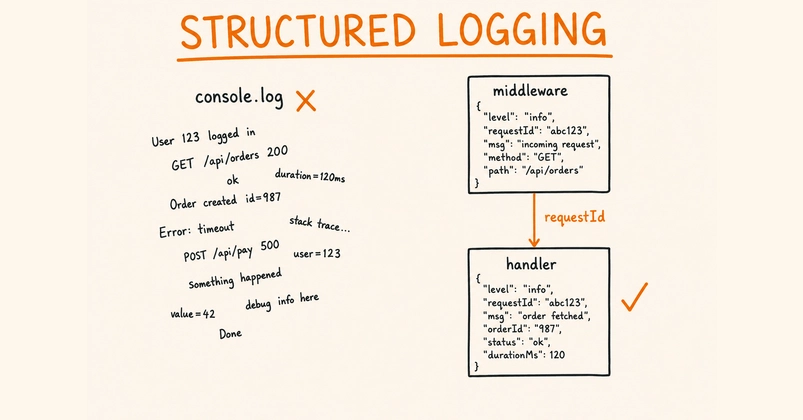
Start with an event contract before comparing destinations. Every application log should be structured and should carry request_id, user_id, trace_id, and environment; for this scenario, add stable fields such as property_id, service, event_name, and a timestamp generated at the event boundary. Do not place a tenant's free-form message, access token, or full request body in the default record. The point is to preserve enough linkage to reconstruct the control flow, not to make the log store a shadow database.