Nigeria’s manufacturing sector has remained trapped in single-digit contribution to the nation’s Gross Domestic Product (GDP) over the past decade, losing ground to peers including South Africa, Morocco, Egypt, and Ghana despite successive policy reforms aimed at accelerating industrialisation.
The 2023 removal of the petrol subsidy aimed to unlock public funds for investment, but instead drove up operating costs for industrial players. Combined with the recently launched National Industrial Policy (2025–2030), which aims for a 20–25 percent GDP contribution by 2030, the sector’s failure to cross the 10 percent threshold highlights a disconnect between policy goals and real-world implementation.
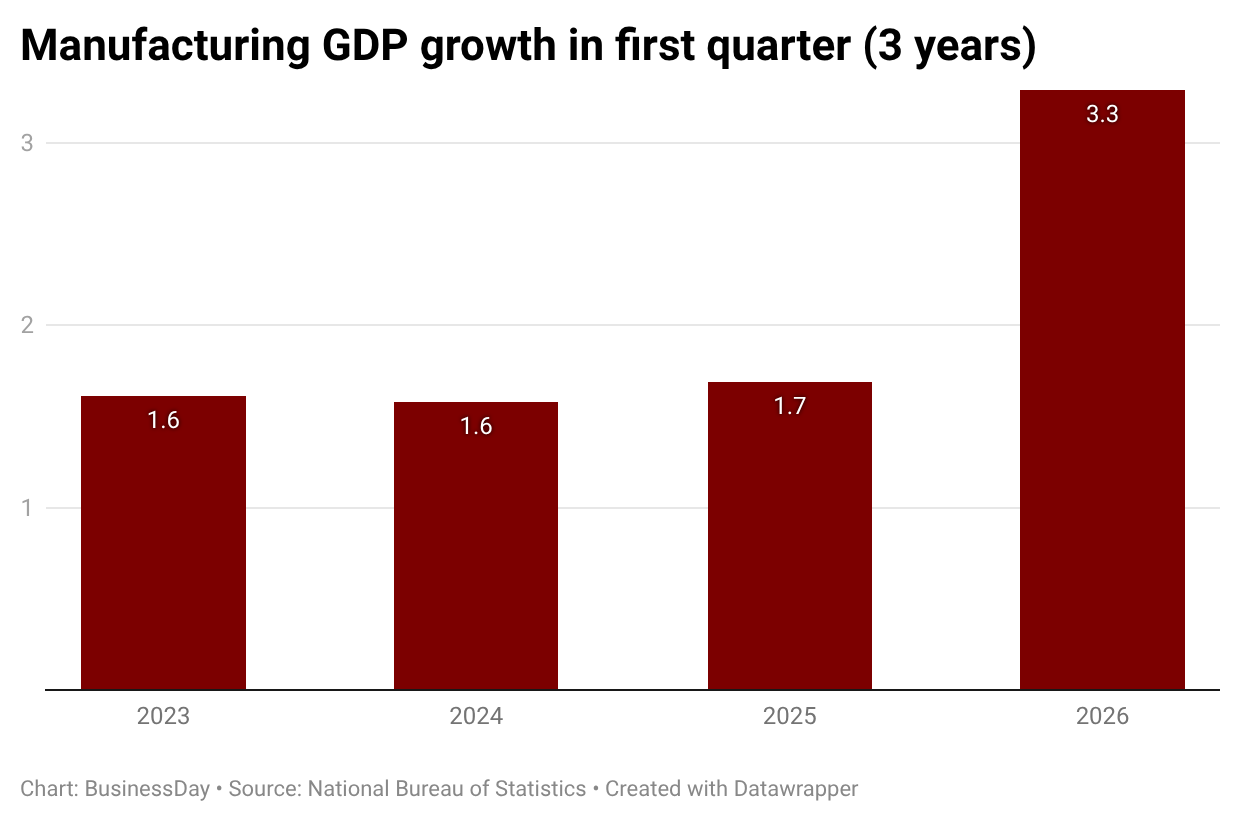
Data compiled from the National Bureau of Statistics (NBS) and the World Bank showed that manufacturing contributed 9.43 percent to GDP in 2015 but declined to 8.05 percent a decade later, highlighting what industry experts have described as a “lost decade” for Nigeria’s industrial sector.
Experts explained that the sector recorded 8.68 percent during the 2016 economic recession before recovering to 9.65 percent in 2018, its highest contribution within the decade. However, the gains proved short-lived as manufacturing slipped to 9.10 percent in 2019 and further dropped to 8.08 percent in 2020, following disruptions caused by the COVID-19 pandemic.