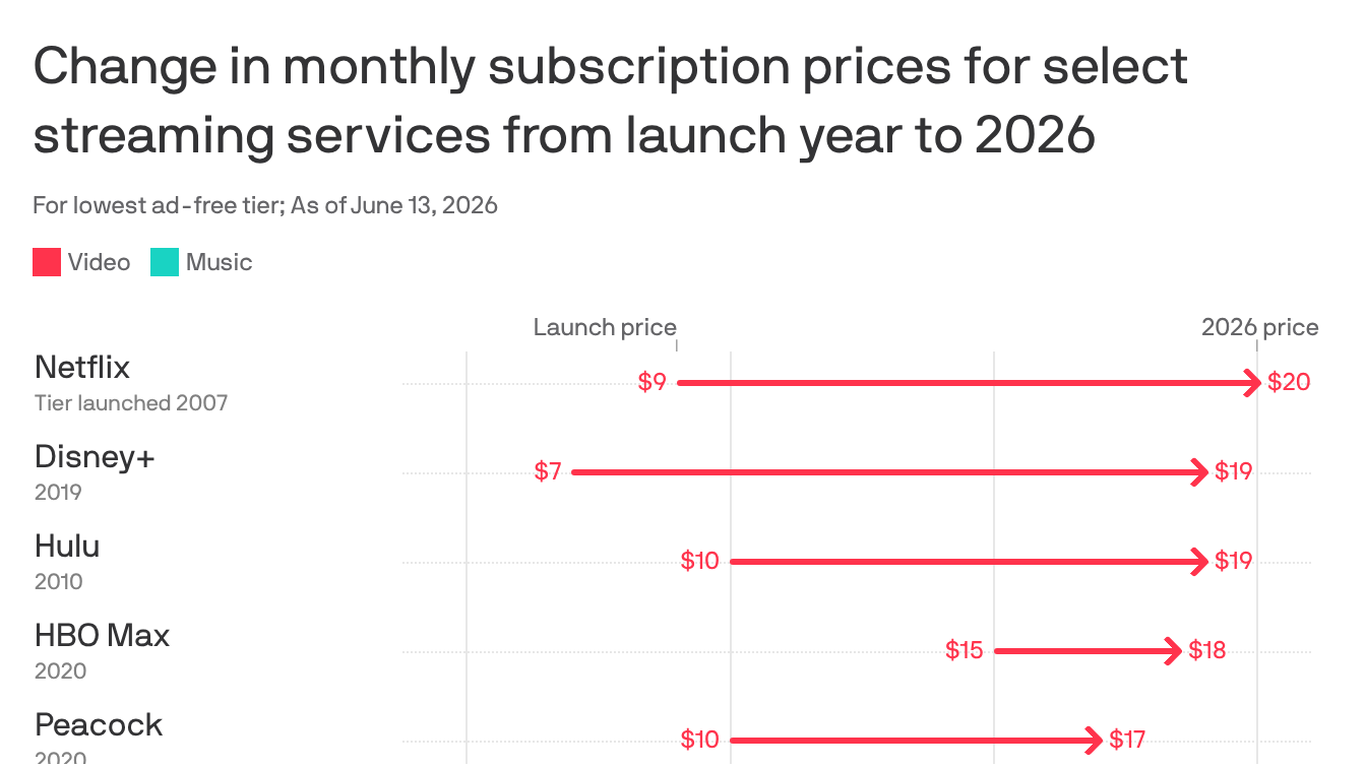
The skyrocketing costs of streaming services are no longer adding up for consumers — and now, platforms are starting to feel the pressure, too.According to new data from Ampere Analysis reported by Deadline, streaming giants like Netflix, Disney+ and Amazon Prime Video are scaling back the size of their price increases as consumers hit their spending limit on monthly subscriptions.The report showed that average price hikes across the three tracked services fell from 24% per subscription in 2023-24 to 14% in 2025-26, which, in dollar terms, translates to a slight decline from $1.67 to $1.54 over the same period.The shift suggests streaming services may finally be nearing their ceiling on rising subscription costs, as consumers have more alternative options across the entertainment landscape (including free, ad-supported platforms) and less room in their budgets for higher monthly bills.Ampere says the trend could also indicate that “streamers are moving closer to the limits of consumers’ willingness to pay,” leaving, in some cases, less room for bigger increases down the road.“The decline in price increases comes as streamers diversify how they monetize their audiences,” Jaanika Juntson, a senior research manager at Ampere Analysis, said in the report. She also noted that advertising is “an increasingly important revenue stream” that’s influencing how much platforms raise their prices. As a result, streamers have had more incentive to keep price increases modest on ad-supported plans while raising them more aggressively for ad-free tiers.Hence, Ampere’s findings reflect that plans without ads have seen larger average price hikes than those with ads ($1.61 versus $1.21), further widening the gap between the two. Still, the data shows that all three tracked platforms have made some progress in recent years to offer relief to consumers.In the case of Netflix, Ampere found that pricing changes across its plans have “remained broadly stable” over the past three years, while Disney+ has “seen the clearest shift toward more modest increases.” Prime Video, however, has made the fewest, which is “likely reflecting the broader role of the Prime subscription within Amazon’s retail business.” The frequency of price increases has also differed across each platform.As Juntson notes in Ampere’s report, streaming platforms appear to be relying less on price hikes to drive revenue growth today. Still, rising subscription costs remain a big concern for consumers.Why have streamers continued to raise prices?Inflation among streaming services, better known as “streamflation,” isn’t particularly new in the era of cord-cutting.However, as streaming platforms evolve and the cost of content continues to climb, so have subscription prices. Speaking with NerdWallet earlier this year, streaming media expert and consultant Dan Rayburn pointed to the growing pursuit of sports rights as one factor driving up the cost of subscription plans.“The business model doesn’t work if you’re paying $8 a month,” he said.Rayburn points to Paramount as one example. Last August, the company struck a seven-year deal for Paramount+ to be the exclusive home of all UFC events in the U.S., then announced a move to raise prices across its ad-supported and ad-free plans just a few months later in November.“It’s billions of dollars they just spent,” Rayburn added. “They need to somehow pay for this.”In the past, streamers have typically raised prices gradually, spreading out small increases over time to make them easier for subscribers to stomach. But when the average U.S. consumer already pays for four major streaming services each month, spending about $69 in total, according to a study published by consulting firm Deloitte in March, even modest price hikes can quickly add up.Last year alone, major services, including Hulu, Disney+, Apple TV and Paramount+ hiked fees on their plans. All of them, along with Prime Video, have also seen some of the steepest increases in recent years across both ad-supported and ad-free tiers, with prices climbing by at least 50% since 2022, according to data reported by CableTV.com.However, Peacock has seen the most dramatic rise, particularly among its premium ad-free plan, which has nearly doubled from $9.99 to $19.99 over the last four years.Here’s how consumers are responding to “subscription fatigue.”Peacock’s recent announcement to raise prices again this month, marking its fourth hike in four years just after turning profitable for the first time, left some subscribers particularly frustrated online:Peacock going up on their prices makes it sooo easy for me to cancel their subscription. lol them & paramount + can gone on somewhere. 🙅🏾♀️— mook. 🌺 (@mookaveli92) August 24, 2026Meanwhile, ESPN also just announced that monthly and annual prices for ESPN Select and ESPN Unlimited are going up starting Sept. 17, which will also affect Disney+ and Hulu bundles. It’s safe to say the news didn’t sit too well with subscribers to the impacted platforms.Why is the hulu/espn/disney bundle going up to $32!!!!! WHAT IN THE FUCK! They literally increase the price every year, this shit is a scam!— Dom (@Rxde_BB) August 23, 2026Just got an email saying my Disney+, Hulu, and ESPN+ subscription is going from $15/mo on my Verizon bill to $32.99/mo??????????? I will be canceling that so fast— lauren ❤️🔥🏈 (@folklaurenx) August 20, 2026It’s unclear how many subscribers have actually followed through on their threats to cancel. Still, the backlash reflects a broader dissatisfaction with rising streaming costs, which aligns with Deloitte’s study showing that nearly three-quarters of consumers (73%) are tired of streamers they subscribe to continually raising their prices.That may help explain why roughly 40% of consumers surveyed in the same study said they’ve recently cut back on entertainment subscriptions because of financial concerns.Similarly, a 2024 Horowitz Research survey found that 53% of free, ad-supported streaming TV (FAST) users had reduced their paid streaming subscriptions after turning to free platforms such as Tubi, Pluto TV, Freevee, YouTube and Roku.“As the FAST space matures, it does feel like a correction of many of the issues that on-demand streaming created for both consumers and the industry,” Adriana Waterston, EVP, and insights and strategy lead for Horowitz Research, noted in the survey. Alternatively, as prices rise, consumers are also increasingly trading ads for savings, with 45% of Americans already using or likely to use lower-cost, ad-supported tiers from services like Netflix and Hulu to reduce their monthly costs, according to a 2025 KPMG survey.Consumers seem to be taking matters into their own hands now, adapting to rising costs in ways platforms are only beginning to address. While some services may finally be changing course, meaningful relief from the collective cost of streaming still appears to be a ways off.
Consumers Have Hit Their ‘Limit’ With Streaming Price Hikes. Now Platforms Are Changing Course.
If you’re tired of rising costs, there may finally be some relief on the way.
1,073 words~5 min read