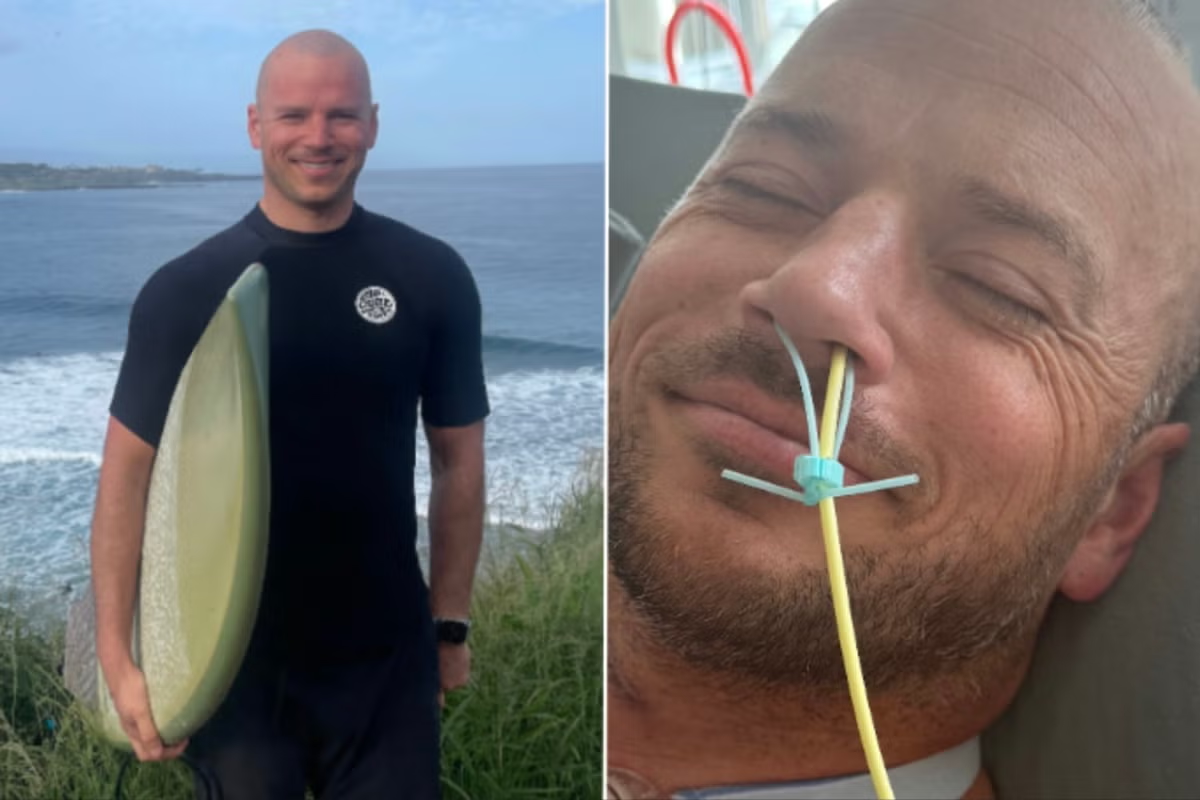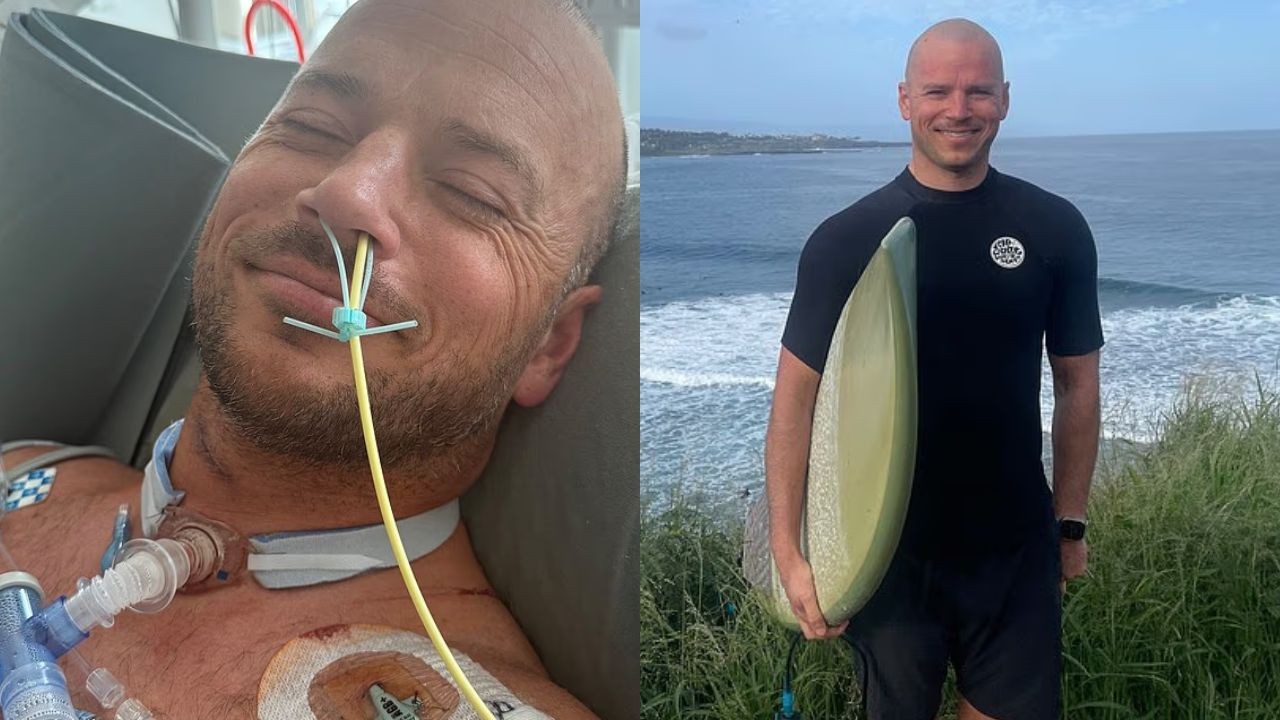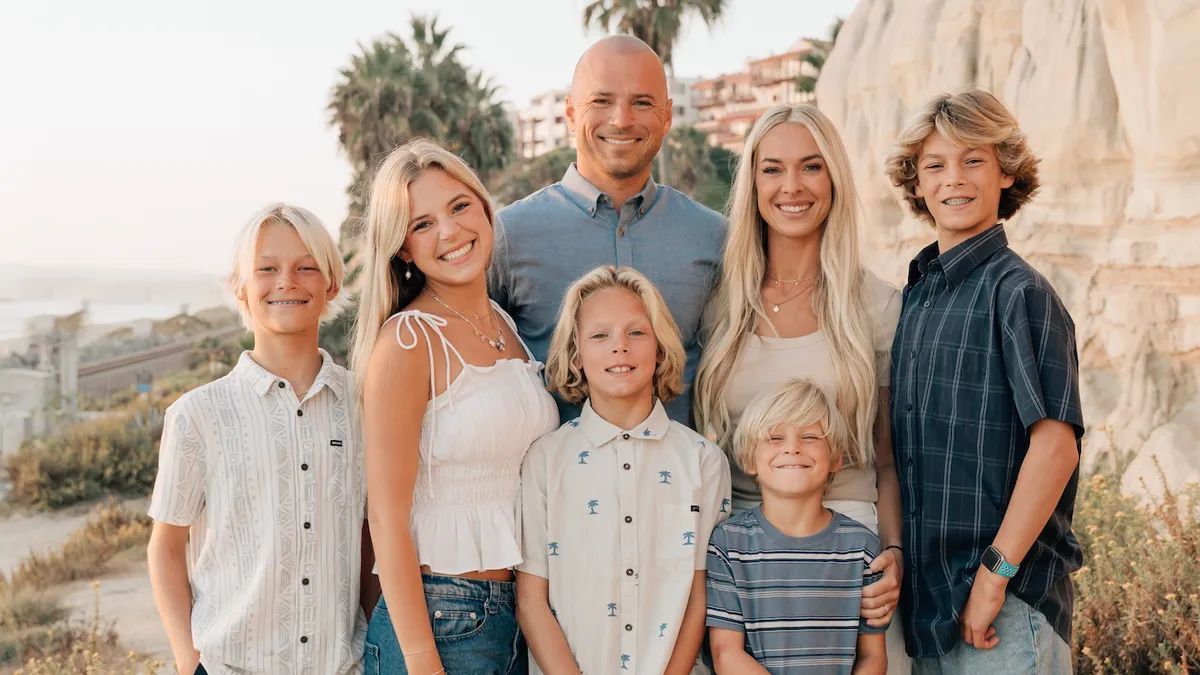
On Aug. 15, my 42-year-old cousin, Josh Collette, broke his neck after diving into the surf to save a young child caught in a rip current at Riviera Beach in San Clemente, California.It’s a beach Josh knows well. “He is literally in the water every day and is constantly surfing with our boys – often near that very spot,” his wife, Rose, tells me. But powerful El Niño-fueled swells have been reshaping the shoreline, stripping away sand and changing the contours beneath the water.That may be why Josh felt uneasy from the moment he arrived at the beach that Saturday afternoon with Rose, three of their five children, and some friends. “Right when we got there, Josh said he could tell the beach was different and that something was ‘off,’” Rose explains.As the children played and the adults talked, Rose kept noticing her husband looking toward the water, scanning the horizon. Then the mother of an 8-year-old boy they were visiting with screamed that her son was being swept out to sea in a rip current.“It was right where Josh had pointed when we first arrived,” Rose says. The boy’s mother sprinted toward the water, but Josh barreled past her. “I’ve never seen him run that fast,” Rose tells me.He charged into the ocean and dove toward the child. "But he didn’t come up,” she says.When Rose, their friends and other beachgoers reached Josh, he appeared lifeless. His strong body was "dead weight" as they pulled him from the water and carried him across the sand and rocks.Josh remembers his head striking compacted ground where he expected deep water to be. “I immediately knew I had broken my neck,” he later communicated to Rose. “I felt my entire body tingle.”As soon as he saw his wife, he locked eyes with her and gasped, “I can’t breathe!”Rose began giving him mouth-to-mouth and continued until help arrived. The child Josh had rushed to save was helped by others, but Josh had to be transported from the beach, unable to move.His actions have since been documented by news outlets like People, Fox News, CBS News and KTLA. Inside Edition was also at the hospital this morning interviewing Josh and Rose. The world has rightly called my cousin a hero.But while she appreciates the support and it's never in her to complain, Rose tells me that no headline can capture what that one heroic effort has taken from a young family – or the fight now required simply to reclaim their ordinary life.A man no stranger to helping othersAs family, I share those concerns. He's the cousin I remember driving to visit in his childhood home in Concord, California, many times in my childhood. He's the cousin who once ran some eight miles with me down from Half Dome back to our campsite during a family reunion in Yosemite. He's the cousin I have gotten into trouble with, laughed with and cried with – and whose leadership and advice have guided me at pivotal moments in my life. And though he is two years my junior, he's also the cousin who gave me one of my first jobs after college.This is a man who is no stranger to challenges or helping those around him. He lost his father when he was 16, yet three years later, put his own life on hold to spend two years serving others as a missionary. As an adult, he spent years waking before dawn to teach early-morning seminary, has donated blood consistently for a decade and works alongside Rose to regularly coordinate youth activities in their community – some involving as many as 600 to 800 teenagers at a time.He also co-founded a renewable-energy company and became its CEO, helping build an organization that now employs some 500 people. He calls Rose the "love of (his) life," and the pair have four sons and a daughter together. Their 20th wedding anniversary is just over a week away.But now, everything they have built together has been upended. “Josh can’t feel anything from the neck down,” Rose says. “His doctors say the paralysis is ‘complete.’”As devastating as that word is, it is also often misunderstood. In spinal cord medicine, “complete” does not necessarily mean the spinal cord was physically severed, but instead means a neurological examination has found no preserved movement or sensation below the injury – from the neck down, in Josh’s case. Surgery can stabilize fractured vertebrae and relieve pressure on the spinal cord in some such cases, but it cannot undo damage that has already occurred.It's the kind of devastating injury that can even make something as fundamental as breathing extraordinarily difficult, because, while the brain normally sends signals through the spinal cord to nerves in the neck that activate the diaphragm, an injury high in the neck can interrupt those signals.It can also weaken or cripple the chest and abdominal muscles needed to cough and clear secretions, sharply increasing the risk of mucus buildup, collapsed portions of the lungs, pneumonia and other respiratory complications, all of which Josh is currently fighting.“Almost all of his breathing has to be done by machine right now,” Rose tells me, noting that over the past 10 days, he has breathed independently for only a total of 15 minutes. The breathing tube placed through an opening in his neck has also left him unable to use his voice. So for now, he communicates by mouthing words, while Rose reads his lips.Their children saw him in the hospital for the first time just three days ago. “To see their Superman father hooked up to machines and wires and unable to move or speak was beyond difficult for them,” Rose says.'He will forever be our family's hero'No one can yet promise how much function or feeling Josh will recover, if any. A neurologically complete cervical spinal cord injury carries a grave prognosis, and regaining the ability to walk after such an injury is rare.At the same time, writing the final chapter of recovery only 10 days after an injury is far too early. Swelling and spinal shock can cloud the earliest neurological picture, and physicians repeat examinations over time for good reason, as many people once given a grave prognosis go on to recover. Some even walk again. But when neurological recovery does occur, it is generally greatest during the first several months after an injury. That is why a state-of-the-art rehabilitation facility in Colorado is standing by to receive Josh as soon as he is medically stable and his fever and pneumonia are under control.Once there, his days will revolve around learning to breathe as independently as possible; strengthening his remaining muscles; protecting his immune system; preventing pressure injuries and other complications; managing bowel and bladder function; preserving the mobility of his joints; operating a power wheelchair and communication technology; and relearning how to direct the countless routines of daily life that many take for granted.He will also receive intensive physical, occupational and respiratory therapy – helping to maximize any neurological recovery that may be possible.But Rose explains that this vital inpatient care could cost the family as much as $10,000 a day. And once Josh finishes his time there, he will still need extensive and costly outpatient therapy, medical equipment, accessible transportation, home modifications and ongoing caregiving.There is one responsibility that Josh will never surrender: Being a husband and a father. “A silver lining in all this is that Josh is looking forward to spending more time with us," Rose says. "We are his pride and joy, and he will forever be our family's hero." A GoFundMe campaign has been established to help cover Josh’s medical care, rehabilitation, equipment and his family’s mounting expenses.
He dove into the ocean to save a child. Now he's paralyzed
No headline can capture what that one heroic effort has taken from a young family – or the fight now required simply to reclaim their ordinary life.
1,286 words~6 min read