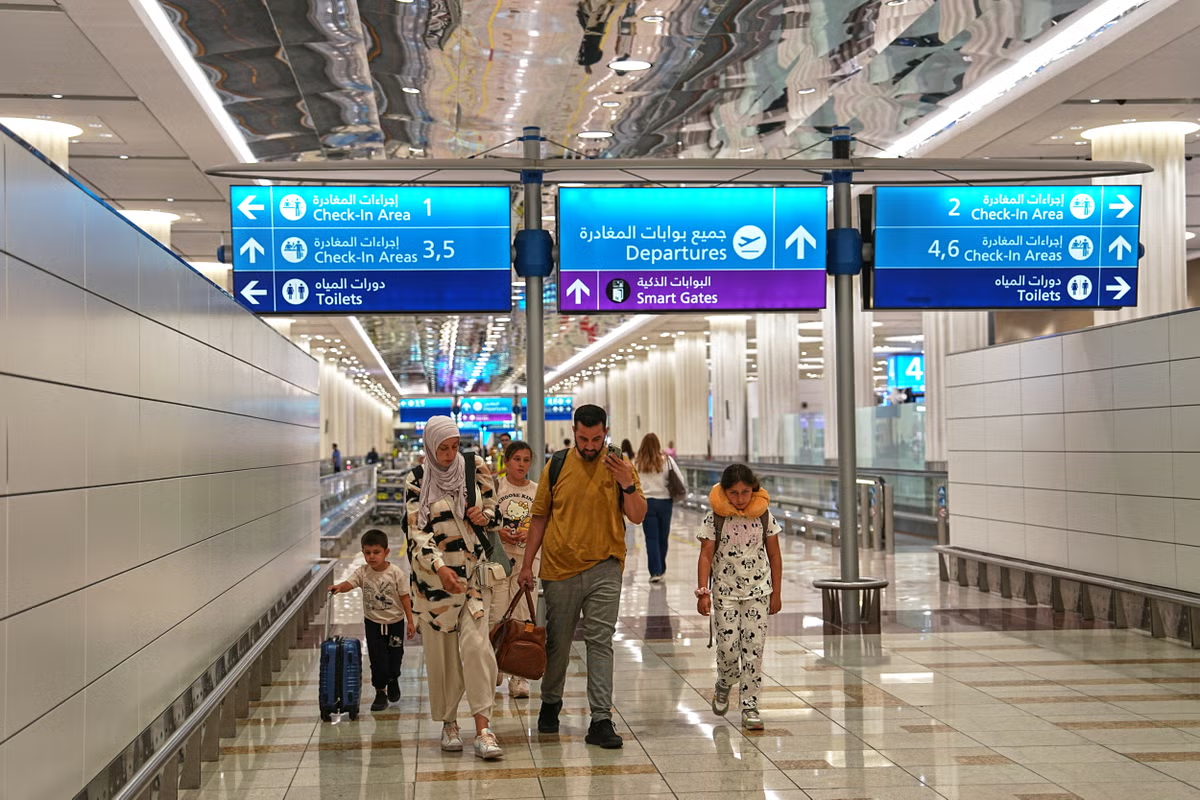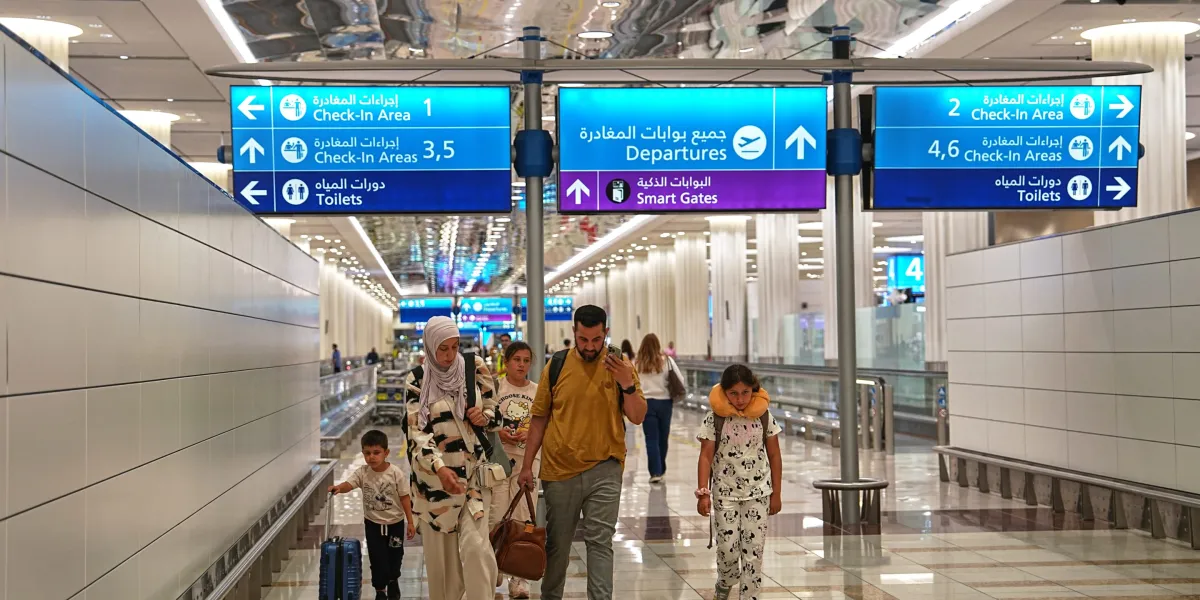
H1 passenger traffic fell 31.3% to 31.5m as aircraft movements dropped 32.1% amid recoveryLast updated: August 26, 2026 | 07:204 MIN READPassengers at the departures area of Dubai International Airport as UAE travellers continue with summer holiday plans while increasingly opting for flexible tickets and delaying last-minute bookings amid ongoing uncertainty in the Middle East.Virendra Saklani/Gulf NewsH1 traffic falls DXB welcomed 13 million passengers during the second quarter, taking first-half traffic to 31.5 million – a 31.3 per cent decline compared with the same period in 2025. Aircraft movements told a similar story, totalling 150,600 during the first half, down 32.1 per cent year on year, including 62,500 movements in Q2 alone.Cargo throughput also slipped, with 751,340 tonnes handled in H1, a 28.7 per cent drop year on year, of which 351,716 tonnes moved through the airport during the second quarter. Baggage handling followed the same trend, with DXB processing 30.3 million bags in H1, down 28 per cent, including 12.7 million in Q2.The declines reflect what Dubai Airports has described as one of the toughest operating environments in the airport's history, shaped largely by regional airspace constraints that disrupted schedules and capacity across the sector during the period.Momentum building through Q2Despite the headline figures, the second-quarter trajectory points to a steady recovery. Monthly guest volumes rose consistently, climbing from 3.5 million in April to 4.5 million in May and 5 million in June, as international carriers gradually resumed operations and connectivity improved.Paul Griffiths, CEO of Dubai Airports, said the first half tested every part of the aviation system, but pointed to a swift rebound as capacity returned. "The first half of the year tested every part of the aviation system, and demonstrated our resilience," he said. "As capacity steadily returns across the board, demand is responding immediately. That is particularly important for DXB, where international transfers account for a significant share of traffic."Griffiths added that the airport community’s performance in recent months had positioned DXB well for the demand still to come. "Strong performance across the airport community in recent months has left us well placed to accommodate returning demand, work closely with our airline partners, and reinforce Dubai's position as a leading global hub."Get updated faster and for FREE: Download the Gulf News app now - simply click here.Global reach holds firmEven amid the disruption, DXB's network remained extensive. By the end of the first half, almost 50 international airlines served the airport, connecting travellers to 217 destinations across 99 countries. Load factors continued to strengthen and were reported to be approaching 2025 levels as international connectivity expanded – a signal, Dubai Airports said, of resilient underlying demand across key source markets.Operationally, DXB maintained strong service benchmarks despite the lower volumes.The airport reported that 98.98 per cent of guests cleared departure passport control in under 10 minutes, 98.95 per cent cleared arrival passport control in under 15 minutes, and 99.34 per cent passed through security in under five minutes.Baggage handling also outperformed global standards, with a mishandled baggage rate of 2.7 per 1,000 passengers, well below the latest industry benchmark of approximately 4.9 per 1,000 passengers.Investment programme continuesAs airline schedules rebuild, Dubai Airports said it is pressing ahead with a broad investment programme to future-proof the hub. This includes upgrades to guest facilities, a new consolidated remote departures experience, expanded self-service options, the continued rollout of biometric systems, smarter operational tools and targeted capacity improvements.The airport is also deploying new technology and redesigning key guest areas to improve comfort and ease of movement, particularly around waiting zones and high-traffic corridors.Dubai Airports said the combined effect of these initiatives would be to simplify journeys, increase operational flexibility and reinforce the seamless experience passengers expect at one of the world's busiest gateways.Stronger H2 expectedLooking ahead, Dubai Airports said it anticipates stronger momentum through the remainder of the year.The recovery is expected to be driven by the continued rebuilding of airline networks and frequencies, rising international transfer traffic, easing travel advisories across key source markets, the start of the winter schedule, and Dubai’s packed calendar of global business, leisure and sporting events.In fact, top aviation analysts told Gulf News recently that passenger numbers in the UAE are recovering faster than expected as airport projects remain on track, and confidence is returning. André Martins, Partner and Head of Transportation and Advanced Industrials at Oliver Wyman (IMEA), said, “The recovery has been faster than many expected. Assuming there is no further major disruption, and international tourism continues to recover through the remainder of the year, Dubai is on track to finish 2026 close to 100 million passengers - broadly in line with its pre-conflict trajectory.”Martins added that transfer traffic — a core part of DXB's hub model — has already rebounded. "Transfer traffic took the sharpest hit during the disruption, but it has rebounded strongly. By the summer peak, connecting passengers were once again accounting for around half of Dubai's traffic."On the investment outlook, James Burlumi, Managing Director at Matthews EMEA, said Gulf airport expansion plans remain largely undisturbed. "We have not seen any meaningful reduction in development activity across the aviation sector as a result of the recent conflict... We are seeing significant and sustained investment in aviation development programs across the major international gateways (Dubai, Riyadh, Jeddah)."Also In This PackageDhanusha is a Chief Reporter at Gulf News in Dubai, with her finger firmly on the pulse of UAE, regional, and global aviation. She dives deep into how airlines and airports operate, expand, and embrace the latest tech.
Dubai Airports set to pick up pace after tough first half sees 31% traffic drop
Dubai International Airport sees 31% H1 traffic drop but gears up for a stronger H2 2026 with rising passenger volumes, robust global connectivity and major upgrades.
1,021 words~5 min read