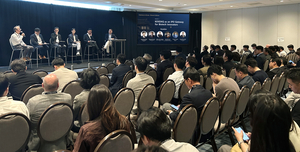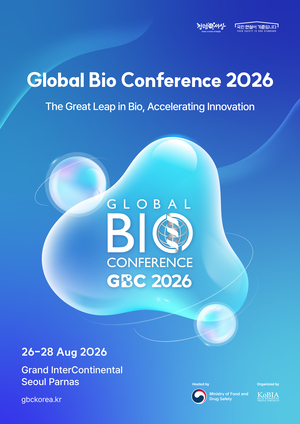
Global Bio Conference 2026 (GBC) The 2026 Global Bio Conference opened on Wednesday, bringing together regulators, industry leaders and researchers to discuss emerging biopharmaceutical technologies and the regulatory frameworks needed to bring them to market.Hosted by the Ministry of Food and Drug Safety, the three-day event is being held under the theme “The Great Leap in Bio, Accelerating Innovation" at the Grand InterContinental Seoul Parnas in Gangnam-gu, southern Seoul.Now in its 12th edition, the conference brings together some 5,000 participants from around the world each year.This year’s conference focuses on how regulation and international cooperation can help translate fast-moving innovations, such as artificial intelligence and advanced biopharmaceuticals, into real-world products and medical treatments.Discussions will also address ways to strengthen the global competitiveness of Korea's biopharmaceutical industry.President Lee Jae Myung and National Assembly Deputy Speaker Nam In-soon are expected to deliver congratulatory remarks at Wednesday’s opening ceremony.The keynote session will feature Lee Sang-yup, distinguished professor at KAIST; Jeremy Farrar, assistant director-general at the World Health Organization; Azad Bonni, senior vice president and global head of neuroscience and rare diseases at Roche Pharma Research and Early Development; and David Nogales, head of technology strategy at Merck KGaA.They will discuss the outlook for innovation and changes in the global pharmaceutical industry and the evolving role of regulation.A newly created session, “GBC Special: K-BIO Innovation Leaders Talk,” will bring together industry leaders who have driven the growth and innovation of Korea’s biopharmaceutical industry. They will share first-hand accounts of their successes and challenges, as well as strategies for entering global markets.From vaccines to regulatory scienceOn Thursday and Friday, the conference will feature a series of forums covering vaccines, recombinant protein products, the biopharmaceutical supply chain and regulatory science.The Vaccine Forum will examine overseas regulatory experience in post-authorization vaccine safety management, platform-based vaccines and emerging regulatory science. The Recombinant Protein Products Forum will focus on AI-driven antibody drug development and the regulatory shift toward greater use of analytical evidence.The Biopharmaceutical Supply Chain Forum will discuss strategies for overcoming supply chain vulnerabilities and building a stable pharmaceutical supply system under crisis conditions, such as pandemics, geopolitical tensions and instability in raw material supply.Another key program, the Regulatory Science Innovation Forum, will examine the Food and Drug Safety Ministry's “Innovation Plan for the Approval and Review of Medical Products,” implemented June 1. The initiative is aimed at accelerating reviews of new drugs, biosimilars and medical devices using new technologies.Amid a broader move to replace animal testing of biopharmaceuticals with nonanimal methods, the Workshop on Animal Testing Alternatives for Biologicals will discuss trends in alternative test methods at the WHO, the European Directorate for the Quality of Medicines & HealthCare and other national regulatory authorities. It will also examine the status of development in Korea and the latest quality control trends.Mentoring for Bio Youths, a mentoring program for young people who will lead the biopharmaceutical industry, will also be held as part of a total of 16 forums.Building global regulatory tiesInternational regulatory cooperation will be another focus.The Regulatory Workshop will introduce the latest approval and review systems of participating regulatory authorities and discuss the role of regulators in supporting the development of biological therapeutics through technological innovation.Following the workshop, one-on-one meetings will be held between Korean companies and overseas regulators from Canada, Japan, Singapore and other countries to support Korea’s entry into overseas markets.Regulators from the WHO, European Medicines Agency and Japan's Pharmaceuticals and Medical Devices Agency will participate in discussions on emerging vaccine technologies and regulatory issues during the Vaccine Assessors Workshop.The Collaboration Meeting of Reviewers for Recombinant Protein Products will bring together regulatory authorities from the Food and Drug Safety Ministry, the US Food and Drug Administration, EMA and PMDA to share the current status and issues surrounding the marketing authorization and review of recombinant protein products and discuss approaches to regulatory cooperation.The ninth NIFDS-PMDA Joint Workshop will also take place. Participants will examine the current landscape in advanced biopharmaceuticals, including cell and gene therapy products, discuss key issues arising in the review process and exchange internationally harmonized perspectives on approval and review.Food and Drug Safety Minister Oh Yu-kyoung said the rapidly evolving biopharmaceutical industry has emerged as a key future growth engine and that the conference would help connect technological innovation with regulatory progress.She said GBC 2026 will allow regulators, industry officials and academics from around the world to share their expertise and accelerate biopharmaceutical innovation, while helping Korea take a further leap forward as a global biopharmaceutical powerhouse.She noted that the ministry will support innovation and Korea's entry into global markets through science-based regulatory innovation and active global regulatory cooperation.The ministry said it plans to use the conference to deepen cooperation with overseas regulators and expand regulatory diplomacy so that Korean biopharmaceutical technologies can reach global markets more quickly.
Global Bio Conference opens with focus on innovation
The 2026 Global Bio Conference opened on Wednesday, bringing together regulators, industry leaders and researchers to discuss emerging biopharmaceutical technol
796 words~4 min read