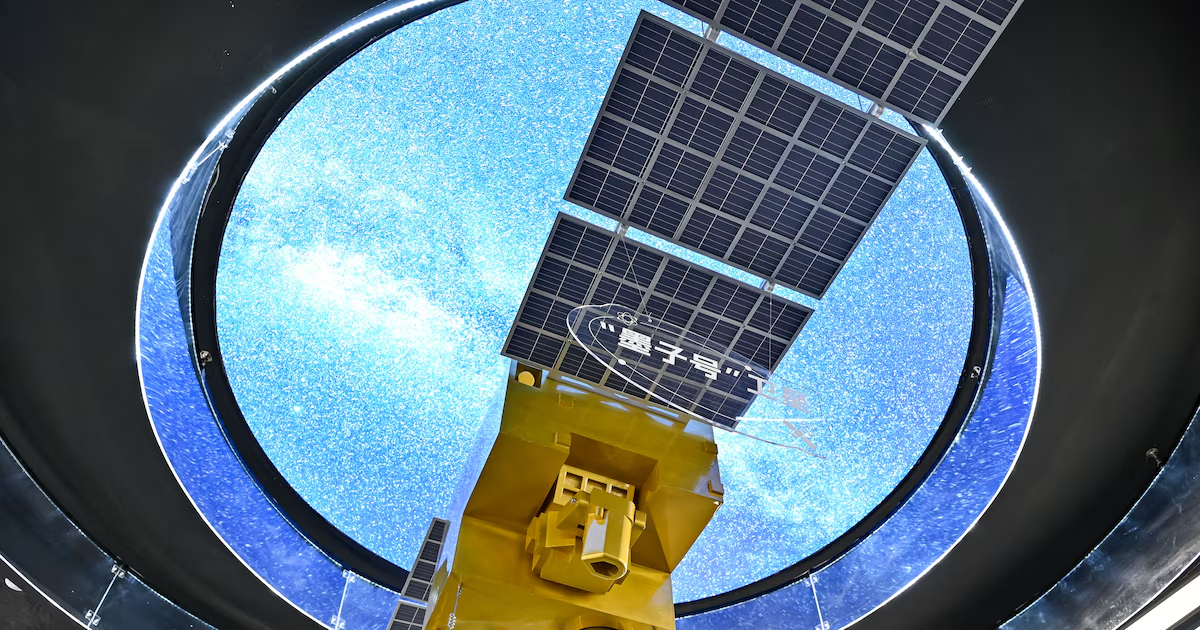
The competition between the United States and China for primacy in quantum technology has heated up in recent years.PixabayIn October 2019, I wrote a Forbes article describing how the United States and China were locked in “the world’s most important technology race.” At that time, the situation was relatively straightforward. China had just launched its national quantum strategy aimed at achieving technological self-sufficiency. President Xi Jinping had invested billions into a vast quantum computing initiative with the expectation of achieving significant breakthroughs by 2030.The U.S. had already signed the National Quantum Initiative Act that authorized $1.2 billion in spending over five years. At the time, I didn’t believe that the level of funding was sufficient to match the Chinese commitments. In 2019, the U.S. had a lead in quantum computing primarily as a result of heavy investments made by IBM, Google and Microsoft.(Note: My firm, Moor Insights & Strategy, provides advisory and related services to many tech companies — including, from this article, Google, IBM and Microsoft. We have previously had paid business relationships with Atom Computing, D-Wave, GlobalFoundries, IonQ, Quantinuum and Rigetti Computing.)At that time, the only technology lead China had over the United States was in quantum communications. Scott Aaronson, a top theoretical computer scientist at the University of Texas, said that China held an edge in quantum communications simply because they chose to invest heavily in that area while the U.S. had opted to maintain its strong lead in quantum computation. His reasoning made sense. Google had just claimed quantum supremacy by solving a problem in 200 seconds that would take a classical computer thousands of years to solve — a quantum computation feat that China was not likely to match anytime soon.My chief concern in 2019 was that additional federal funding was needed because the quantum race would unfold over decades, not months, and therefore required a long-term financial commitment. Even though that prediction proved accurate, I didn’t anticipate how dramatically the quantum development landscape would change. The decisive factor shifted from which country spent the most money to which country could assemble the most viable commercial quantum stack. That change opened the door to small startups, some of which have since become viable and competitive.MORE FOR YOUU.S. Quantum In 2026: Industrial Policy Meets Private CapitalThe United States has undergone a significant quantum awakening since 2019. One of the most important developments came this year. On May 21, the Department of Commerce announced that $2 billion in CHIPS Act incentives would be spread across nine quantum computing companies. That was the largest single federal intervention in the quantum industry to date. It was also different from previous conventional grants because this time the government took minority equity stakes in each recipient — a major shift in U.S. government industrial policy.For starters, the government granted $1 billion to IBM for a new quantum foundry (more on that in a moment). The remaining $1 billion was distributed to GlobalFoundries ($375 million for a multi-modality quantum foundry), with $100 million each to D-Wave, Rigetti, Infleqtion, PsiQuantum, Quantinuum and Atom Computing, with up to $38 million for Diraq’s silicon-spin qubit work. It was a strategic distribution of funds across every major hardware modality: superconducting, trapped-ion, photonic, neutral-atom, topological and silicon-spin quantum computers.IBM complemented the government’s massive funding package with its own $1 billion to launch Anderon, a standalone quantum wafer foundry in Albany, New York, that would be America’s first pure-play quantum chip manufacturing facility. On June 2, IBM committed more than $10 billion in total quantum investment that would be spread over five years. The funds are focused on developing a large-scale, fault-tolerant quantum computer by 2029.These moves fit with IBM’s long-term commitment to quantum computing. It has deployed over 90 quantum systems globally, which is more than the rest of the industry combined. It has more than 340 members in the IBM Quantum Network spread across financial services, healthcare, materials science, academia and government.Not content with its quantum supremacy demonstration in 2019, Google has also continued to invest for the long haul. Google Quantum AI achieved a historic milestone in December 2024 by developing its 105-qubit Willow chip. That processor demonstrated below-threshold quantum error correction. That meant that by adding more qubits, it actually reduced errors exponentially — a goal that Google and other researchers had been pursuing for about three decades.In October 2025, Google reported that its Quantum Echoes chip also produced verifiable quantum advantage (which occurs when a quantum machine demonstrably outperforms any comparable classical computer). That calculation was 13,000 times faster than the Frontier supercomputer at the Oak Ridge National Laboratory and created results that were reproducible on a separate quantum machine. In January 2026, the Google Research Blog explained how the company used dynamic surface codes on the Willow chip as part of its push toward a long-lived logical qubit with fewer than one error per million correction cycles.Meanwhile, U.S.-headquartered quantum startups raised more than $2.7 billion in funding across 2025. Leading the way, PsiQuantum held a $1 billion Series E funding round, led by BlackRock, that valued the company at $7 billion. That was the largest single private funding round in quantum computing history.There’s more support in place from the federal government, too. Last year, President Trump signed an executive order to create a new national quantum strategy. It included funding for a federally backed quantum computer for scientific research, along with agency-level deadlines for migration to post-quantum cryptography systems. The order was described as the most expansive federal quantum policy action since the NQI Act of 2018. In 2026, the Department of Energy followed Trump’s executive order with Quantum Genesis, a program that set a goal to achieve fault-tolerance for systems “with logical qubits numbering in the low hundreds” by 2028.By the way, the PQC migration deadlines reflect the U.S.’s leadership in cryptographic defense. NIST finalized three post-quantum cryptography standards (FIPS 203, 204, 205) in August 2024. These provide foundational algorithms for quantum-resistant key encapsulation and digital signatures. NIST’s transition guidance, IR 8547, provides a way to deprecate quantum-vulnerable algorithms such as RSA and elliptic-curve cryptography from federal standards by 2035. The PQC market is projected to grow from $420 million in 2025 to $2.84 billion by 2030.China’s Quantum Industry In 2026: State-Directed AccelerationChinese private venture capital and public investments have surged since 2019. According to QED-C’s State of the Global Quantum Industry 2026 report, private quantum VC reached $4.9 billion in 2025. All evidence suggests that the support is paying off: The country’s quantum computing sector income reached 11.56 billion yuan ($1.61 billion) in 2025, with annual growth above 30%. And its number of quantum companies jumped from 93 in 2023 to 153 in 2024, according to China Briefing.The 2025 funding amount more than doubled the prior year’s record — and China has maintained that momentum. The 15th Five-Year Plan, which runs from 2026 to 2030, was approved in March of this year. Quantum has been designated the first of seven “future industries,” a designation with a specific legal and budgetary classification that separates it from ordinary strategic sectors.The Chinese National Venture Guidance Fund has allocated 121.8 billion yuan ($17.5 billion) across three regional quantum-focused funds: Beijing-Tianjin-Hebei for quantum computing and quantum sensing, Yangtze River Delta for quantum communications and Guangdong-Hong Kong-Macao for commercial products. Earlier this year, these funds announced backing for 27 direct investment projects. Overall, China’s quantum investment in Q1 2026 alone was close to its total 2025 investments.Along the way, China has made significant progress with quantum hardware across several different architectures. For example, the Zuchongzhi superconducting processor series had 62 qubits in 2021. Chinese scientists increased that to 105 qubits in Zuchongzhi 3.0. In December 2025, Zuchongzhi 3.2 was equipped with 107 qubits and demonstrated below-threshold quantum error correction on a distance-7 surface code. It is important to note that this is a major technical achievement accomplished only by China and Google so far.Another one of China’s superconducting systems, the Tianyan-504, was equipped with 504 qubits. On the networking front, the Origin Wukong platform has completed more than 760,000 quantum computing tasks, serving users across 163 countries via cloud access. And in October 2025, a 100-qubit neutral-atom quantum computer, the Hanyuan-1, was China’s first commercial quantum deployment. Its customers included the Pakistani government.Quantum Communications: China Is Still LeadingIn 2019, I wrote that China held a significant advantage over the United States in quantum communications. We have yet to catch China in that area. In fact, in the seven years since my article was published, China increased its lead by building the world’s largest operational quantum communication network. It is a carrier-grade system with more than 12,000 km of fiber and 145 backbone nodes across 80 cities in 17 provinces. The network serves 6.8 million users.China launched its Micius quantum communication satellite in 2016. That satellite is no longer in service because of orbit decay earlier this year, but China’s backup is the Jinan-1 microsatellite, which has established real-time quantum key distribution with ground stations across China and one in Stellenbosch, South Africa. Besides creating the first quantum satellite communication link in the southern hemisphere, that system set a 12,900 km intercontinental QKD record. China has plans to launch another global quantum communication service in 2027 using a satellite constellation to provide transmissions among BRICS nations.In January 2026, researchers at the University of Science and Technology of China published an important research paper in Nature explaining the first scalable building block for a quantum repeater — a critical step in practical quantum networking. It used trapped-ion quantum memories with remote entanglement over 10 km of fiber.Unfortunately, the United States has no comparable deployed infrastructure for quantum networking. However, the U.S. Department of Energy’s Quantum Internet Blueprint and various testbeds represent early-stage efforts. I also wrote a white paper this year that describes IonQ’s aggressive plans for a global quantum network.Quantum Export Controls And The Supply-Chain FrontA dimension missing from my 2019 article was the emergence of quantum-specific export controls as a strategic policy tool. The U.S. Bureau of Industry and Security finalized list-based quantum computing controls in September 2024. Those controls restrict the export of quantum computers of 34 or more qubits, cryogenic cooling systems and key components such as dilution refrigerators.The Treasury Department’s outbound investment rule became effective on January 2, 2025. It prohibits U.S. persons from investing in Chinese quantum computing, sensing for military use and quantum communication systems. The May 2024 Entity List added an additional 22 Chinese quantum entities. Controls have also been added for cryogenics suppliers and scientific equipment distributors.However, the export controls had an unintended consequence: accelerating China’s domestic supply chain development. Within two years of the U.S. adding the initial controls, China began producing in-country dilution refrigerators. Previously, cryogenic systems were sourced almost exclusively from Finland’s Bluefors and the U.K.’s Oxford Instruments.A Multidimensional Quantum Race EmergesWhen I wrote my 2019 article, the quantum race was basically a team effort between America’s academics and quantum startups against China’s state-directed strategic investment. That conflict still exists, but the real competition has shifted to another, more serious question: Will China or the United States be the first to assemble the full stack of hardware, error correction, software, networks, standards, supply chains, talent and customers fast enough to gain a strategic advantage?The U.S. leads today in the diversified commercial quantum computing ecosystem. Currently, China cannot match the combination of our venture-backed startups, cloud quantum access, enterprise pilot programs and hyperscale integration. Indeed, IBM’s $10 billion commitment to quantum, Google’s error correction breakthroughs and the federal government’s equity-stake industrial policy represent a scale of coordinated investment that I couldn’t imagine when I wrote the original article in 2019. Another important element comes from the United States’ lead in post-quantum cryptography standards that are being adopted globally. And according to IBM’s latest report, we have finally begun to achieve quantum advantage according to the tracking system that it established for the industry. That is a category that will be difficult for China to match.Meanwhile, China leads in quantum communications infrastructure and concentrated national deployment. Its 12,000 km quantum network, satellite QKD capabilities and $17.5 billion Venture Guidance Fund represent a scale of state commitment that the U.S. has yet to replicate.In my view, there are two decisive factors that will determine the winner of the two-country quantum competition: (1) the achievement of fault tolerance and (2) the development of truly useful fault-tolerant applications. The U.S. has several companies with a good chance to build fault-tolerant systems by 2028 and 2029; among others, IBM, IonQ and QuEra have been vocal in their roadmap statements about meeting this timeline. China has yet to announce a fault-tolerance timeline, but I assume it will closely match the projected dates for U.S.-based firms.Quantum, AI And The Contest For Strategic PrimacyLike many people, I regard quantum computing and artificial intelligence as historic technology revolutions. However, these revolutions have unfolded at vastly different speeds. Generative AI appeared late in 2022 — three years after Google achieved its quantum supremacy milestones. Since then, it is clear that AI has had more impact on the average person and on the economy.Despite their differing impacts so far, both AI and quantum seem sure to be pillars in a new technological era. And it is no secret that the United States and China are engaged in an all-out race for leadership in both domains. It remains to be seen whether, in the long term, these technologies will advance humanity or destabilize it. Ultimately, that will depend on the wisdom, governance and ethical guardrails established by world leaders. In any case, I believe that for decades to come the strategic contest between the United States and China to shape global security, commerce and geopolitics will be fought at the intersection of advanced AI and fault-tolerant quantum.
How Has The U.S.-Versus-China Quantum Rivalry Changed Since 2019?
U.S. strength in quantum computing and cryptography vies with China’s preeminence in quantum communication, with major new investments coming from both governments.
2,298 words~10 min read