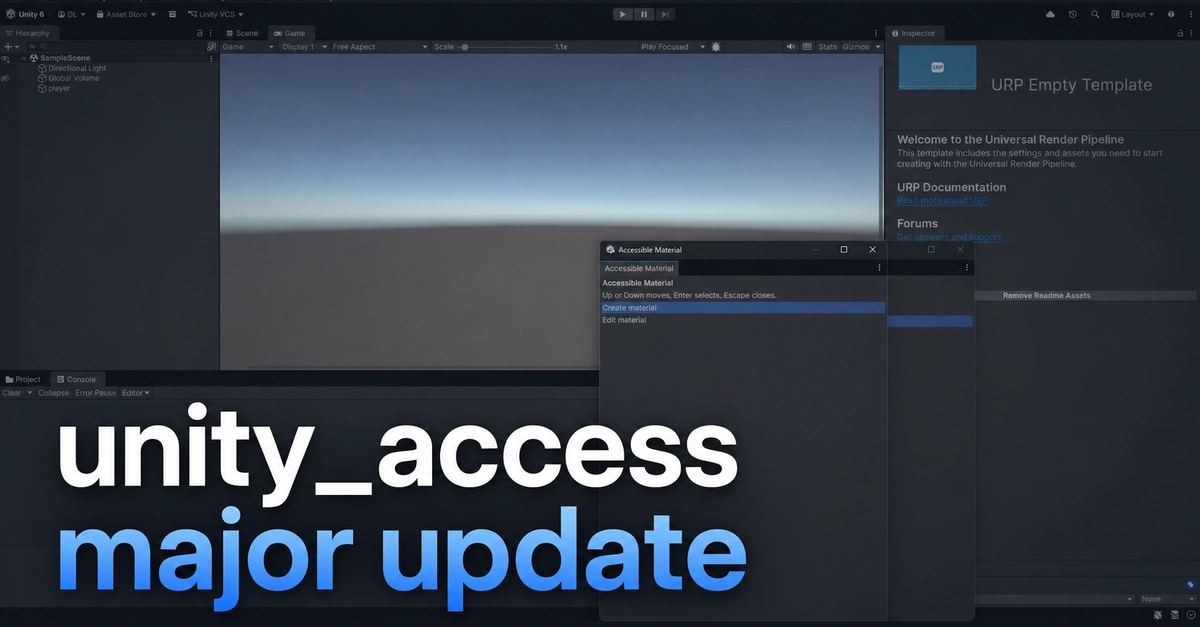
Over the past week, I have been vibe coding Unity Access, a plugin for the Unity Editor that makes the previously difficult-to-access editor more screen-reader compatible.
Unity Access uses the NVDA API alongside the Unity Editor API to create a bridge between Unity and the NVDA screen reader.
I have been using Codex for the programming, and it is for this reason that I wanted to write this post. During the development of Unity Access, I have learnt a lot about using Codex to develop an accessible application that tutorials and documentation simply do not cover.
One of the biggest lessons I have learnt is that building accessible software with AI requires considerably more than simply telling the model to "make it accessible". Accessibility needs to be expressed as specific, testable behaviour.
In this post, I will describe what worked, what did not work, how you can build your own accessible applications, and some of the things you should watch out for.