Introduction
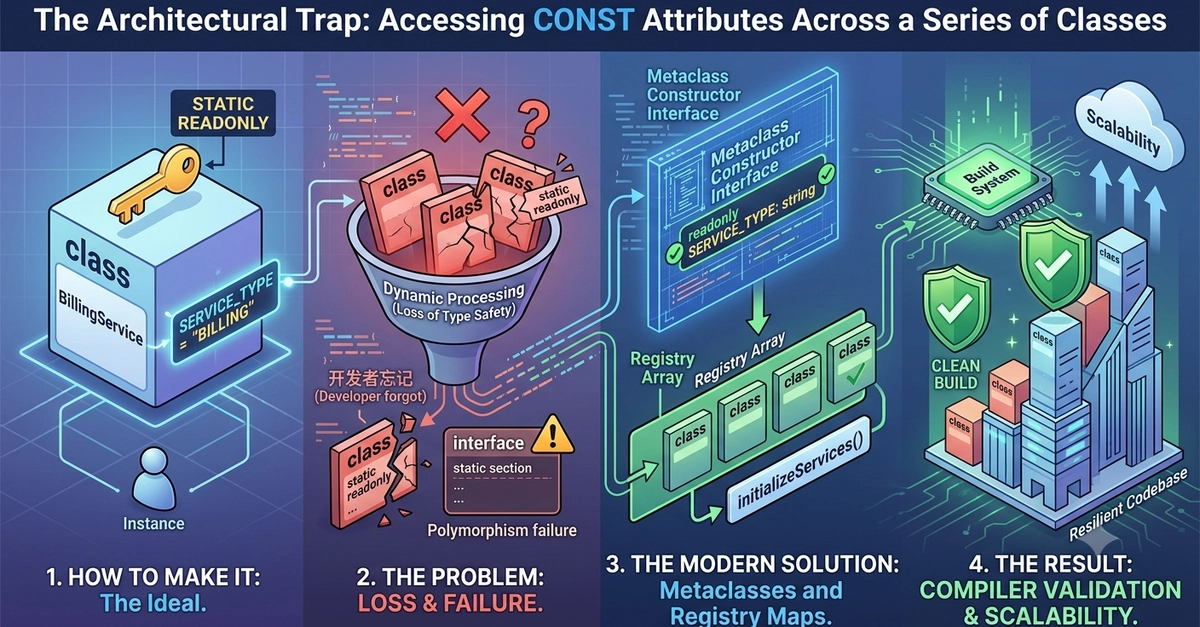
In object-oriented programming, deeply nested class hierarchies often lead to awkward and inefficient code when accessing parent or grandparent class properties. A common scenario involves passing entire parent objects as method arguments to child classes, as illustrated in the [AskJS] case study. For instance, consider a hierarchy where ClassA contains instances of ClassB, ClassC, and ClassD, and ClassD further nests instances of ClassD1 through ClassD9. When a method in ClassD9 requires a property from its "uncle" ClassB, developers often resort to passing the entire ClassA object as an argument:
const returnval = myClassAObject.itsClassDObject.theClassD9method(myClassAObject);
This approach, while functional, is inelegant and introduces several issues. First, it violates the principle of encapsulation by exposing the entire parent object to child methods, increasing the risk of unintended modifications or dependencies. Second, it bloats method signatures, making the code harder to read and maintain. Third, it creates a tight coupling between classes, reducing flexibility and reusability. These inefficiencies are exacerbated in large, complex systems, where such patterns can lead to spaghetti code and increased bug risks.