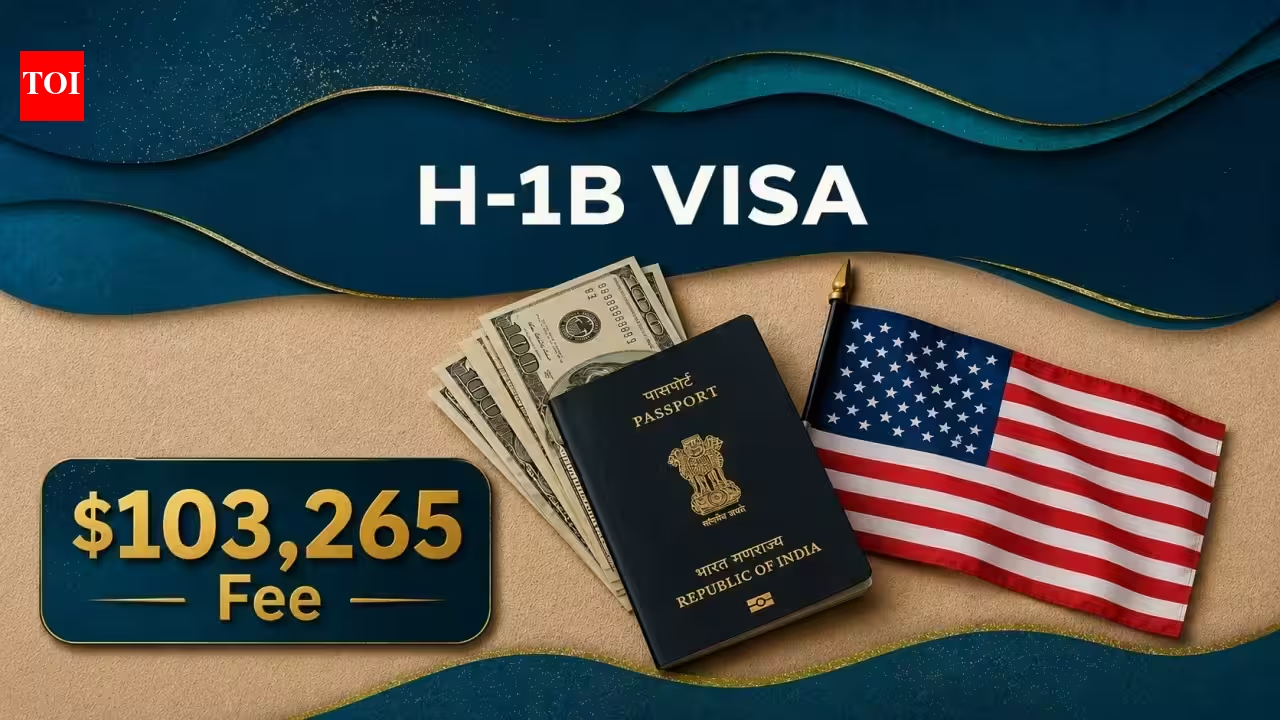
The Trump administration has put forward a fee of $103,265 on cap-subject H-1B petitions, aiming to establish a substantial charge that may considerably raise the expenses for U.S. employers who wish to hire skilled foreign workers.The Department of Homeland Security proposes a $103,265 fee for cap-subject H-1B petitions, aimed at recovering immigration costs.The proposal from the Department of Homeland Security, released in the Federal Register on Monday, would be applicable to cap-subject H-1B petitions, which encompass those submitted under the standard annual cap of 65,000 as well as the additional allocation of 20,000 for individuals holding advanced degrees from U.S. institutions.The proposal follows the administration's previous $100,000 H-1B fee, which was halted by a federal judge. The proclamation from 2025 that established this fee is scheduled to expire in September, although legal disputes regarding the measure are still ongoing.What happens if new H-1B visa proposal gets approved?If implemented, the new fee would be applied in addition to the current H-1B filing expenses and would signify a substantial increase from the usual range of $2,000 to $5,000 typically linked to H-1B petitions, depending on various factors.The Department of Homeland Security (DHS) stated that the suggested fee aims to recoup federal expenditures related to the management of the immigration system, estimating an annual revenue generation of approximately $8.8 billion, based on an anticipated yearly volume of 85,000 H-1B cap-subject petitions. This proposed income would facilitate immigration-related functions across multiple agencies, including the Department of Homeland Security, the Department of Justice, the Department of State, and the Department of Labor.Also Read: US visa alert for minors: Embassy issues key update for parents, clarifies if kids must be present for interviews“The proposed H‑1B fee is intended to recover the costs incurred across the federal government to adjudicate, vet, and support lawful immigration programs that otherwise must be funded by taxpayers,” US Citizenship and Immigration Services spokesperson Zach Kahler said in a release.Who will be affected by new H-1B fee?The proposed measure would impact employers who wish to sponsor new H-1B workers, which includes foreign graduates moving from F-1 status and Optional Practical Training to H-1B status. Additionally, the advanced-degree exemption would also be subject to the suggested fee. Small businesses would not be granted a special exemption under this proposal.This proposal is expected to heighten the discussion regarding the role of the H-1B program within the U.S. labor market.Proponents of stricter H-1B regulations contend that the program ought to prioritize American workers and deter companies from substituting U.S. employees with foreign labor.Conversely, business organizations and technology firms assert that H-1B workers assist employers in filling specialized roles that may be challenging to staff with qualified domestic candidates.The suggested fee may also impact U.S. universities, startups, and technology firms that depend on international graduates and skilled professionals. Detractors argue that such a substantial initial expense could deter employers from keeping foreign graduates who have been educated in the United States, thereby diminishing the nation's competitiveness in drawing global talent.What Indian professionals need to knowFor Indian professionals and international students in the U.S., this proposal could hold particular importance, as Indians represent the largest proportion of H-1B beneficiaries. The added expense could complicate the transition from F-1 student status and OPT to H-1B sponsorship for both employers and graduates.According to the proposed regulation, the extra fee will not be applicable to H-1B petitions that are exempt from the cap, including those submitted by specific nonprofit research organizations, governmental research entities, and institutions of higher education, as per DHS.DHS will be open to public comments for a period of 30 days after the formal publication of the proposed rule. Subsequently, the administration may amend and finalize the regulation, which could lead to another series of legal disputes regarding the government's power to enforce the fee.The question is whether a US company will be inclined to invest such a significant amount to employ one.A government fee in the six-figure range could alter the financial dynamics of hiring. Companies may become more discerning in sponsoring foreign workers, especially for entry-level or lower-wage roles where the extra expense is more challenging to rationalize. Employers might prefer candidates who are already permitted to work in the US or consider other hiring locations.For Indian IT firms, the situation may become increasingly complex. Companies that dispatch employees to the United States for client projects have traditionally depended significantly on the H-1B program.Consequently, a substantial increase in costs could prompt these companies to enhance local recruitment in the US, shift more operations overseas, or reassess the frequency of employee transfers.Here's what critics are sayingHowever, opponents are raising doubts about whether this interpretation of the government's authority to set fees will withstand legal examination.FWD.us President Todd Schulte described the proposal as a "massive tax on American businesses" and contended that the government intends to impose charges that are considerably higher than the actual cost of processing an H-1B petition.“This proposed tax clearly violates the law by charging far more than is allowed, which should be the cost to adjudicate an H-1B petition,” Schulte states.This challenge mirrors the controversy surrounding a previous $100,000 H-1B fee introduced by the Trump administration.In June, a federal judge in Massachusetts took action to prevent the implementation of that payment. The government then filed an appeal against the ruling.
H-1B visa woes: Why the $103,265 fee could spark another legal fight and why Indian professionals need to worry?
A new $103,265 fee on cap-subject H-1B petitions by the Trump administration aims to fund immigration management.
878 words~4 min read