The first time my RAG system gave a confidently wrong answer, I did what everyone does: I blamed the model. I swapped in a bigger one. I tuned the prompt. I added "only answer from the context provided" in bold. The answer got no better.
The problem was never the model. The model was faithfully summarizing the context it was handed — the context was just wrong. It had retrieved the wrong chunks, so it answered the wrong question, fluently.
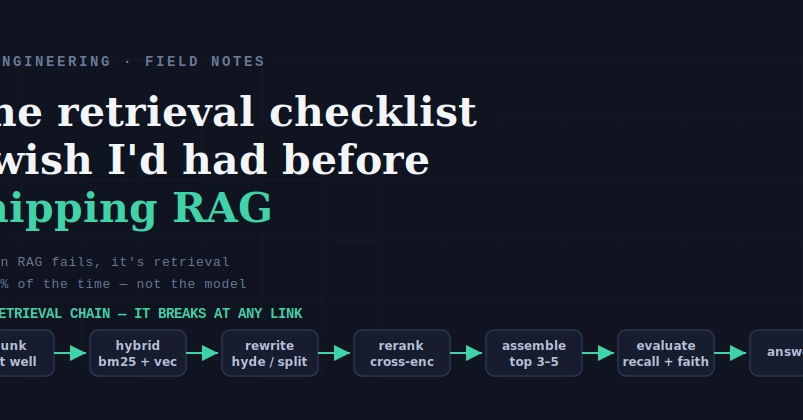
This turns out to be the norm, not the exception. Industry analysis in 2026 keeps landing on the same number: when RAG fails, the failure is in retrieval roughly 73% of the time, not generation. The LLM gets blamed for a mistake that happened several steps upstream, before it ever saw a token.
So here's the checklist I wish someone had handed me before I shipped — organized as a walk through the whole pipeline, because retrieval isn't one step, it's a chain, and it can break at any link. Naive RAG ("chunk, embed, cosine similarity, stuff into prompt") was always a prototype. This is the gap between that and production.
Let's go link by link.