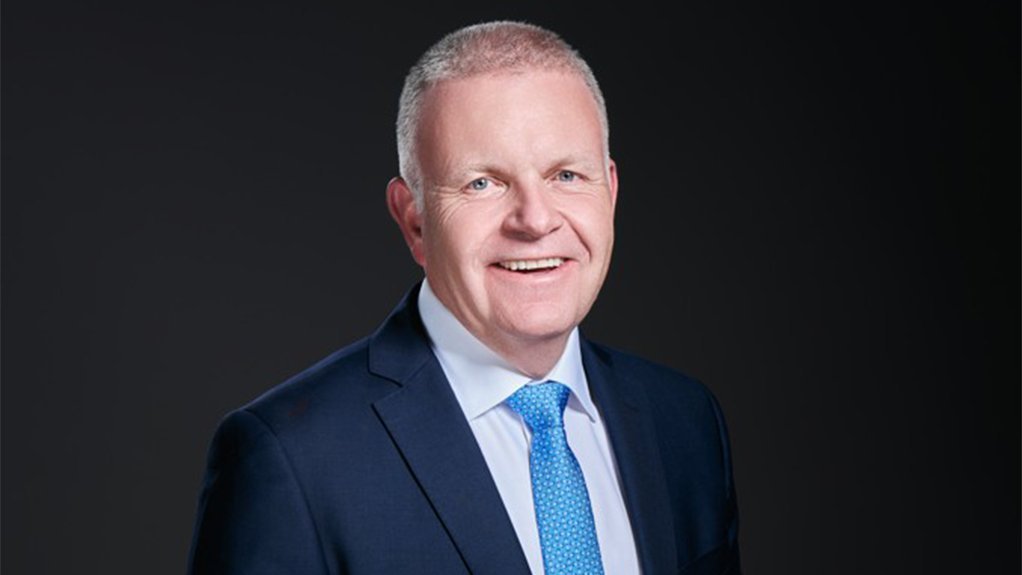
Gold Fields plans to return more funds to shareholders as the group reported a more than 80% rise in profits in the first half as the gold price soared and production increased.The group said on Tuesday that attributable profit rose 81% to $1.85bn, or $2.07 per share, for the six months ended June. It declared an interim dividend of R16.25, more than double that of R7 per share a year ago.In the first half, 61% of adjusted free cash flow was paid to shareholders and the company stepped up its share buyback programme and completed share repurchases of $300m between March and July, it said in a statement.The board has allocated a further $500m to additional shareholder returns, lifting the programme announced in November to $1.25bn to be delivered through a combination of special dividends and targeted share buybacks.CEO Mike Fraser said the miner delivered a strong first half as sales volumes rose by 18% to 1.27-million ounces (Moz), supported by a higher average realised gold price of $4,678/oz. This resulted in adjusted free cash flow more than doubling to $2.225bn from $925m a year ago.“This gave us the platform to strengthen our balance sheet further, continue investing in the long-term growth and resilience of our business, while delivering upper quartile shareholder returns,” he said.He said operational momentum built in 2025 continued through the first half, with group attributable production increasing 12% year on year to 1.267 Moz, keeping the group firmly on track to deliver to the upper end of full-year guidance. Salares Norte (Chile) was a key contributor as the mine reached steady-state production and delivered a 173% increase in gold equivalent production. Granny Smith (Australia) also delivered a strong first half, with production up 10% on record haulage fleet availability and autonomous truck performance. In South Africa, South Deep continued to demonstrate incremental improvement in stope turnover and mining productivity while Gruyere and Agnew (Australia) and Tarkwa (Ghana) showed encouraging signs of improvement in the second quarter as recovery plans gained traction, he said.Net debt to adjusted earnings before interest, tax, depreciation and amortisation (ebitda) fell to 0.06 times, from 0.37 times a year earlier, reflecting the strength and resilience of the balance sheet.“Gold Fields enters the second half of 2026 with strong operational and financial momentum, a materially strengthened balance sheet, and continued visibility on our growth pipeline, including advancing Windfall towards FID (final investment decision) and ongoing engagement with the government of Ghana on the Tarkwa lease renewal,” said Fraser.The Windfall project is the high-grade, advanced underground gold development in Canada, which Gold Fields now fully owns following its acquisition of Osisko Mining in late 2024.The group remains on track to meet the production and cost guidance for 2026. Attributable gold-equivalent production is expected to be at the upper end of the guidance range of 2.4Moz and 2.6Moz, supported by continued outperformance expected at Salares Norte in the second half.Recovery plans are being implemented at Gruyere and Tarkwa, however, despite improved performance in the second quarter, and expected improvements in the second half, both assets remain at risk of delivering below their full-year guidance, the group noted. In line with guidance provided in February, all-in sustaining costs (AISC) and all-in costs (AIC) are expected to be between $1,800 and $2,000/oz, and $2,075 and $2,300/oz respectively. However, AIC is expected to be towards the lower end of the range, as group capital expenditure is now expected to be between $1.6bn and $1.8bn, down from prior guidance of $1.9bn to $2.1bn, it said.Business Day
Gold Fields to hike dividend as profit soars
Board boosts shareholder payout programme to $1.25bn
587 words~3 min read