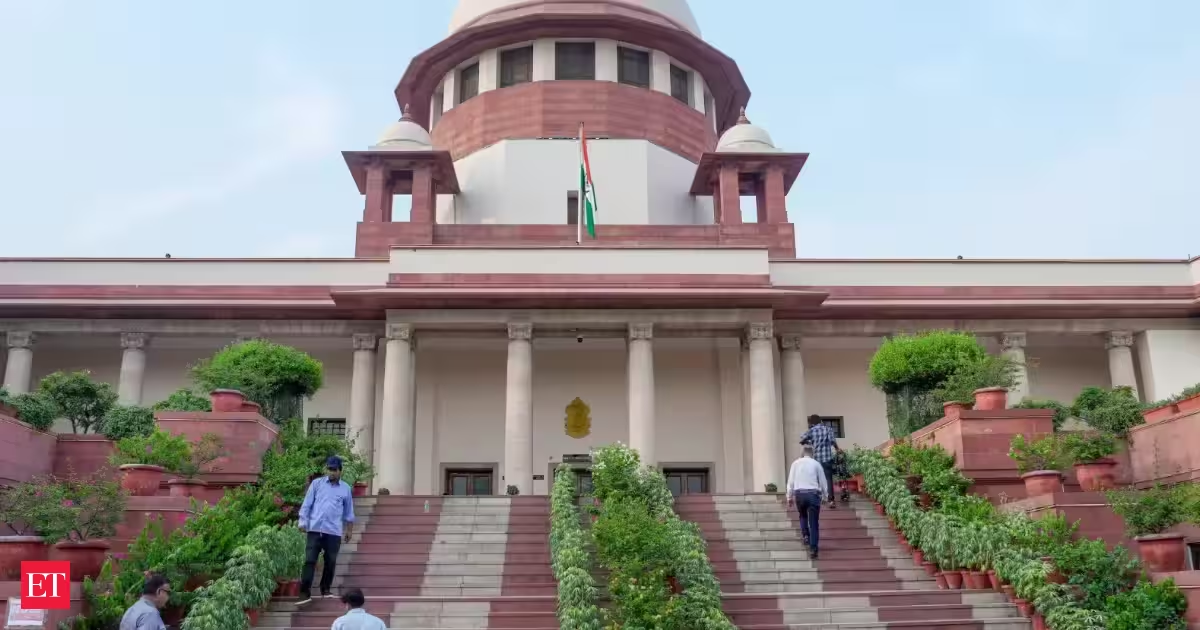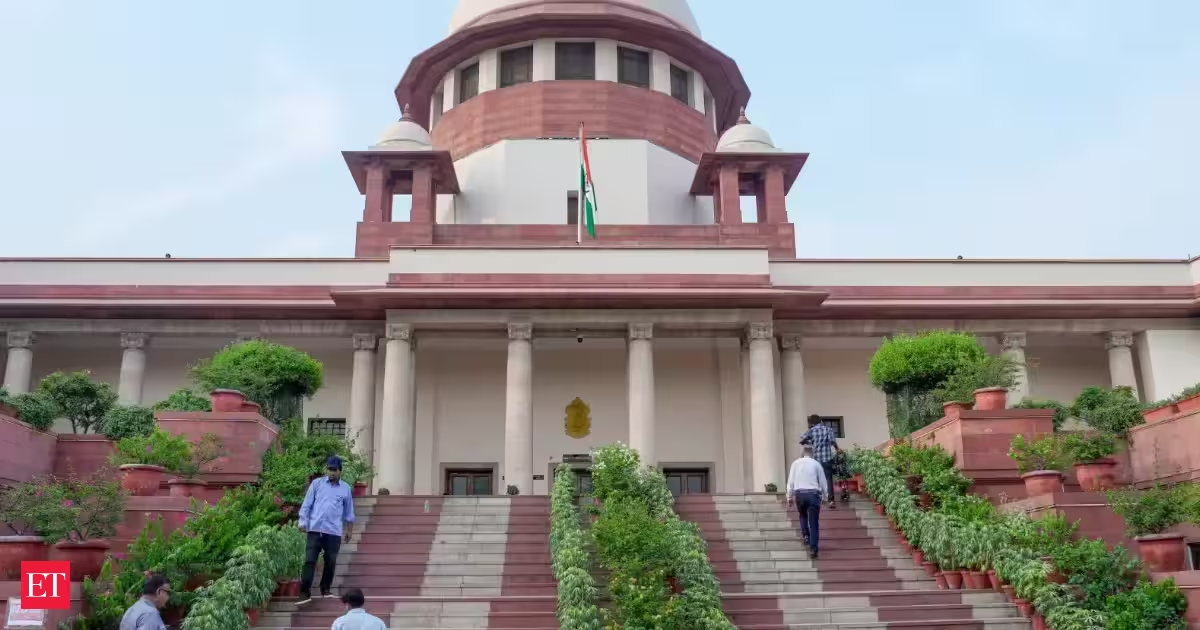
The issue is related to the March 11 judgement of the Supreme Court of India (Rohith Nathan case) in a batch of petitions filed by OBC candidates of Civil Service Examinations, who were excluded as being part of the creamy layer on account of the salaries of their parents
| Photo Credit: Shashi Shekhar Kashyap
The Union government has now moved applications seeking that the Supreme Court’s March judgement on using parents’ salaries and incomes to determine the creamy layer among the Other Backward Classes for reservations should not be applied retrospectively. The government has thus sought that the 2025 and 2026 Civil Service Examinations (CSE) processes be allowed to continue with the older interpretation on how to determine the creamy layer and asked the Supreme Court to clarify its March judgement with respect to its retrospective applicability.The Centre, through the Department of Personnel and Training, has argued before the Supreme Court that the judgement’s application retrospectively would end up impacting lakhs of OBC recruitments and admissions already conducted as per the previous interpretation of the creamy layer criteria across Central government ministries, State government departments, and higher educational institutions across the country.The issue is related to the March 11 judgement of the Supreme Court of India (Rohith Nathan case) in a batch of petitions filed by OBC candidates of Civil Service Examinations, who were excluded as being part of the creamy layer on account of the salaries of their parents who were working at public sector undertakings where an equivalence of posts with government posts had not been established yet.In the judgement, the Supreme Court decided that the income/wealth test was not meant to be applied on its own and that the purpose of the regulation was to read this test along with the status of the post at which the respective candidates’ parents might be at. The Supreme Court had directed the Centre to create supernumerary posts for the category of candidates who had approached the court within six months and consider the creamy layer criteria for OBCs accordingly.As for the establishment of equivalence with government posts, which encapsulates the spirit of the creamy layer exclusion criteria, the government has told the Supreme Court that it may take up to two years to do this given the large number of State public institutions and consultations that would be necessary with each State and UT government.Further, for establishing similar equivalence of posts for the private sector, the government has said this may take “considerable time”, and has also gone on to argue that the implementation of the Supreme Court’s judgement may end up in scenarios where even OBC candidates whose parents are earning over ₹1 crore annually would be considered part of the Non-Creamy Layer. The government has argued that the implementation of the judgment “might affect the claims and rights of the resource-deprived candidates, going against the principles of natural justice and fairness”.In applications to the Supreme Court, the Centre has argued that if the Rohith Nathan judgement is applied retrospectively “without suitable policy intervention”, it would have a “far-reaching consequence” on the over 3.7 lakh OBC recruitments in Central government posts since 2016, along with recruitments and examinations either conducted or ongoing in 18 States and Union Territories.“Major examination bodies/exployers i.e. Railways, Banks, Department of Posts, and paramilitary, would be flooded with hundreds of thousands of representations and litigations warranting consideration in several situations,” the government has argued, further suggesting that this may also result in adverse impact in the higher education sector, where candidates not accepted would be able to ask for fresh consideration under OBC Non-Creamy Layer in light of the judgement.The Union government has noted that the implementation of this judgement would end up resulting in a cascade of litigation from previous years’ candidates, not just in CSEs, but in all other aspects of government recruitment where a similar understanding of the OBC Creamy Layer exclusion has been applied. The government has also argued that creating the supernumerary posts as per the directions was creating vacancies which were now being claimed by other candidates, and further noted that the retrospective applicability of this direction would lead to issues of seniority. Published - August 25, 2026 11:33 am IST