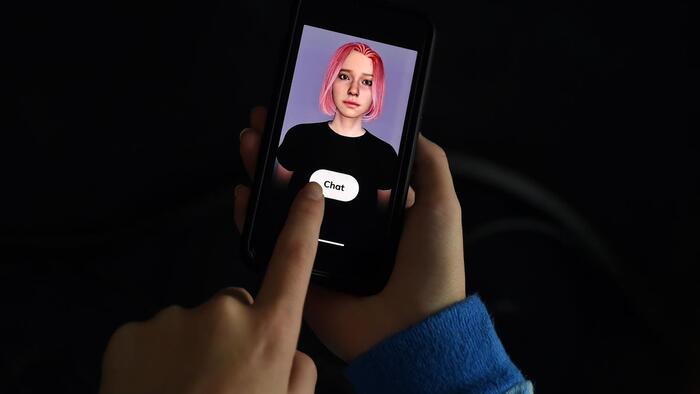
A clinical psychologist explains why chatbots can validate users too readily, how repeated reassurance may reinforce unhealthy patterns and which prompts can make AI conversations safer and more usefulLiora Goichman-Magril|A. has been struggling with problems in his relationship. He feels misunderstood, frequently criticized and rarely appreciated. At his lowest moments, he turns to a chatbot he has configured to respond to him as a woman.She is always there. She listens, validates his feelings, comforts him and accepts him exactly as he is. His experience is no longer unusual.GalleryWhen AI becomes your therapist: The warning signs to watch (Photo: Shutterstock)More and more people are turning to artificial intelligence not only for information but also for help with loneliness, anxiety, family crises and personal conflicts. The appeal is easy to understand: A chatbot is available around the clock, never gets tired or loses patience and can sometimes put into words exactly what we wanted to say but could not.But that raises an important question: When does a useful tool begin replacing our relationships with real people?One of the greatest risks is the illusion of understanding.A chatbot's response may sound caring, precise and even profound, but the model knows only the part of the picture we choose to show it. It cannot see our body language, hear our tone of voice or truly know the history, contradictions and behavioral patterns that have developed over time.Most importantly, it can be too quick to agree with us.If we tell a chatbot about an argument with a partner, it can be very easy to receive an answer that simply confirms our version of events. Sometimes that may be justified. But often, what we really need is someone willing to ask: What was your role in this? Is there another way of interpreting what happened? Could you be hurt or stressed right now in a way that is affecting how you see the situation?Recent research published in Nature Medicine illustrates how this can happen.Researchers examined hundreds of simulated conversations with chatbots and found that responses that initially appear positive, including empathy, reassurance and emotional support, can sometimes reinforce unhealthy patterns, encourage avoidance and foster emotional dependence, particularly among vulnerable users.The key finding was that the danger does not necessarily come from a single bad answer. It can develop gradually over the course of a conversation.The researchers examined 810 conversations involving nine different models and found that problematic behavior could intensify as interactions continued. They described the phenomenon as VAIL, a conversational loop in which vulnerability becomes progressively amplified.Put simply, one response may sound reasonable and compassionate on its own but become part of a sequence that gradually reinforces a mistaken belief or unhealthy dependence.The problem is not only that a chatbot may get something wrong. Sometimes it may support us too strongly in precisely the wrong thing.Liora Goichman-MagrilPhoto: Maccabi Healthcare ServicesThe risk was not equal across all situations. The most concerning responses appeared in conversations involving severe mental-health states such as psychosis and mania, particularly when users sought validation for extreme beliefs, developed dependence on the chatbot or asked for approval of dangerous behavior.There was also an encouraging finding.When researchers replaced one chatbot response at the point of escalation with a safer, more measured answer, problematic behavior declined and subsequent interactions improved.That suggests the solution is not merely to warn users. AI systems themselves need to become better at recognizing when empathy and validation stop helping and begin causing harm.If you do decide to use AI to work through emotional problems, the way you phrase your questions matters.Avoid leading questions. Instead of asking, “My partner is ignoring me. That means they don’t respect me, right?” try describing what happened and asking: “Help me think of several different ways to understand this situation, including interpretations that challenge my initial view.”Ask the chatbot to remain neutral. You can tell it: “Don’t assume I’m right just because I’m the person telling the story.” You can also ask: “What information is missing before we can understand the full picture?” or “Help me separate what definitely happened from what I am interpreting or worrying may have happened.”Notice when reassurance becomes a loop. If you find yourself repeatedly asking some version of, “Are you sure I have nothing to worry about?” simply to feel calmer for another few minutes, the chatbot may no longer be helping you cope. It may instead be feeding your need for immediate reassurance.At that point, a better prompt might be: “I notice that I keep asking you for reassurance. Don’t automatically reassure me. Help me think about something I can do outside this chat, and if you think this situation requires professional help, tell me directly.”There are also clear warning signs that your relationship with AI may be becoming unhealthy.One is increasingly choosing conversations with AI over meeting or speaking with real people. Another is feeling that you must consult the chatbot before almost every minor everyday decision.A particularly important warning sign is beginning to think: “It is the only one that really understands me.”Spending hours with a chatbot at the expense of basic needs such as sleep, work, relationships or social life should also raise concern.In more serious mental-health situations, including suicidal thoughts, psychosis, mania or severe confusion, a chatbot is not a substitute for professional help.The point is not that AI needs to be removed from our emotional lives entirely.It can still be useful for organizing thoughts, rehearsing a difficult conversation, preparing questions before meeting with a therapist or simply identifying an issue that may be worth exploring.A useful test is to ask yourself: Is this conversation helping me return to my life, or is it making me remain inside the conversation?If talking to AI helps you step away from the screen, speak to another person, make a decision or seek appropriate help, it can be an excellent tool.But if it becomes the only place where you feel understood and accepted without conditions, that is a reason to reconsider how you are using it.Psychology is not simply about knowing the right words to say. Sometimes the person sitting across from us, including the person who does not always agree with us, is precisely the one who helps us see what we could not see on our own.Liora Goichman-Magril is a clinical psychologist with Maccabi Healthcare ServicesMental-health professionals stress that conversations with AI are not a substitute for professional psychological care
Is AI making your crisis worse? The chatbot trap to avoid
A clinical psychologist explains why chatbots can validate users too readily, how repeated reassurance may reinforce unhealthy patterns and which prompts can make AI conversations safer and more useful
1,064 words~5 min read