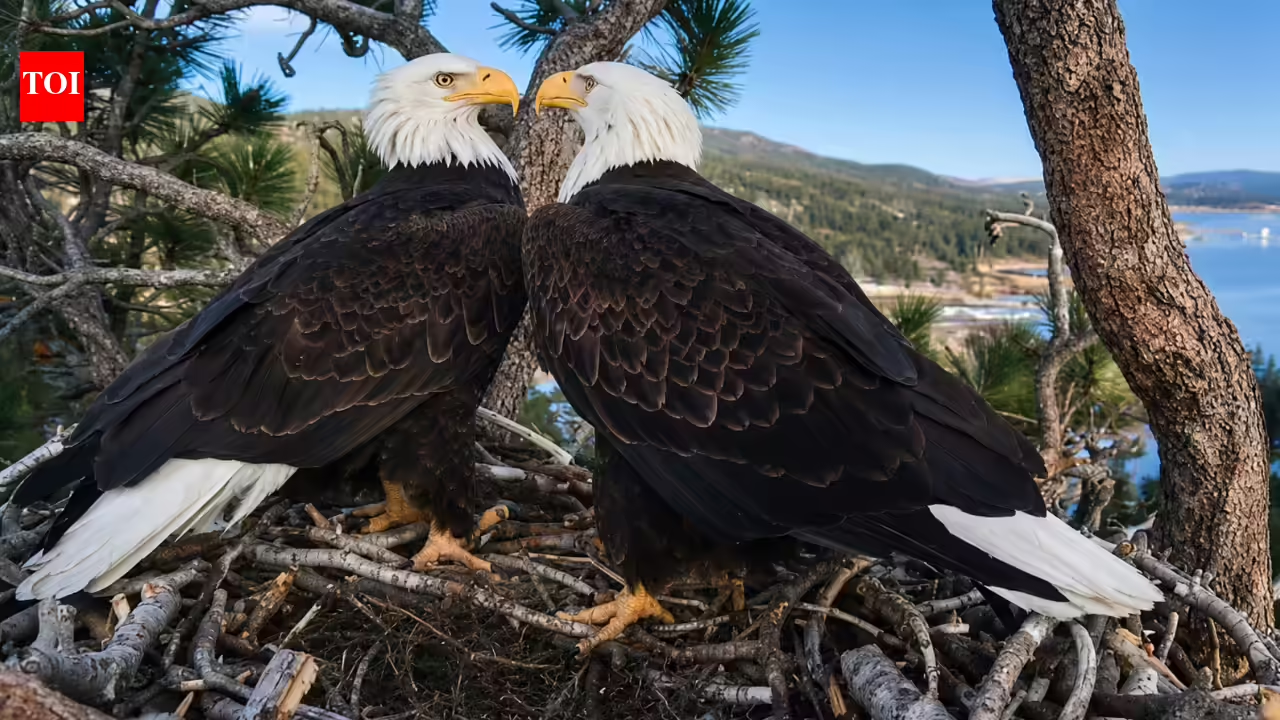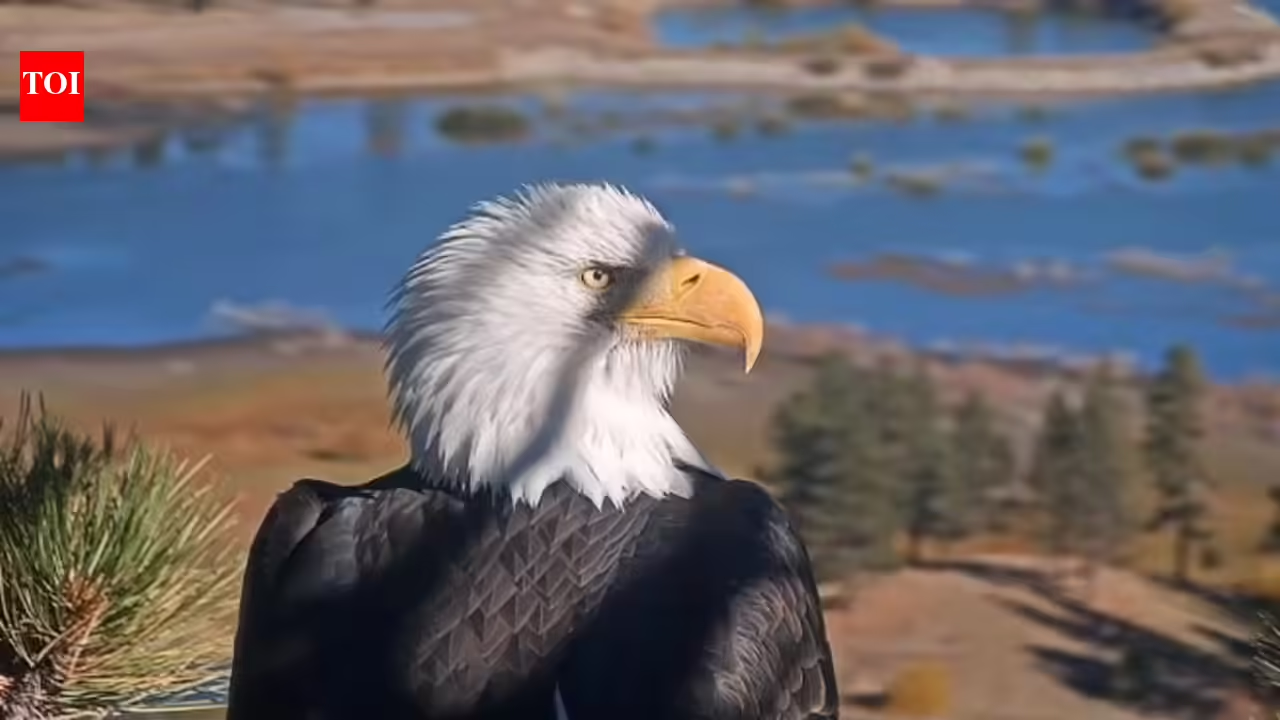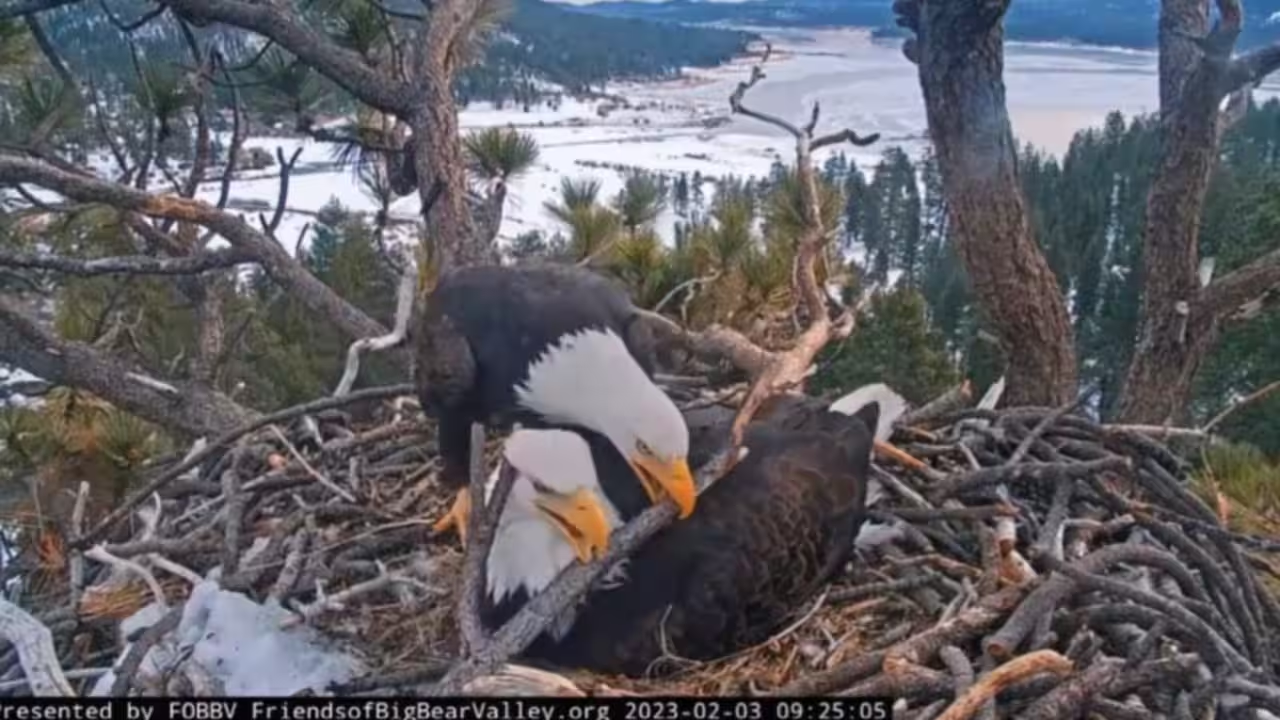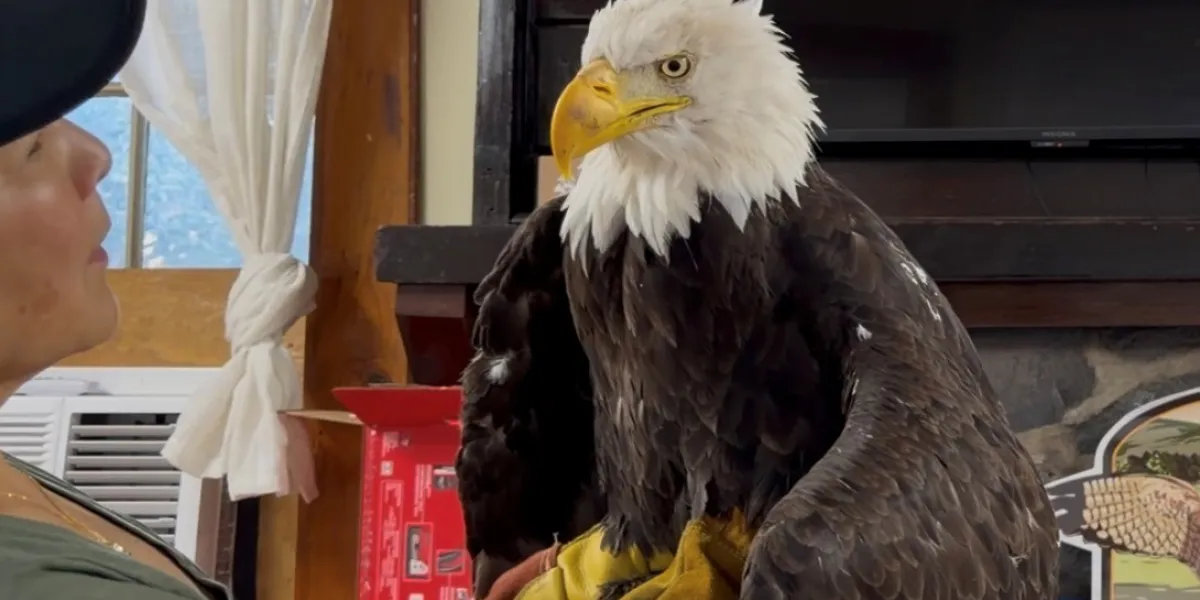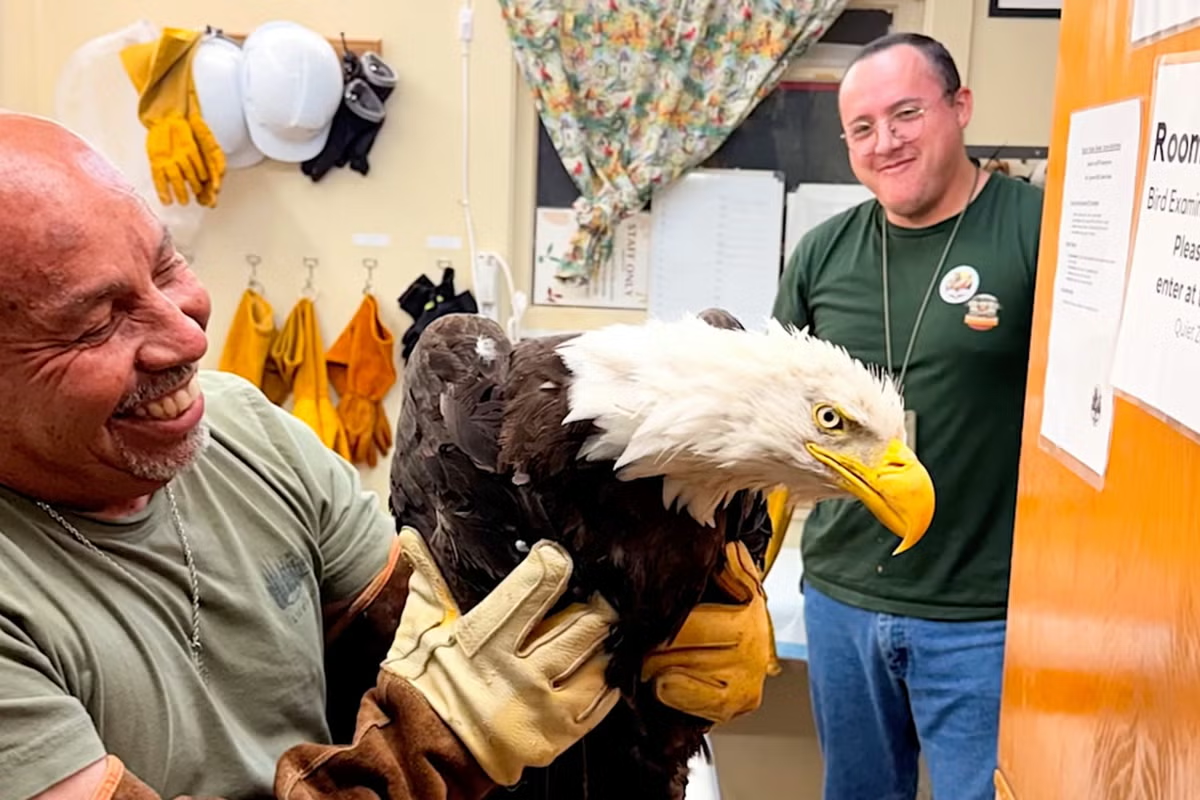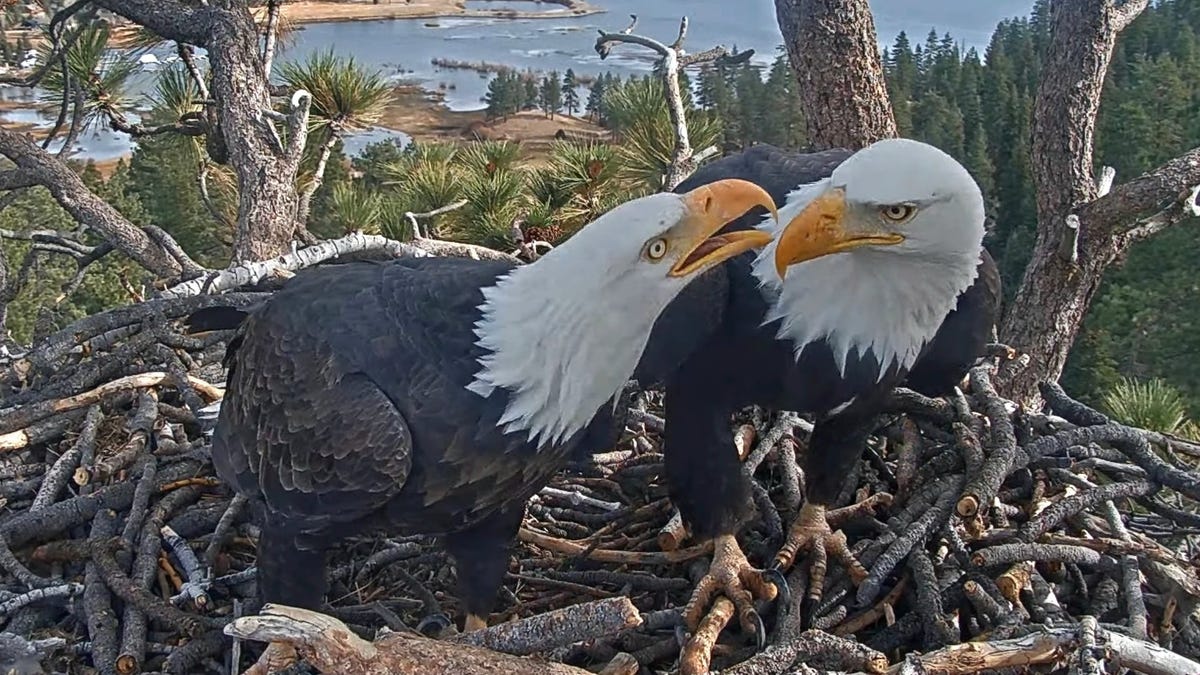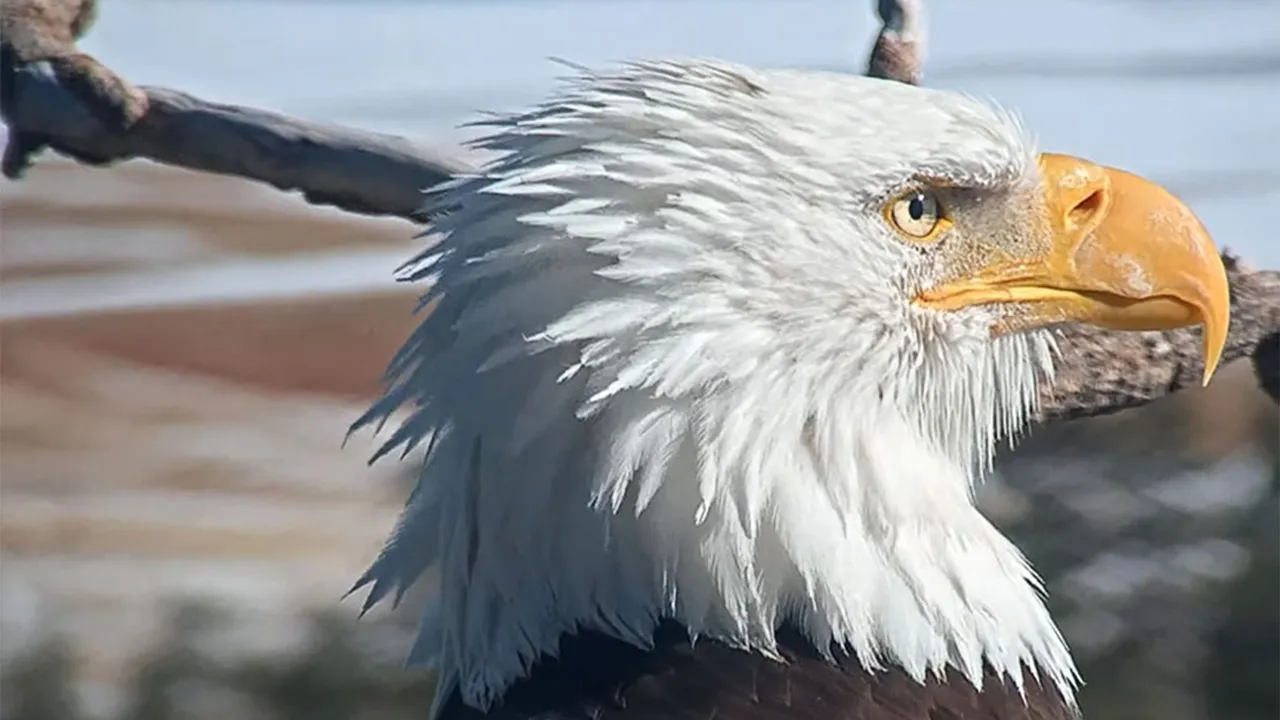
It has been a tumultuous year on the Big Bear Valley eagle cam. For more than a decade, a live feed has documented events at a bald-eagle nest near Big Bear Lake, in the San Bernardino Mountains, east of Los Angeles. Lately, the cam’s followers have witnessed an aquiline epic worthy of Douglas Sirk: domestic bliss, joyful birth, painful loss, adolescent tantrums, the wistfulness of an empty nest, sudden illness, tragic death, mildly scandalous flirtations, and new beginnings. Human observers became so invested in the drama that recriminations flew and comment sections were restricted. The entire affair could be seen as a case of anthropomorphism run amok: the eagles are, after all, doing what eagles have been doing for tens of millions of years, long before we began weaving stories around them. Then again, it would be human arrogance to assume that the birds thought or felt nothing. The desperate-sounding call that an eagle named Shadow let out early one morning, after his mate, Jackie, had gone missing, was not a bland biological fact.I started watching the Big Bear Valley eagle cam during the pandemic. The live feed was calming, like unpretentious slow cinema. The nest is attractively situated, as any raptor realtor would point out. The main camera is positioned so that Big Bear Lake gleams in the background, changing hue throughout the day. You hear, aside from the sounds of the occupants, the buzzing of insects, the cries of more distant birds, the rush of the wind, the creaking of branches, and, less romantically, human racket from the Big Bear Lake recreation area. A second camera is clamped to a neighboring tree and shows the nest pine and other trees of eagle interest. You won’t see much now, since nesting season is over, but you can scroll back to find the day’s highlights.Any square-jawed patriots tuning in to see the majestic strutting of our national bird—the Second Continental Congress placed the bald eagle on the Great Seal to symbolize that the “United States of America ought to rely on their own virtue”—might be disappointed by the fidgety domesticity of daily life at the nest. The eagles fuss obsessively with their habitat, waddling around on their huge, scaly reptilian feet, moving sticks to and fro with their bony beaks. They are in a constant state of high alertness, training their eyes this way and that. Their calls are not exactly musical; to human ears, they sound peeved. To the degree that the eagles are representatively American, they resemble a suburban family that is always rearranging the furniture and peering out the windows to see what the neighbors are up to.From time to time, the residents seem to fix the camera with a suspicious glare. You worry that they’ve sussed out the surveillance and are about to rip the place apart, like Gene Hackman in “The Conversation.” This is, of course, projection; eagles are always glaring suspiciously. But there’s something queasy about our eavesdropping: even when we think we’re appreciating animals, we’re exploiting them. Balancing out that discomfort is the sense that such unedited, real-time encounters with other species alter and personalize our relationship with the natural world. Giving a wild animal a name raises it above the level of a biological underclass. This happened in the case of the celebrated Los Angeles mountain lion P-22, whom I memorialized in 2023. Anthropomorphism can work in tandem with zoomorphism: we may recognize and cultivate animal decency in ourselves.Friends of Big Bear Valley (F.O.B.B.V.), a nonprofit group that is devoted to protecting wildlife around the lake, installed the camera in 2015. It was hardly the first of its kind; a falconer named Bob Anderson, who had been setting up bird cams since the late nineties, launched an eagle stream in Decorah, Iowa, in 2010, and there are now dozens around the world, from North Uist, Scotland, to Selati, South Africa. Big Bear Valley is one of the most popular feeds, with as many as a hundred thousand people watching at peak moments, such as the hatching of chicks or the fledging of eaglets. A daily F.O.B.B.V. report, written by a team of far-flung volunteers, recaps events in granular detail. Here is an excerpt from November, when Jackie (J) and Shadow (S) were renovating the nest for the next batch of eaglets:12:14 S#1 stick; 12:15 J#2 stick; 12:21 J out; 12:22 S out; 12:25 S#3 stick; 12:26 J#4 stick; 12:29 S&J out; 12:51 S#5 stick; 12:52 J#6 stick; 12:54 J out; 12:56 S out, J#7 stick; 12:58 S#8 stick; 13:04 S out; 13:06 S#9 stick; 13:10 J&S out; 13:12 J#10 stick; 13:15 J out; 13:26 S#11 stick; 13:28 J#12.By 15:41, the pair had collected twenty-eight sticks—an all-time record day, exceeding a previous total of twenty-five.Jackie appears to have hatched in Big Bear Valley in 2012. Her parents, Ricky and Lucy, had built a nest that later blew down in a storm. The present one, a spacious, roughly six-foot-wide structure, was completed after Jackie fledged. By the time the first camera had been set up, however, Ricky and Lucy had decided to move on to another nest. Fortunately, Jackie took up residence, and she was soon joined by a mate named Mr. B. In 2018, two eaglets hatched in the nest; one of them, Stormy, survived winter storms and flew off to great fanfare.Shadow made his entrance in the same year. He had patches of brown on his head, meaning that he hadn’t yet reached maturity; bald eagles go snowy white at around the age of five. According to F.O.B.B.V.’s official history, an “adult male intruder” began visiting the nest in the summer and “with great tenacity” held his ground, “no matter how much Jackie, Mr. B and Stormy tried to chase him away.” A YouTube chronicler named Lady Hawk chose the name after seeing the interloper cast his shadow on the nest. He proved his worth by bringing sticks and arranging them with finesse. Jackie warmed to his presence, and Stormy stopped squawking at him. After a low-key confrontation between the suitors, Mr. B gave up and went away.A time of struggle ensued. In the 2018-19 season, two chicks were born, Cookie and Simba; the latter successfully fledged. (Names are chosen in consultation with local third graders.) In 2019-20, two eggs were laid but failed to hatch. In 2020-21, Jackie produced five eggs, again yielding no chicks. Observers were treated to the gruesome sight of ravens hacking open unattended eggs and devouring the contents. Finally, in the 2021-22 season, an eaglet named Spirit grew up before the eyes of a rapt audience and soared into the great wide open. What became of her is unknown. Several earlier chicks had been banded so that their subsequent movements could be tracked. Unfortunately, neither Stormy nor Simba lived much more than a year. Seventy or eighty per cent of eagles don’t make it to maturity. Spirit and more recent eaglets have been left unbanded, perhaps because the public is better off left in the dark.Another hard winter followed in 2023-24, with repeated storms testing Jackie’s endurance. At one point, she hunched over her eggs for nearly sixty-two hours straight, with snow piled around her. (Shadow also spent a good amount of time incubating, but Jackie took the lead in inclement weather because female eagles are bigger and generate more warmth.) Still, no eggs hatched. The two most recent nesting seasons have been cheerier. Last summer, birds named Sunny and Gizmo took flight, and this year saw the fledging of Luna and Sandy—the latter named for Sandy Steers, the longtime executive director of F.O.B.B.V., who had died in February.Eaglets are a joy to watch. Early on, they are little yellowish balls of buzz that can hardly stand upright and frequently tip over. Later, they become brown-feathered balloons, jostling against one another in their furious quest for food. As their eyesight sharpens, they become cognizant of their environment, their heads swivelling in tandem with their parents’. They test their wings—“wingercizing,” in Big Bear lingo—and take to hovering briefly in the air. How they decide they are ready to fly is a heart-catching mystery. Sometimes, it happens by accident. In June, Luna hopped clumsily from one branch to another, bumping Sandy off her perch and sending her to a branch below. After hanging upside down for several minutes, Sandy tumbled farther down and finally winged her way to a nearby tree. This is known as a “fludge.” Jackie, who had been monitoring the situation, later brought Sandy a fish as a reward.For some years, a threat had been looming over the habitat, in the form of a long-planned residential-housing project called Moon Camp. This would have been less than a mile from the nesting pine and might have scared the eagles away. In July, F.O.B.B.V. announced that it raised enough money to protect the land in question. Just as this news broke, however, it became clear that something was wrong with Jackie. She vanished from the cameras for several days, then was seen struggling in the lake after a fight with two visiting eagles over fish. She was captured and brought to the Ojai Raptor Center, where she was found to be suffering from severe anemia. She received a CT scan and a blood donation from an eagle in Bakersfield. For a few days, she seemed to be on the mend, and was said to be quarrelling with her doctors. Then her health declined again, and she died on the night of August 9th. Some members of the eagle public went off the beam. The Ojai center was bombarded with intrusive calls, and conspiracy theorists accused the staff of manipulating information to secure donations.Back in Big Bear Valley, the melodrama took another turn. A four-year-old banded eagle named KD1, also known as Kaydee, began perching in Shadow’s vicinity, as if trying to win his attention. On the day of Jackie’s death, Kaydee ventured into the nest. When Shadow stopped in a few days later, he made no attempt to chase the visitor away, as Jackie had done when he made his own move, in 2018. Did he sense that Jackie was gone? Soon enough, he and Kaydee were sharing branches and chortling back and forth. Kaydee appears to be female, and now of nesting age for the upcoming season. Her advent caused further consternation in eagledom. At first, she gave off a vampy, Lana Turner vibe. Some took to calling her Jolene, after the Dolly Parton song. In recent days, though, the tut-tutting has subsided. If the two do mate and remain at the nest, the eagle show will go on indefinitely, and all will be glad. Perhaps, as in E. M. Forster’s “Howards End,” the nest itself is the governing force, guiding destinies.For several years, I’ve been exchanging messages about Jackie and Shadow with Susan Orlean, The New Yorker’s leading chronicler of animal life. Indeed, I discovered the feed at her prompting. “It will keep you sane,” she said. It didn’t, but it helped. Susan writes about animals with close attention and keen sympathy, but she doesn’t presume to know their inner lives. In her book “On Animals,” she observes, “I resist the urge to anthropomorphize them, but I do think they know something we don’t about living elementally.”That comment pinpoints for me why the delight of following the eagle cam is undermined by a nagging guilt. We were all taught in school about ecosystems and the balance of nature; the cam displays the mechanics of that balance in extraordinary detail. Bald eagles are apex predators, meaning that they hunt at will and are not hunted themselves. But these masters of the air exist in equipoise with the life below. They do not deplete local populations of fish, their favored food, and they economize by scavenging food from other birds and beasts—a trait that caused Benjamin Franklin to complain that eagles don’t belong on the Great Seal because they are of “bad moral character.”The only species of bad moral character is, of course, Homo sapiens. From the nineteen-forties to the seventies, the bald-eagle population in the lower forty-eight states plummeted as a result of the use of the pesticide DDT, which thinned eagle eggshells and caused them to break prematurely. Rachel Carson, in the book version of “Silent Spring,” pointed out that the national bird was on its way to extinction. After DDT was banned, the eagles rebounded. The human din audible on the Big Bear Valley feed—cars, planes flying overhead, loud music from the shores of the lake—is a necessary reminder that this natural idyll survived by lucky accident and that some other force could start killing the eagles again.I felt a twinge of grief when the Ojai Raptor Center reported Jackie’s death, and I didn’t feel foolish for doing so. Perhaps she was no different from any other eagle, in that she lived her life according to ageless eagle principles. But she demonstrated the restless labor that goes into such a life—twenty-eight sticks in one day!—and the fragile beauty that emerges from it. Not to place too heavy a burden on her, but I’m reminded of a passage in Theodor W. Adorno and Max Horkheimer’s “Dialectic of Enlightenment,” which recounts how humans use their powers of reason to exercise domination over one another and over nature. Recoiling from the mass slaughter of animals, the authors question the linkage of reason and the soul. To possess a soul, they suggest, is to live in harmony with the world. “Only and precisely in the case of the animal,” they conclude, “is it fitting to speak of and recognize a soul.” ♦
On Jackie the Eagle and the Nature of the Soul
Live-streaming tragedy and seduction from a nest in the San Bernardino Mountains.
2,273 words~10 min read