Adverse weather has cut yields, while export restrictions have weakened demand
2 HOUR(s)
Suzit Kumar Das
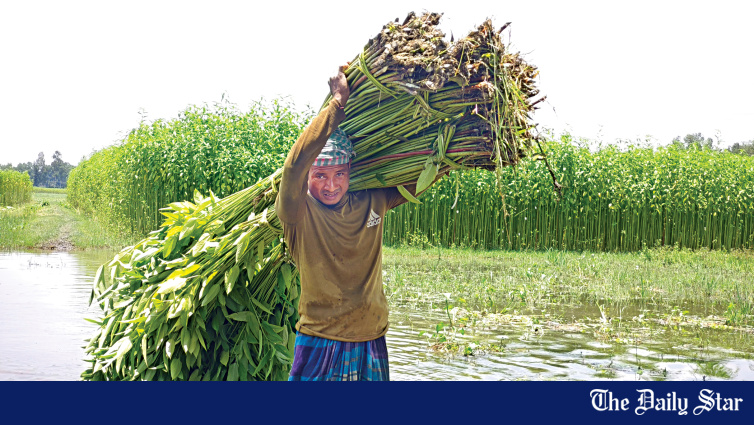
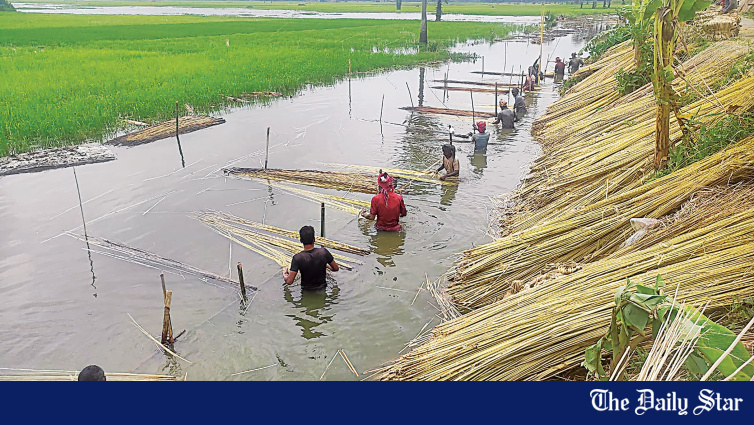
Farmers strip fibres from jute stalks after retting. Jute growers say excessive rainfall has reduced yields this season. The photo was taken recently in Khoar village under Saltha upazila of Faridpur. PHOTO: Suzit Kumar Das
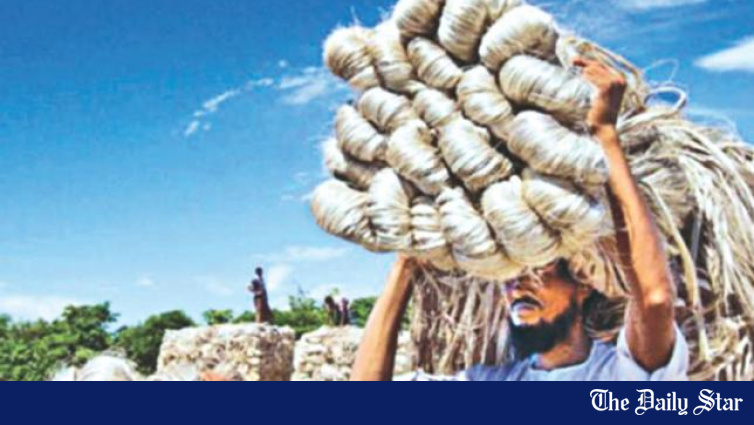
Adverse weather has reduced jute yields this year, while export restrictions have weakened demand and pushed down prices, raising fears of losses among farmers.Farmers said they expanded jute acreage after receiving good prices last year. However, excessive rainfall forced many to harvest the crop earlier than usual, resulting in lower yields.Traditionally, lower supply supports higher prices, but farmers and traders said the suspension of raw jute exports to India had reduced demand in the local market.Prices of good-quality raw jute have fallen by around Tk 1,200 per maund over the past one-and-a-half months. Rising production costs have further squeezed farmers.FARMERS COUNT LOSSESAccording to the Department of Agricultural Extension (DAE), the government has set a target of cultivating jute on 708,282 hectares in the 2026-27 season, with a production target of 85.21 lakh bales.Data from the Bangladesh Bureau of Statistics (BBS) shows projected jute cultivation in FY2025-26 was 2.31 percent lower than FY2024-25, while production was expected to decline by 1.89 percent year-on-year.Several farmers in Faridpur, Rajbari and Magura said yields per bigha had declined this season.Sukontho Pal, a jute farmer from Boalmari upazila of Faridpur, said production costs had increased while yields had declined.“Good-quality jute is now selling for a maximum of Tk 4,000 per maund, whereas I received around Tk 4,500 last year,” he said.“Production costs per bigha have increased by Tk 4,000 to Tk 5,000 from last year. At the current market price, we cannot even recover our production costs.”Md Siam Mallik, a farmer in Baliakandi upazila of Rajbari, blamed excessive rainfall for lower yields.“Most farmers were forced to harvest jute 15 to 20 days earlier than usual due to excessive rainfall. As a result, yields fell by two to four maunds per bigha,” he said.Naba Kumar Kundu from Magura Sadar upazila said farmers earned Tk 12,000 to Tk 15,000 per bigha last year when jute prices were high.“The situation is completely different this year. It is difficult for farmers to make a profit unless jute prices remain above Tk 4,500 per maund,” he said.