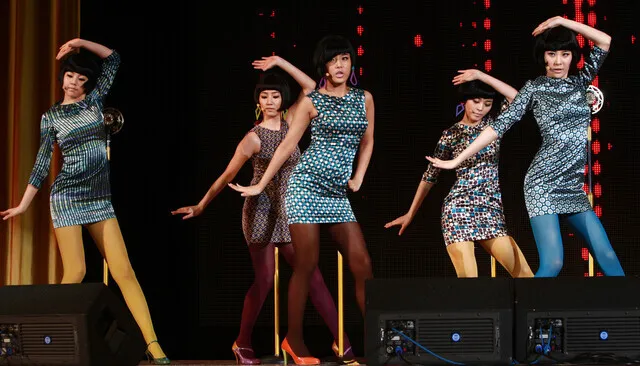
Girl group Wonder Girls performs at the 27th Cyworld Digital Music Awards held at Lotte World in Seoul’s Jamsil neighborhood in October of 2007. (Yonhap)
K-pop idol groups who were active from 1996 to 2004, are generally called the “first-generation” K-pop groups. H.O.T., who debuted that year, along with Sech Skies, S.E.S., Fin.K.L, and Shinhwa shaped the K-pop idol industry as we know it today, and mostly targeted a domestic audience.The second-generation K-pop idols refer to those who were active around 2004 to 2011, such as TVXQ, SS501, Big Bang, Super Junior, Girls’ Generation, KARA, and 2NE1. The second generation is credited with expanding Hallyu by targeting fans in Asia.When we talk about the first generation, which focused on a domestic audience, and the second generation, which spread out to Asia, there are some groups that are hard to categorize. Rain, BoA, and Wonder Girls: all are idols that tried to break into the US but failed to make it big.Some refer to them as the 1.5 generation. You might wonder why people wanted to branch out to the US even after several failures. However, the US pop music industry was a market that K-pop couldn’t ignore at that stage of its development.Performing in the US brought as much money as a world tour, and the revenue from music sales and advertisements were also large. Succeeding in the US meant that you would become a world star. The problem was that the obstacles that one must overcome in order to gain that title were high.SM Entertainment’s failureIn 2008, SM Entertainment tried to use the same method it used to gain success in Japan with BoA in the US. It formed SM USA and picked Max Gousse, who had produced music for some of the biggest names in hip-hop, as its US manager. SM signed an exclusive contract with Creative Artists Agency, or CAA, the largest agency in North America, to represent them in music, performance and marketing.However, their preparations were not enough. While the Japanese pop industry was somewhat similar to that of the South Korean industry, in the US pop industry, BoA had to be situated in a different position.Female solo artists in the US pop music market could be divided into three categories. Firstly, there were hip-hop musicians who were all about sex appeal. Then there were artists who flaunted their singing skills such as Amy Winehouse and Duffy, who sang jazz, soul and R&B. Finally, there were teen pop idols, who were idolized by young girls, such as Britney Spears and Christina Aguilera.BoA was a girl with a small physique, who could sing while dancing dynamic choreography. She could not be placed in the first category and didn’t have the vocals to be put in the second. It was also difficult for an Asian woman in her mid-20s to win over the hearts of American teenage girls.BoA couldn’t fit into any of those categories. The appeal of American female singers had not been analyzed enough. Of course, like the case of her success in Japan, a new category could have been created with the agency’s marketing. However, the manager of BoA’s label was the CEO of an indie label. BoA was unable to show her potential in such a background.From then on, SM focused more on Asia, with producer Lee Soo-man often saying that “China will soon be as influential as the US.” The idea was that, once the East Asian network of South Korea, China, and Japan became livelier, it would become the largest pop music market on par with the US and Europe. There would be no need to leave that market behind and struggle to break into the US market, which had already proved to be a struggle.SM Entertainment created TVXQ, which succeeded greatly in Japan, and Super Junior, which was a hit in China. These second-generation idols, with members specifically included so as to make it big in East Asia, established a strong fan base in Asia.